
Reeti Mukherjee,
A Shashank,
N S Achyuth Anand,
N Kiran Kumar,
M Vamshikrishna.,
P Arun,
- Assistant Professor, Department of Mechanical engineering, ACE Engineering College, Hyderabad, Telangana, India
- Student, Department of Mechanical engineering, ACE Engineering College, Hyderabad, Telangana, India
- Student, Department of Mechanical engineering, ACE Engineering College, Hyderabad, Telangana, India
- Student, Department of Mechanical engineering, ACE Engineering College, Hyderabad, Telangana, India
- Student, Department of Mechanical engineering, ACE Engineering College, Hyderabad, Telangana, India
- Student, Department of Mechanical engineering, ACE Engineering College, Hyderabad, Telangana, India
Abstract
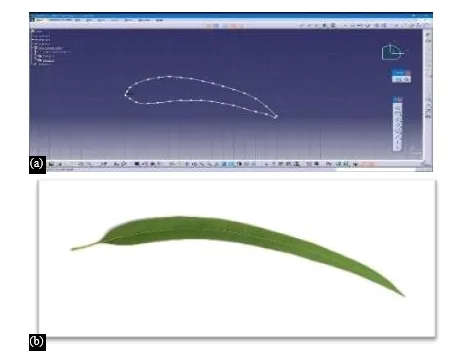
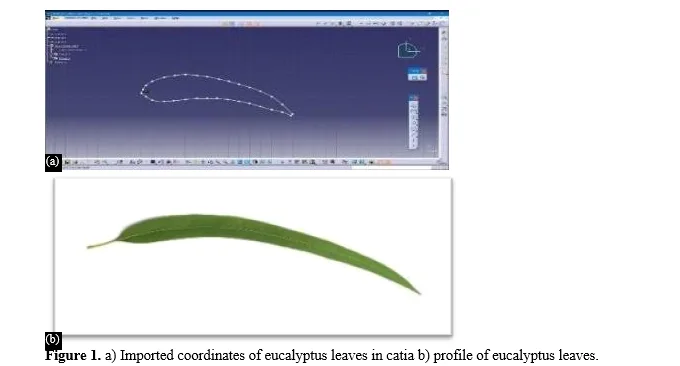
Biomimicry is the practice of drawing inspiration from natural forms to solve engineering problems, which has become progressively popular for refining design efficiency and performance. This work discovers how biomimicry can be applied to airfoil design, precisely through the unique structure of Eucalyptus leaves, a concept rarely explored in airfoil profiling. The work presented here, focuses on enhancing airfoil designs by incorporating the intricate features of these leaves. The airfoil in question has a thickness of 54.3mm, a chord length of 142.5mm, and operates at a Reynolds number ranging from 3E5 to 7E5, with wind speeds between 4 and 7 meters per second. The web digitizer software uses Eucalyptus Leaf design to provide leaf structural coordinates, and then the parameters are translated into a computational model using Catia, enabling the generation of a prototype airfoil structure. In due course, the newly developed airfoil undergoes experimental testing within a wind tunnel environment to assess its aerodynamic characteristics. Factors such as lift, drag, and stall characteristics are inspected to determine how efficient the biomimetic approach is, and comparing the result to traditional airfoil designs has shown some results that need optimization of design for applications in the real world. This comprehensive approach highlights the collaboration between biological inspiration, computational models, and experimental validation in advancing aerodynamic design specimens. This study looks at how the natural design of eucalyptus leaves can inspire better air foil designs. It focuses on using advanced polymers and composite materials that replicate the leaf’s strong, yet lightweight structure, while also maintaining the right balance of weight and flexibility for optimal performance.
Keywords: Biomimetic design, computational modelling, polymers, composite materials, aerodynamic performance.
[This article belongs to Special Issue under section in Journal of Polymer & Composites (jopc)]
References
- F Rosa et al 2022 IOP Conf. Ser.: Earth Environ. Sci. 1108 012001
- Sahana D S, Prof. Srinath R ,”Bio-Inspired Study and Build-Out of New Airfoil for the Design of Basic Aircraft “, Volume. 2 Issue. 11, November- 2017, International Journal of Innovative Science and Research Technology (IJISRT) , www.ijisrt.com, ISSN – 2456-2165, PP:-180-187.
- Camilo Herrera, Mariana Correa, Valentina Villada, Juan D. Vanegas, Juan G. García, César Nieto-Londoño, Julián Sierra-Pérez, Structural design and manufacturing process of a low scale bio-inspired wind turbine blades, Composite Structures, Volume 208, 2019, Pages 1-12, ISSN 0263-8223.
- Shengxian Huang, Yu Hu, Ying Wang, Research on aerodynamic performance of a novel dolphin head-shaped bionic airfoil, Energy, Volume 214, 2021, 118179, ISSN 0360-5442,
- Yan H, Su X, Zhang H, Hang J, Zhou L, Liu Z and Wang Z 2020 Design approach and hydrodynamic characteristics of a novel bionic airfoil Ocean Eng. 216 108076 Xinyu L, Bifeng S, Wenqing Y and Wenping S 2021 Aerodynamic performance of owl-like
- Srividhya, R. Prakash, M. Vinod Kumar, et.al, 2024, Impact of various Fibers on the Mechanical and Durability Performance of Fibre-Reinforced Concrete with SBR latex, Journal of Polymer & Composites, Vol 12, No 2, 2024
- Tian, Weijun & Liu, Fangyuan & Cong, Qian et.al (2014). Study on aerodynamic performance of the bionic airfoil based on the swallow’s wing. Journal of Mechanics in Medicine and Biology. 13. 10.1142/S0219519413400228.
- Hao, Lishu & Gao, Yongwei & Wei, Binbin & Song, Ke. (2021). Numerical Simulation of Flow over Bionic Airfoil. International Journal of Aerospace Engineering. 2021. 1-17. 10.1155/2021/5556463.
- Sanket Thorwat Lift and Drag Analysis of NACA 1412 Airfoil Using Unstructured Mesh Influence of Wing Shape on Airfoil Performance: a Comparative Study. International Journal For Research in Applied Science and Engineering Technology.
- Achour G, Sung WJ, Pinon- Fischer OJ, et al. Development of a conditional generative adversarial network for airfoil shape optimization.Aerospace research centre. 2020.
- Barrett TR, Bressloff NW, Keane AJ (2006) Airfoil shape design and optimization using multifidelity analysis and embedded inverse design. AIAA J 44(9):2051–2060
- Drela, Mark. (1989). XFOIL: An Analysis and Design System for Low Reynolds Number Airfoils. 54. 10.1007/978-3-642-84010-4_1. Conference on Low Reynolds Number Airfoil Aerodynamics, University of Notre Dame.
- Jameson, Antony. (1995). Optimum Aerodynamic Design Using CFD And Control Theory. CFD Review. 3. 10.2514/6.1995-1729. 12th Computational fluid dynamics conference, 1995
- Tong Zhao, Yufei Zhang, Haixin Chen, et al., Supercritical wing design based on airfoil optimization and 2.75D transformation,Aerospace Science and Technology,Volume 56,2016,Pages 168-182,ISSN 1270-9638,
- Zhang Y, Fang X, Chen H, et al. (2015) Supercritical natural laminar flow airfoil optimization for regional aircraft wing design. Aerospace Science and Technology 43:152–164.
- Carlo Santulli, Sivasubramanian Palanisamy, Mayandi Kalimuthu, Chapter 14 – Pineapple fibers, their composites and applications, Editor(s): Sanjay Mavinkere Rangappa, Jyotish Kumar Parameswaran Pillai, Suchart Siengchin, Togay Ozbakkaloglu, Hao Wang, In The Textile Institute Book Series, Plant Fibers, their Composites, and Applications, Woodhead Publishing, 2022, Pages 323-346, ISBN 9780128245286.
- Palanisamy, S.; Kalimuthu, M.; Santulli, C.; Palaniappan, M.; Nagarajan, R.; Fragassa, C. Tailoring Epoxy Composites with Acacia caesia Bark Fibers: Evaluating the Effects of Fiber Amount and Length on Material Characteristics. Fibers 2023, 11, 63. https://doi.org/10.3390/fib11070063
- JOUR Karthik, A. Bhuvaneshwaran, M. Senthil Kumar, M. S. Palanisamy, Sivasubramanian Palaniappan, Murugesan Ayrilmis, Nadir e202400650 A Review on Surface Modification of Plant Fibers for Enhancing Properties of Biocomposites ChemistrySelect 9 ISSN – 2365-6549.
- Palaniappan, M., Palanisamy, S., Khan, R. et al. Synthesis and suitability characterization of microcrystalline cellulose from Citrus x sinensis sweet orange peel fruit waste-based biomass for polymer composite applications. J Polym Res 31, 105 (2024). https://doi.org/10.1007/s10965-024-03946-0
- Palanisamy, S., Kalimuthu, M., Palaniappan, M., Alavudeen, A., Rajini, N., Santulli, C. Al-Lohedan, H. (2021). Characterization of Acacia caesia Bark Fibers (ACBFs). Journal of Natural Fibers, 19(15), 10241–10252. https://doi.org/10.1080/15440478.2021.1993493.

Journal of Polymer & Composites
| Volume | 13 | |
| Special Issue | 03 | |
| Received | 13/09/2024 | |
| Accepted | 08/04/2025 | |
| Published | 26/04/2025 | |
| Publication Time | 225 Days |