
Dol H. S.,
Vaishali Patil,
Prasanna Kattimani,
Mahesh Sharma,
- Assistant Professor, Department of Pharmaceutics, Krishna Vishwa Vidyapeeth (Deemed to be University), Krishna Institute of Pharmacy, Karad, Maharashtra, India
- Professor, Department of Engineering Science and Humanities, Vishwakarma Institute of Technology, Pune, Maharashtra, India
- Assistant Professor, Department of Mechanical Engineering, Dr. D.Y. Patil Institute of Technology, Pimpri, Pune, Maharashtra, India
- Professor, Department of Pharmacy, Arya College of Pharmacy, Jaipur, Rajasthan, India
Abstract
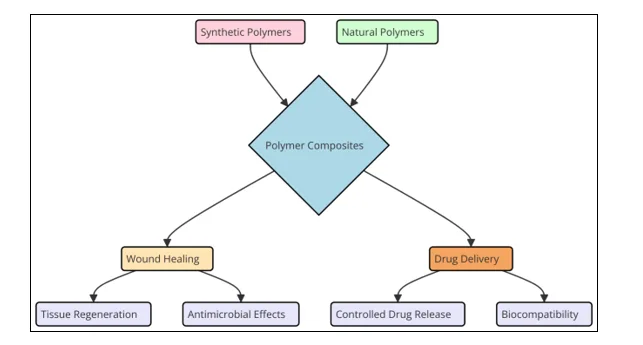
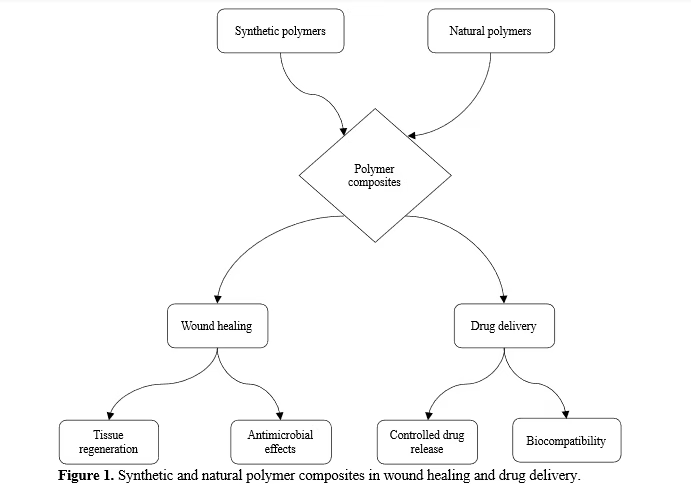
Both man-made and natural polymer mixtures have become important materials in wound repair and medicine delivery because they can be used in many ways and work well with living things. The benefits of both man-made and natural polymers are combined in these composites. They have a wide range of mechanical, chemical, and biological qualities that make them useful for many medical uses. In wound healing, polymer mixtures help tissues grow back faster and lower the risk of infection by creating a shield that protects the area and encourages cell growth. Natural polymers like collagen, chitosan, and hyaluronic acid are very bioactive and help wounds heal by acting like the extracellular matrix. However, man-made polymers such as poly(lactic acid) (PLA) and polycaprolactone (PCL) can be easily changed in terms of how quickly they break down and how strong they are, both of which are important for managing the mending process. Polymer mixtures help with controlled, long-lasting, and localised drug release, which lowers the risk of systemic side effects and raises the effectiveness of therapy. You can make these combinations react to certain things, like pH, temperature, or enzyme activity. This makes sure that healing drugs get to the right place to work. Adding nanoparticles or bioactive agents to polymer frameworks also improves the drugs’ absorption and release profile, which opens up new ways to make medicine more personalised. When manufactured and natural polymers are mixed, they help make wound bandages, drug carriers, and tissue scaffolding that work better in special ways.
Keywords: Polymer composites, wound healing, drug delivery, biocompatibility, controlled release.
[This article belongs to Special Issue under section in Journal of Polymer & Composites (jopc)]
References
- Hurlow, J.; Bowler, P.G. Acute and chronic wound infections: Microbiological, immunological, clinical and therapeutic distinctions. J. Wound Care 2022, 31, 436–445.
- Zabaglo, M.; Sharman, T. Postoperative wound infection. In StatPearls [Internet]; StatPearls Publishing: Treasure Island, FL, USA, 2023.
- Tham, K.W.; Lim, A.Y.L.; Baur, L.A. The global agenda on obesity: What does this mean for Singapore? Singapore Med. J. 2023, 64, 182–187.
- Wenhui, L.; Changgeng, F.; Lei, X.; Baozhong, Y.; Guobin, L.; Weijing, F. Hyperbaric oxygen therapy for chronic diabetic foot ulcers: An overview of systematic reviews. Diabetes Res. Clin. Pract. 2021, 176, 108862.
- Holloway, S.; Harding, K.G. Wound dressings. Surgery 2022, 40, 25–32.
- Ho, T.C.; Chang, C.C.; Chan, H.P.; Chung, T.W.; Shu, C.W.; Chuang, K.P.; Duh, T.H.; Yang, M.H.; Tyan, Y.C. Hydrogels: Properties and Applications in Biomedicine. Molecules 2022, 27, 2902.
- Shu, W.; Wang, Y.; Zhang, X.; Li, C.; Le, H.; Chang, F. Functional Hydrogel Dressings for Treatment of Burn Wounds. Front. Bioeng. Biotechnol. 2021, 9, 788461.
- Surowiecka, A.; Strużyna, J.; Winiarska, A.; Korzeniowski, T. Hydrogels in Burn Wound Management—A Review. Gels 2022, 8, 122.
- Chen, W.-H.; Chen, Q.-W.; Chen, Q.; Cui, C.; Duan, S.; Kang, Y.; Liu, Y.; Liu, Y.; Muhammad, W.; Shao, S. Biomedical polymers: Synthesis, properties, and applications. Sci. China Chem. 2022, 65, 1010–1075.
- Kamlesh Kumar Sen, Vikas Sahu. (2015). PAPR Reduction of OFDM Signal Based on PTS Technique. Advance Physics Letter, 2(2), 1-4
- Surendra Kumar Sahu, C.P.Dewangan, Chitrasen Patel. (2015). Design Optimization of Helical gears using Genetic Algorithm: A review. Advance Physics Letter, 2(2), 5-11
- Akinyelu, J.; Oladimeji, O.; Daniels, A.; Singh, M. Folate-Targeted Doxorubicin Delivery to Breast and Cervical Cancer cells using a Chitosan-Gold Nano-delivery System. J. Drug Deliv. Sci. Technol. 2022, 67, 102978.
- Skopinska-Wisniewska, J.; Tuszynska, M.; Olewnik-Kruszkowska, E. Comparative Study of Gelatin Hydrogels Modified by Various Cross-Linking Agents. Materials 2021, 14, 396.
- Wang, Y.; Lv, Q.; Chen, Y.; Xu, L.; Feng, M.; Xiong, Z.; Li, J.; Ren, J.; Liu, J.; Liu, B. Bilayer hydrogel dressing with lysozyme-enhanced photothermal therapy for biofilm eradication and accelerated chronic wound repair. Acta Pharm. Sin. B 2023, 13, 284–297.
- Della Sala, F.; Longobardo, G.; Fabozzi, A.; di Gennaro, M.; Borzacchiello, A. Hyaluronic Acid-Based Wound Dressing with Antimicrobial Properties for Wound Healing Application. Appl. Sci. 2022, 12, 3091.
- Li, M.; Liang, Y.; Liang, Y.; Pan, G.; Guo, B. Injectable stretchable self-healing dual dynamic network hydrogel as adhesive anti-oxidant wound dressing for photothermal clearance of bacteria and promoting wound healing of MRSA infected motion wounds. Chem. Eng. J. 2022, 427, 132039.
- Wang, T.; Yi, W.; Zhang, Y.; Wu, H.; Fan, H.; Zhao, J.; Wang, S. Sodium alginate hydrogel containing platelet-rich plasma for wound healing. Colloid. Surf. B Biointerfaces 2023, 222, 113096.
- Güiza-Argüello, V.R.; Solarte-David, V.A.; Pinzón-Mora, A.V.; Ávila-Quiroga, J.E.; Becerra-Bayona, S.M. Current Advances in the Development of Hydrogel-Based Wound Dressings for Diabetic Foot Ulcer Treatment. Polymers 2022, 14, 2764.

Journal of Polymer & Composites
| Volume | 13 | |
| Special Issue | 04 | |
| Received | 20/03/2025 | |
| Accepted | 06/05/2025 | |
| Published | 01/06/2025 | |
| Publication Time | 73 Days |