
Jayant Rajaram Pawar,
Rohit Ghugare,
E.A. Singh,
Amar Mohite,
Rohan S. Phatak,
- Associate Professor, Krishna Institute of Nursing Sciences, Krishna Vishwa Vidyapeeth Deemed to be University, Karad, Maharashtra, India
- Research Scholar, Centre for Materials for Electronics Technology (C-MET), Pune, Maharshtra, India
- Associate Professor, Rajiv Gandhi Institute of IT & Biotechnology, Bharati Vidyapeeth Deemed to be University Katraj, Pune, Maharshtra, India
- Research Associate, Krishna Institute of Nursing Sciences, Krishna Vishwa Vidyapeeth Deemed to be University, Karad, Maharshtra, India
- Assistant Professor, Department of Pharmacognosy, Krishna Institute of Pharmacy, Krishna Vishwa Vidyapeeth Deemed to be University, Karad, Maharshtra, India
Abstract
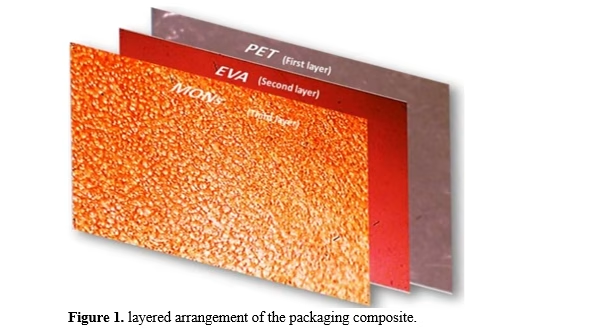
The development of high-performance polymeric composites for food packaging applications has gained significant attention in recent years due to increasing concerns about food safety, durability, and environmental impact. The increasing demand for active packaging materials that not only protect food but also extend shelf life has led to extensive research into polymer-based antimicrobial composites. Traditional packaging materials, including plastics, ceramics, and metals, often lack bioactive properties and can contribute to environmental waste. One of the most promising advancements in active packaging is the integration of antimicrobial agents into polymer matrices. These agents can inhibit the growth of spoilage organisms and foodborne pathogens, reducing the risk of contamination and foodborne illness. Despite the numerous advantages of polymer-based antimicrobial composites, there are challenges associated with their commercialization. One key challenge is the uniform dispersion of nanoparticles within the polymer matrix. The continued development of multilayer polymer composites holds great potential for revolutionizing the food packaging industry, ensuring longer shelf life, reduced food waste, and improved consumer health. This study presents an innovative multilayer packaging composite composed of polyethylene terephthalate (PET), ethylene-vinyl acetate (EVA), and metal oxide nanoparticles (MONs), offering enhanced antimicrobial properties, improved mechanical strength, and superior barrier characteristics. Its multifunctional properties make it a promising candidate for improving food safety and extending product shelf life, ultimately contributing to the advancement of eco-friendly and high-performance packaging solutions.
Keywords: Polymer, nanofillers, packaging, metal, nanoparticles, chemistry.
[This article belongs to Special Issue under section in Journal of Polymer & Composites (jopc)]

References
- Nikolic MV, Vasiljevic ZZ, Auger S, Vidic J. Metal oxide nanoparticles for safe active and intelligent food packaging. Trends in Food Science & Technology. 2021 Oct 1;116:655-68.
- Wani AA, Singh P, Pant A, Langowski HC. Packaging methods for minimally processed foods. Minimally Processed Foods: Technologies for Safety, Quality, and Convenience. 2015:35-55.
- Firouz MS, Mohi-Alden K, Omid M. A critical review on intelligent and active packaging in the food industry: Research and development. Food Research International. 2021 Mar 1;141:110113.
- Kamal T, Khan SB, Asiri AM. Antimicrobial activities of metal containing compounds and hybrids. Current Pharmaceutical Design. 2020 Dec 1;26(45):5881-91.
- Wang J, Zhao F, Huang J, Li Q, Yang Q, Ju J. Application of essential oils as slow-release antimicrobial agents in food preservation: Preparation strategies, release mechanisms and application cases. Critical Reviews in Food Science and Nutrition. 2024 Jul 14;64(18):6272-97.
- Alias AR, Wan MK, Sarbon NM. Emerging materials and technologies of multi-layer film for food packaging application: A review. Food Control. 2022 Jun 1;136:108875.
- Kroshefsky RD, Price JL, Mangaraj D. Role of compatibilization in polymer nanocomposites. Rubber chemistry and technology. 2009 Jul 1;82(3):340-68.
- Aswathi VP, Meera S, Maria CA, Nidhin M. Green synthesis of nanoparticles from biodegradable waste extracts and their applications: a critical review. Nanotechnology for Environmental Engineering. 2023 Jun;8(2):377-97.
- Aththanayaka S, Thiripuranathar G, Ekanayake S. Emerging advances in biomimetic synthesis of nanocomposites and potential applications. Materials Today Sustainability. 2022 Dec 1;20:100206.
- Sharma G, Saini MK, Thakur K, Kapil N, Garg NK, Raza K, Goni VG, Pareek A, Katare OP. Aceclofenac cocrystal nanoliposomes for rheumatoid arthritis with better dermatokinetic attributes: a preclinical study. Nanomedicine. 2017 Mar 1;12(6):615-38.
- Reddy KR, Park W, Sin BC, Noh J, Lee Y. Synthesis of electrically conductive and superparamagnetic monodispersed iron oxide-conjugated polymer composite nanoparticles by in situ chemical oxidative polymerization. Journal of colloid and interface science. 2009 Jul 1;335(1):34-9.
- Crucho CI, Barros MT. Polymeric nanoparticles: A study on the preparation variables and characterization methods. Materials Science and Engineering: C. 2017 Nov 1;80:771-84.
- Shankar S, Wang LF, Rhim JW. Incorporation of zinc oxide nanoparticles improved the mechanical, water vapor barrier, UV-light barrier, and antibacterial properties of PLA-based nanocomposite films. Materials Science and Engineering: C. 2018 Dec 1;93:289-98.
- Wijekoon MJ, Bhat R, Karim AA, Fazilah A. Chemical composition and antimicrobial activity of essential oil and solvent extracts of torch ginger inflorescence (Etlingera elatior Jack.). International Journal of Food Properties. 2013 Aug 18;16(6):1200-10.
- Santulli C, Palanisamy S, Kalimuthu M. Pineapple fibers, their composites and applications. Plant Fibers, their Composites, and Applications [Internet]. 2022;323–46. Available from: http://dx.doi.org/10.1016/b978-0-12-824528-6.00007-2
- Palanisamy S, Kalimuthu M, Santulli C, Palaniappan M, Nagarajan R, Fragassa C. Tailoring Epoxy Composites with Acacia caesia Bark Fibers: Evaluating the Effects of Fiber Amount and Length on Material Characteristics. Fibers [Internet]. 2023 Jul 17;11(7):63. Available from: http://dx.doi.org/10.3390/fib11070063
- Karthik A, Bhuvaneshwaran M, Senthil Kumar MS, Palanisamy S, Palaniappan M, Ayrilmis N. A Review on Surface Modification of Plant Fibers for Enhancing Properties of Biocomposites. ChemistrySelect [Internet]. 2024 Jun 3;9(21). Available from: http://dx.doi.org/10.1002/slct.202400650
- Palaniappan M, Palanisamy S, Khan R, H.Alrasheedi N, Tadepalli S, Murugesan T mani, et al. Synthesis and suitability characterization of microcrystalline cellulose from Citrus x sinensis sweet orange peel fruit waste-based biomass for polymer composite applications. Journal of Polymer Research [Internet]. 2024 Mar 19;31(4). Available from: http://dx.doi.org/10.1007/s10965-024-03946-0
- Palanisamy S, Kalimuthu M, Palaniappan M, Alavudeen A, Rajini N, Santulli C, et al. Characterization of Acacia caesia Bark Fibers (ACBFs). Journal of Natural Fibers [Internet]. 2021 Nov 1;19(15):10241–52. Available from: http://dx.doi.org/10.1080/15440478.2021.1993493
- McNally T, Pötschke P, editors. Polymer-carbon nanotube composites: Preparation, properties and applications. Elsevier; 2011 Mar 28.
- Xin H, Liu Y, Xiao Y, Wen M, Sheng L, Jia Z. Design and Nanoengineering of Photoactive Antimicrobials for Bioapplications: from Fundamentals to Advanced Strategies. Advanced Functional Materials. 2024 Apr 23:2402607.
- Roy A, Gupta A, Haque B, Qureshi AA, Verma D, Sharma K, Lee SF, Hee CW, Roy A, Verma R. An updated review on carbon nanomaterials: Types, synthesis, functionalization and applications, degradation and toxicity. Green Processing and Synthesis. 2024 Oct 29;13(1):20240150.
- Pallavi Suryarao, Shashikiran N.D, Sachin Gugawad, Namrata Gaonkar, Swapnil Taur, Savita Hadakar. Comparative Assessment of Conversion Degree, Resin Tag Depth, and Mineral Deposition in Adhesive Resin Enhanced with Inorganic Nanofillers such as Cerium Dioxide and Tantalum Oxide Nanoparticles. Journal of Polymer and Composites. 2024; 12(04):110-118.
- Girish Suragimath, Nikhil Bhalchandra Awale, Siddharth Varma, Sameer Zope, Ashwinirani SR, Apurva Kale. Study to evaluate and correlate the levels of heavy metals in dental calculus of burnt tobacco (Mishri) users and non-tobacco users with their periodontal status Using Atomic Absorption Spectrometry (AAS). Journal of Polymer and Composites. 2024; 12(02):166-174.
- Hahn YB, Ahmad R, Tripathy N. Chemical and biological sensors based on metal oxide nanostructures. Chemical Communications. 2012;48(84):10369-85.

Journal of Polymer & Composites
| Volume | 13 | |
| Special Issue | 05 | |
| Received | 28/02/2025 | |
| Accepted | 08/04/2025 | |
| Published | 30/05/2025 | |
| Publication Time | 91 Days |