
Gandhi J. M.,
Haripriya H. Kulkarni,
S. P. Komble,
Shailly Gupta,
- Associate Professor, Department of Pharmacognosy, Krishna Vishwa Vidyapeeth (Deemed to be University), Krishna Institute of Pharmacy, Karad, Maharashtra, India
- Professor, Department of Electrical Engineering, Dr. D.Y. Patil Institute of Technology, Pimpri, Pune, Maharashtra, India
- Associate Professor, Department of Mechanical Engineering, Vishwakarma Institute of Technology, Pune, Maharashtra, India
- Associate Professor, Department of Pharmacy, Arya College of Pharmacy, Jaipur, Rajasthan, India
Abstract
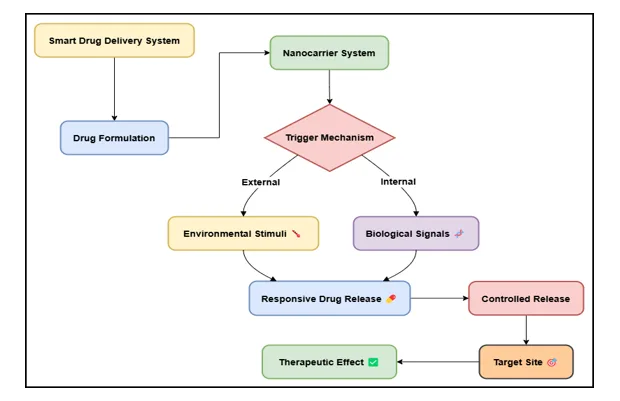
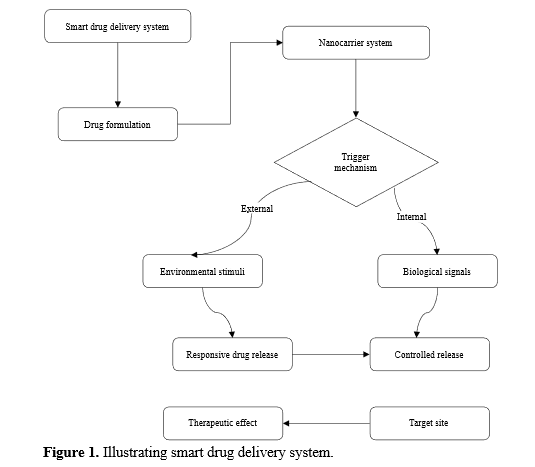
Sensitive to temperature and pH, polymers are becoming a fascinating new class of material suitable for application in drug delivery systems. These polymers can be utilised in controlled release of medications as they change form depending on temperature and acidity. Thermosensitive polymers vary their formation and breakdown behaviour with temperature variations. They are therefore perfect for delivering pharmaceuticals to individuals as heat may be utilised to activate the medications at specified body temperature. Like in sections of the digesting system or development cells, polymers sensitive to pH alter depending on their pH environment that of acids or bases. This allows medications to be dispatched straight to certain locations. Using materials that can alter with temperature and pH, we can create drug delivery systems that function with changing bodily circumstances. These polymers can release medications exactly where they are required and hang on to others. Treatments are therefore more successful and adverse effects are reduced. Smart polymers may be moulded to fit many medical uses, including cancer treatment, precise medication delivery, and gradual over-time operation of pharmaceuticals. Studying these polymers aims to improve their structure and characteristics so that they may release medications in the correct manner. Targeting ligands such as antibodies or peptides into polymers facilitates their access and absorption by specific cells, therefore facilitating the therapy. Furthermore, being able to combine several responses to inputs in one system helps create systems of drug administration capable of managing a broad spectrum of medical requirements.
Keywords: Thermosensitive polymers, pH-responsive polymers, smart drug delivery, controlled release, targeted therapy, stimuli-responsive systems.
[This article belongs to Special Issue under section in Journal of Polymer & Composites (jopc)]
References
- Feng, W.; Iscience, Z. Biomedical Applications of Chitosan-Graphene Oxide Nanocomposites. Iscience 2022, 25, 103629.
- Xue, B.; Wang, Y.; Tian, J.; Zhang, W.; Zang, Z.; Cui, H.; Zhang, Y.; Jiang, Q.; Li, B.; Hai Liu, R. Effects of Chitooligosaccharide-Functionalized Graphene Oxide on Stability, Simulated Digestion, and Antioxidant Activity of Blueberry Anthocyanins. Food Chem. 2022, 368, 130684.
- Khan, M.U.A.; Yaqoob, Z.; Nainar, M.M.A.; Razak, S.I.A.; Raza, M.A.; Sajjad, A.; Haider, S.; Busra, F.M. Chitosan/Poly Vinyl Alcohol/Graphene Oxide Based Ph-Responsive Composite Hydrogel Films: Drug Release, Anti-Microbial and Cell Viability Studies. Polymers 2021, 13, 3124.
- Yiang, G.T.; Chou, P.L.; Hung, Y.T.; Chen, J.N.; Chang, W.J.; Yu, Y.L.; Wei, C.W. Vitamin C Enhances Anticancer Activity in Methotrexate-Treated Hep3B Hepatocellular Carcinoma Cells. Oncol. Rep. 2014, 32, 1057–1063.
- Maqsood, M.F.; Raza, M.A.; Ghauri, F.A.; Rehman, Z.U.; Ilyas, M.T. Corrosion Study of Graphene Oxide Coatings on AZ31B Magnesium Alloy. J. Coat. Technol. Res. 2020, 17, 1321–1329.
- Smith, A.T.; LaChance, A.M.; Zeng, S.; Liu, B.; Sun, L. Synthesis, Properties, and Applications of Graphene Oxide/Reduced Graphene Oxide and Their Nanocomposites. Nano Mater. Sci. 2019, 1, 31–47.
- Magne, T.M.; de Oliveira Vieira, T.; Alencar, L.M.R.; Junior, F.F.M.; Gemini-Piperni, S.; Carneiro, S.V.; Fechine, L.M.U.D.; Freire, R.M.; Golokhvast, K.; Metrangolo, P.; et al. Graphene and Its Derivatives: Understanding the Main Chemical and Medicinal Chemistry Roles for Biomedical Applications. J. Nanostruct. Chem. 2021, 12, 693–727.
- Aslam Khan, M.U.; Abd Razak, S.I.; Al Arjan, W.S.; Nazir, S.; Sahaya Anand, T.J.; Mehboob, H.; Amin, R. Recent Advances in Biopolymeric Composite Materials for Tissue Engineering and Regenerative Medicines: A Review. Molecules 2021, 26, 619.
- Mamidi, N.; Delgadillo, R.M.V.; Ortiz, A.G.; Barrera, E.V. Carbon Nano-Onions Reinforced Multilayered Thin Film System for Stimuli-Responsive Drug Release. Pharmaceutics 2020, 12, 1208.
- Zarbab, A.; Sajjad, A.; Rasul, A.; Jabeen, F.; Javaid Iqbal, M. Synthesis and Characterization of Guar Gum Based Biopolymeric Hydrogels as Carrier Materials for Controlled Delivery of Methotrexate to Treat Colon Cancer. Saudi J. Biol. Sci. 2023, 30, 103731.
- Chen, S.; Wang, H.; Jian, Z.; Fei, G.; Qian, W.; Luo, G.; Wang, Z.; Xia, H. Novel Poly(Vinyl Alcohol)/Chitosan/Modified Graphene Oxide Biocomposite for Wound Dressing Application. Macromol. Biosci. 2020, 20, 1900385.
- Anju Singh, H.L.Vishwakarma. (2015). Studies onChemical synthesis andStructural, Morphological and Optical Properties of ZnONanorods. Advance Physics Letter, 2(3), 25-31
- Deepti S. Deshpande. (2015). On the Studies of Thermal and Water Sorption Behavior of Vinyl Monomers. Advance Physics Letter, 2(3), 32-34
- Li, J.; Chen, Q.; Li, S.; Zeng, X.; Qin, J.; Li, X.; Chen, Z.; Zheng, W.; Zhao, Y.; Huang, Z.; et al. An adhesive hydrogel implant combining chemotherapy and tumor microenvironment remodeling for preventing postoperative recurrence and metastasis of breast cancer. J. Chem. Eng. 2023, 443, 145212.
- Zezza, P.; Lucío, M.I.; Maquieira, Á.; Bañuls, M.-J. DNA -based hydrogels for high-performance optical biosensing application. Talanta 2022, 244, 123427.
- Wei, Q.; Young, J.; Holle, A.; Li, J.; Bieback, K.; Inman, G.; Spatz, J.P.; Cavalcanti-Adam, E.A. Soft Hydrogels for Balancing Cell Proliferation and Differentiation. ACS Biomater. Sci. Eng. 2020, 6, 4687–4701.
- Chen, Y.; Meng, J.; Gu, Z.; Wan, X.; Jiang, L.; Wang, S. Bioinspired Multiscale Wet Adhesive Surfaces: Structures and Controlled Adhesion. Adv. Funct. Mater. 2020, 30, 1905287.
- Li, W.; Yang, X.; Lai, P.; Shang, L. Bio-inspired adhesive hydrogel for biomedicine—Principles and design strategies. Smart Med. 2022, 1, e20220024.

Journal of Polymer & Composites
| Volume | 13 | |
| Special Issue | 04 | |
| Received | 20/03/2025 | |
| Accepted | 19/05/2025 | |
| Published | 01/06/2025 | |
| Publication Time | 73 Days |