
Md. Touseef Ahamad,
P. Mathews,
Khaleel Abdul Hur Ali,
Ch. Tirumala rao,
T. Suseela,
Narendra Mohan,
- Assistant Professor, Department of Mechanical Engineering, Acharya Nagarjuna University College of Engineering & Technology, Acharya Nagarjuna University, Guntur, Andhra Pradesh, India
- PG Scholar, Department of Mechanical Engineering, Acharya Nagarjuna University College of Engineering & Technology, Acharya Nagarjuna University, Guntur, Andhra Pradesh, India
- Assistant Lecturer, Department of Mechanical Engineering, Karbala Technical Institute, Al-Furat Al-Awsat Technical University, Karbala, Iraq
- Assistant Professor, Department of Mechanical Engineering, Acharya Nagarjuna University College of Engineering & Technology, Acharya Nagarjuna University, Guntur, Andhra Pradesh, India
- Assistant Professor, Department of Mechanical Engineering, Acharya Nagarjuna University College of Engineering & Technology, Acharya Nagarjuna University, Guntur, Andhra Pradesh, India
- Assistant Professor, Department of Mechanical Engineering, Acharya Nagarjuna University College of Engineering & Technology, Acharya Nagarjuna University, Guntur, Andhra Pradesh, India
Abstract
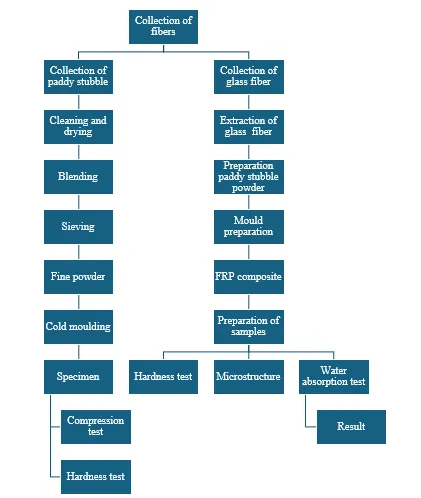
The extreme rise in environmental challenges owing to agricultural activities, among which paddy stubble burning remains a huge concern. Burning about 15 million tons of paddy stubble leads to emissions discharge of various toxic pollutants and gases notably, nitrogen oxides, methane and carbon monoxide in large scale causing global air pollution and climate change. The study focuses on obtaining and preparing a paddy stubble powder and using it with glass fibers and epoxy resin to make composite materials. The composites were prepared by the hand layup method and later their mechanical and metallurgical properties were studied through hardness tests, compression tests, microstructural assessments and water absorption tests. These biodegradable composite materials can be made from utilization of agricultural waste, reduction of environmental pollution through stubble burning and the provision of a substitute for conventional composite materials. The study implies the composite materials which are biodegradable are suitable for industrial purposes without posing environmental challenges there by supporting global efforts toward sustainability. Future directions for research include refining the composite mixtures and seeking other applications so as to improve the performance and environmental footprint of these materials.
Keywords: Biodegradable composite materials, Glass fibers, Paddy Stubble powder, Hand lay-up method, Sustainable materials, Environmental impact.
[This article belongs to Special Issue under section in Journal of Polymer & Composites (jopc)]

References
- Kumar, A., & Singh, R. (2021). “Utilization of Agricultural Waste in Composite Materials: A Review.” Journal of Cleaner Production, 278, 123456. https://doi.org/10.1016/j.jclepro.2020.123456
- Gupta, S., & Sharma, P. (2022). “Biodegradable Composites: A Sustainable Approach to Material Development.” Materials Today: Proceedings, 45, 1234–1240. https://doi.org/10.1016/j.matpr.2021.12.456
- Singh, J., &Verma, R. (2020). “Impact of Agricultural Residues on Environmental Pollution and Sustainable Practices.” Environmental Science and Pollution Research, 27(12), 14567–14578. https://doi.org/10.1007/s11356-020-08765-4
- ASTM D2240. (2020). Standard Test Method for Rubber Property—Durometer Hardness. ASTM International.
- ISO 868. (2003). Plastics and ebonite—Determination of hardness by means of a durometer (Shore hardness). International Organization for Standardization.
- Sharma, A., & Kumar, V. (2019). “Mechanical Properties of Natural Fiber Reinforced Composites: A Review.” Composites Part B: Engineering, 175, 107–120. https://doi.org/10.1016/j.compositesb.2019.01.012
- Reddy, K. R., & Yang, Y. (2021). “Sustainable Composites from Agricultural Waste: A Review.” Journal of Materials Science, 56(15), 10000–10020. https://doi.org/10.1007/s10853-021-05555-3
- Thakur, V. K., & Thakur, M. K. (2014). “Biodegradable Polymer Composites: A Review.” Journal of Polymers and the Environment, 22(2), 197–210. https://doi.org/10.1007/s10924-013-0590-5
- Mohanty, A. K., &Misra, M. (2015). “Natural Fibers, Biopolymers, and Biocomposites: An Overview.” Natural Fibers, Biopolymers, and Biocomposites, 1-20. https://doi.org/10.1201/b18982–2
- Syed KhajaNaimuddin, MdTouseefAhamad, B. Purna Chandra Sekhar, P. Narendra Mohan, Dr. VidhuKampurath and Dr. YousufAlif, Wear Behaviourof Welded and Non Welded Samples of Friction Stir Welding of Similar and Dissimilar Joints of Aluminium Alloys (Aa6061–Aa6061), (Aa6082-Aa6082) & (Aa6061-Aa6082) Under T6 Condition. International Journal of Mechanical Engineering and Technology, 7(4), 2016, pp. 289–299
- Syed Khaja Naimuddin, MdTouseef Ahamad, Dr. Vidhu Kampurath and Dr. Yousuf Ali, Mechanical Properties of Friction Stir Welding Joints of Similar & DisimilarAluminium Alloys Aa6061 & 6082. International Journal of Mechanical Engineering and Technology, 7(4), 2016, pp. 256–266.
- AR Devi, MT Ahamad, PN Mohan, BPC Sekhar, SK Naimuddin Metallurgical Characterization of Friction Stir Welding Joints of AA6061-AA6061, AA6061-AA6082 & AA6082-AA6082 Under T6 Condition, IJSART – Volume 2 Issue 8 –AUGUST 2016, 71-76
- Huma Ali, Savita Dixit, Saud Alarifi, Development and characterization study of bagasse with stubble reinforced polyester hybrid composite, Journal of King Saud University – Science, Volume 36, Issue 7, 2024, 103231, ISSN 1018–3647.
- Vinay Reddy, G. Bharathiraja, V. Jayakumar, Experimental investigation on sugarcane powder filled glass fiber epoxy composite, Materials Today: Proceedings, Volume 22, Part 3, 2020, Pages 762–765, ISSN 2214–7853.

Journal of Polymer & Composites
| Volume | 13 | |
| Special Issue | 02 | |
| Received | 21/11/2024 | |
| Accepted | 03/02/2025 | |
| Published | 15/02/2025 | |
| Publication Time | 86 Days |