
Fathimunnisa Begum,
N. Ravi Kumar,
V. Ramachandra Raju,
- Associate Professor, Department of Mechanical Engineering, Baba Institute of Technology & Sciences, Visakhapatnam, Andhra Pradesh, India
- Professor, Department of Mechanical Engineering, MVGR College of Engineering, Vizianagaram, Andhra Pradesh, India
- Professor, Department of Mechanical Engineering, JNTU Kakinada, Kakinada, Andhra Pradesh, India
Abstract
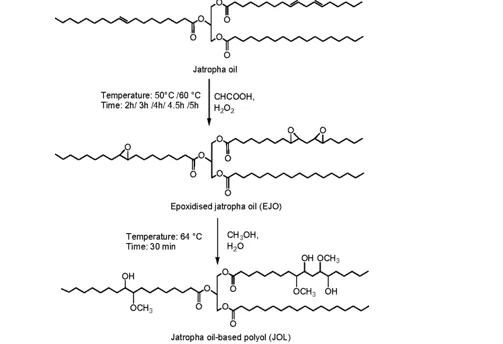
As an alternative to petroleum-based lubricants, environmentally friendly bio-based lubricants are gaining popularity in the lubrication industry. A sustainable bio-based lubricant, Jatropha Curcas Oil (JCO) incorporates nanoparticles as additives. Nevertheless, this oil cannot be used directly as a biolubricant due to its low oxidative stability. By redesigning the oil’s molecular structure through chemical modification, this restriction can be overcome. Epoxidation and oxirane ringopening were the two steps used in this study to convert non-edible Jatropha curcas oil (JCO) into jatropha oil-based polyol (JOL). The first step involved analyzing the oxirane oxygen content (OOC) of epoxidized jatropha oil (EJCO) in relation to the reaction time, molar ratio of the oil double bond to formic acid, and reaction temperature. A molar ratio of 1:0.6, a reaction temperature of 60 °C, and reaction duration of 4 hours were found to be sufficient to achieve 4.3% OOC. FTIR and viscometers are used to monitor the ring-opening and epoxidation processes. Additionallygraphite nanoparticles of size 15-30nm in different concentrations, 0.25% and 0.5% of oil weight, were added to SAE 20W-40 and EJCO by using probe sonicator. Thermo physical characteristics such as kinematic viscosity, viscosity index, flash point and triobolgicalproperties wear and COF for the lab blend samples was conducted and the results showsthat EJCO+ 0.5% graphite is best suitable nano bio lubricant for IC Engine applications.
Keywords: Epoxidation; ring opening; esterification; oleic acid;SDS (Sodium Dodecyl Sulfate); bio lubricant
[This article belongs to Journal of Polymer & Composites ]


References
- Mallik.Biolubricants:Aspects and Prospects.International Journal of Recent Advances in Multidisciplinary Topics. 2022; 3 (1):75-78.
- Bokade VV. Synthesis of bio-diesel and bio-lubricant by transesterification of vegetable oil with lower and higher alcohols over heteropolyacids supported by clay (K-10). Process Saf Environ Prot. 2007; 85: 372.
- Zulkifli N, Masjuki H, Kalam. Lubricity of bio-based lubricant derived from chemically modified jatropha methyl ester. J Tribol.2014; 1:18 –39.
- Adhvaryu, S.Z. Erhan.Epoxidized soybean oil as a potential source of high temperaturelubricants. Ind. Crops Prod .2002; 15:247–254.
- P. Dorado, F. Cruz, J.M. Palomar.An approach to the economics of two vegetable oil-based bio fuels in Spain.Renewable Energy.2006 31: 1231–1237.
- K. Forson, E.K. Oduro, E. Hammond. Performance of jatropha oil Blends in a diesel engine. Renewable Energy.2004; 29: 1135–1145.
- Sarin, M. Sharma, S. Sinharay. Jatropha–palm biodiesel blends.an optimum mix for Asia.2007; 86:1365–1371.
- Araújo Junior AS, Sales WF, da Silva RB.J Cleaner Prod.Lubri-coolingand tribological behavior of vegetable oils during milling of AISI 1045 steel focusing on sustainable manufacturing. 2017; 47: 156-635.
- Bhaumik S, Maggirwar R, Datta. Appl Surf Sci.Analyses of anti-wear and extreme pressure properties of castor oil with zinc oxide nano friction modifiers.2018; 87: 449.
- Cavalcanti EDC,Aguieiras ÉCG, da Silva PR.Fuel:Improved production of biolubricants from soybean oil and different polyols via esterification reaction catalyzed by immobilized lipase from Candida rugosa.2018; 13: 215-705
- Xie H, Jiang B, Liu B.Nanoscale Res Lett. An investigation on the tribological performances of the SiO2/MoS2 hybrid nanofluids for magnesium alloy-steel contacts.2016; 11: 329.
- 12 Singh, A. Sharma, N.K. Singh.Fuel.Development of bio-based lubricant from modified desert date oil (balanitesaegyptiaca) with copper nanoparticles addition and their tribological analysis.2020;259:116-259.
- I. Farfan-Cabrera, E.A. Gallardo-Hernández, M. Gómez-Guarneros.RenewableEnergy.Alteration of lubricity of Jatropha oil used as bio-lubricant for engines due to thermal ageing.2020; 149:1197–1204.
- Ren, L. Gao, BotaoXie.TribologyInternational.Tribological properties and anti-wear mechanism of ZnO@graphene core-shell nanoparticles as lubricant additives.2020; 144:106-114.
- Yan, X. Wang, S. Zhang.Tribology International. Friction and wear Properties of GLC and DLC coatings under ionic liquid lubrication.2020;143(10):60-67.
- Awang NW, Ramasamy D, Kadirgama . Int J Heat Mass Transf. Study on friction and wear of Cellulose Nanocrystal (CNC) nanoparticle as lubricating additive in engine oil. 2019;131(11):96 –204.
- Kotia A, Ghosh GK, Srivastava.J Alloy Compd. Mechanism for improvement offriction/wear by using Al2O3 and SiO2/Gear oil nanolubricants.2019; 782(59):2–9.
- Shi S-C, Jiang S-Z.Surf Coat Technol.Influence of graphene/copper hybrid nanoparticle additives on tribological properties of solid cellulose lubricants. 2020;389(12):56.
- Guzman Borda FL, Ribeiro de Oliveira SJ, Seabra Monteiro Lazaro .Tribol Int. Experimental investigation of the tribological behavior of lubricants with additive containing copper nanoparticles.2018;117(5):2 –8.
- Singh Y, Sharma A, Singh N K. Fuel. Development of bio-based lubricant frommodified desert date oil (balanites aegyptiaca) with copper nanoparticles additionand their tribological analysis. 2020;25(9):116-259.
- Mahara M, Singh Y. Mater TodayProc Tribological analysis of the neem oil during the addition of SiO2 nanoparticles at different loads. 2020.
- Singh Y, Chaudhary V, Pal V. Mater TodayProc Friction and wear characteristics of the castor oil with TiO2 as an additives.2020;262(97):2 –6.
- Jumat S, Abdullah BM, Nadia S.J Biomed Biotechnol. Improvement of physicochemical characteristics of monoepoxide linoleic acid ring opening for biolubricant base oil. 2011; 1–8.
- Jumat S, Abdullah BM, Rahimi MY, Chem Cen J. Synthesis, reactivity and application studies for different biolubricants.2014; 8:1–11.
- Cai, C., Dai, H., Chen, R., Eur. J. Lipid Sci. Technol. Studies on the kinetics of in situ epoxidation of vegetable oils.2008; 110:341–346.
- Desroches, M., Escouvois, M., Auvergne, R., Polym. Rev.From vegetable oils to polyurethanes: synthetic routes to polyols and main industrialproducts.2012;52: 38–79.
- Pena-Paras, J. Taha-Tijerina, L. Garza.Wear. Effect of CuO, Al2O3 Nanoparticle additives on the tribological behavior of fully formulated oils.2015;332-333:1256- 1261.
- Omid Mahian, EvangelosBellos, Christos N. Nano Energy. Recent Advances in Using Nanofluids in Renewable Energy Systems and the Environmental Implications of their Uptake.2021; 86(10):60-69.
- Bingxu Wang, FengQiu, Gary C.Barber. Wear. Role of nano-sized materials as lubricant additives in friction and wear reduction: A Review.2022;490-491: 204-206
- W. Chiam, W.H. Azmi, N.A. Usri.Experimental Thermal Fluid Science. Thermal conductivity and viscosity of Al2O3 nanofluids for different based ratio of water andethylene glycol mixture.2017;81: 420–429.
- Uflyand I.E., Zhinzhilo V.A., BurlakovaV.E.Friction. Metal-containing nanomaterials as lubricant additives: State-of-the-art and future development.2019;7:93–116.
- Ali M.K.A., Xianjun H., Abdelkareem M.A., Tribol. Int .A. Novel approach of the graphene nanolubricant for energy saving via anti-friction/wear in automobile engines. 2018; 124:209–229.

| Volume | 13 | |
| Issue | 02 | |
| Received | 25/01/2025 | |
| Accepted | 07/02/2025 | |
| Published | 15/02/2025 | |
| Publication Time | 21 Days |