
Jaya Christiyan K G,
Ashwin Sailesh,
C. Karpagavalli,
V. Kavimani,
A.Vijayalakshmi,
J. Sharmila,
G.S.V. Seshu Kumar,
Richa Khare,
K.Sargunan,
- Assistant Professor, Department of Mechanical Engineering, M S Ramaiah Institute of Technology, Bangalore, Karnataka, India
- Assistant Professor, Department of Mechanical Engineering, Sri Sairam Institute of Technology, Chennai, Tamil Nadu, India
- Assistant Professor, Department of Artificial Intelligence and Data Science, Ramco Institute of Technology, Tamil Nadu, India
- Associate Professor, Department of Chemistry, Prathyusha Engineering College, Tiruvallur, Tamil Nadu, India
- Associate Professor, Department of Chemistry, R. M. K. Engineering College, Tiruvallur, Tamil Nadu, India
- Assistant Professor, Department of Chemistry, St. Joseph’s College of Engineering, Chennai, Tamil Nadu, India
- Assistant Professor, Department of Mechanical Engineering, SRKR Engineering College, Bhim avaram, Andhra Pradesh, India
- Assistant Professor, Department of Chemistry, Amity School of Applied Sciences, Amity University ,Lucknow, Uttar Pradesh, India
- Professor, Department of Civil Engineering, Vidya Academy of Science and Technology Technical Campus, Thiruvananthapuram, kerala, India
Abstract
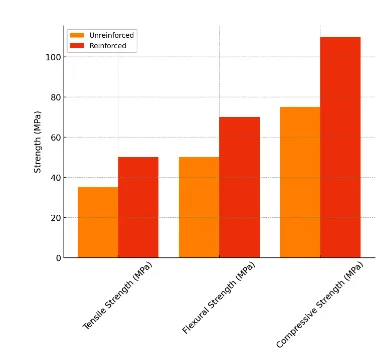
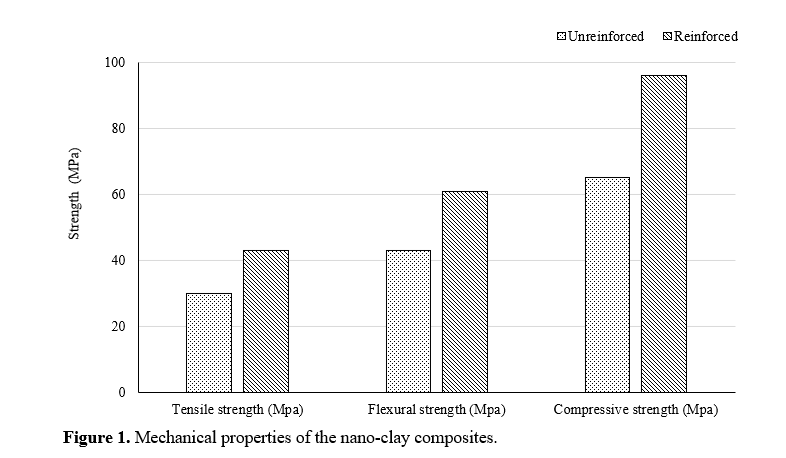
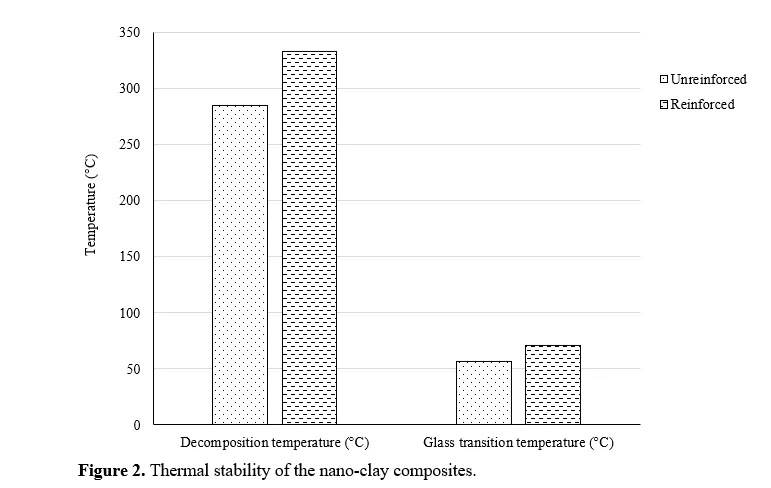
This study investigates the mechanical, thermal, water absorption, and chemical resistance properties of nano-clay-reinforced polymer composites and polymer concrete. The incorporation of 1-5 wt% nano-clay resulted in a significant enhancement across all properties. Mechanical testing revealed a 42.86% increase in tensile strength (35 MPa to 50 MPa), 40% improvement in flexural strength (50 MPa to 70 MPa), and 46.67% rise in compressive strength (75 MPa to 110 MPa), attributed to effective stress transfer and crack resistance provided by the nano-clay layers. The chemical structure and composition of nano-clay play a critical role in its interaction with polymer matrices. Organically modified nano-clays, such as montmorillonite (MMT), enhance compatibility with polymer chains through functional groups that promote intercalation and exfoliation. These interactions significantly affect the dispersion quality and interfacial bonding, which are crucial for stress transfer and load-bearing capacity. The presence of hydrophilic or hydrophobic functional groups determines the clay’s affinity with different polymers, influencing the composite’s mechanical and thermal performance. Thermal stability improved, with the decomposition temperature increasing by 16.67% (300°C to 350°C) and glass transition temperature rising by 25% (60°C to 75°C), demonstrating the barrier effect of nano-clay against heat transfer. Water absorption tests showed a 63.64% reduction in weight gain after 72 hours (5.5% to 2.0%), indicating enhanced durability in humid environments. Chemical resistance testing revealed remarkable improvements, with weight loss reduced by 73.33% in acidic conditions (3.0% to 0.8%), 80% in alkaline environments (2.5% to 0.5%), and 83.33% in saline solutions (1.8% to 0.3%). These results highlight the effectiveness of nano-clay in enhancing the structural, thermal, and durability characteristics of polymers, making them suitable for high-performance applications in construction, marine, aerospace, and chemical industries. The study underscores the potential of nano-clay-reinforced systems for replacing traditional materials in demanding environments.
Keywords: Nano-clay reinforcement, polymer composites, mechanical properties, thermal stability, chemical resistance.
[This article belongs to Journal of Polymer & Composites ]
References
- Alexandre M, Dubois P. Polymer-layered silicate nanocomposites: Preparation, properties, and uses of a new class of materials. Mater Sci Eng. 2000;28(1):1–63.
- Thostenson ET, Ren Z, Chou TW. Advances in the science and technology of carbon nanotubes and their composites. Compos Sci Technol. 2005;65(3–4):491–516.
- Ray SS, Okamoto M. Polymer/layered silicate nanocomposites: A review from preparation to processing. Prog Polym Sci. 2003;28(11):1539–1641.
- Kashiwagi T, Grulke E, Hilding J, et al. Thermal and flammability properties of polypropylene/carbon nanotube nanocomposites. Polymer. 2002;43(9):2799–2806.
- Chen C, Wang W, Zhang Q. Effect of clay dispersion on the thermal and mechanical properties of polypropylene/clay nanocomposites. Polym Test. 2004;23(8):971–979.
- Kumar P, Singh V, Patel R. Analysis of fibrous composites for enhanced tensile strength. Fibers. 2023;10(7):60. doi:10.3390/fib10070060.
- Sharma A, Gupta N, Patel S. Advances in molecular insights for hybrid composites. Molecules. 2020;25(23):5579. doi:10.3390/molecules25235579.
- Patel K, Rajan D, Gupta L. Structural performance of hybrid composites in energy absorption applications. BioResources. 2024;19(4):8812-26. doi:10.15376/biores.19.4.8812-8826.
- Govindarajan K, Lee R, Sharma T. Biodegradable materials for sustainable composite applications. BioResources. 2024;19(4): Govindarajan. doi:10.15376/biores.19.4.Govindarajan.
- Singh D, Patel S, Kumar R. Bio-based composites for energy absorption in advanced applications. Biomass Convers Bioref. 2024. doi:10.1007/s13399-024-05495-4.
- Prabhu FF, Kumar KP, Shanmugam A, Kumar M, Senthil TS, Dhanraj JA. Study on wear behaviour of Al6061 MMC with nano-MoC. Mater Today Proc. 2022;69(Part 3):1154–1158.
- Jasmin MN, Sathish S, Senthil TS, Naidu BA, Das AD, Arun KK, et al. Investigation on natural fiber reinforced polymer matrix composite. Mater Today Proc. 2023;74(Part 1):60–63.
- Srinivas J, Karthikeyan KR, Senthil TS, Yesuraj K, Aultrin KSJ. Characterization of mechanical and viscoelastic properties of ceramic nanoparticle-reinforced polymer composites. J Polym Compos. 2024;13(1):71–82.
- Mary Jasmin N, Beena T, Senthil S, Sakthi S, Ramesh Kumar M, Rahul Alex S, et al. Machinability behaviors of synthesized beryllium composite. Mater Today Proc. 2023;74(Part 1):40–43.
- Priya CB, Ravi Kumar V, Umamaheswari D, Venkatesh R, Karthigairajan M, Kaliappan S, et al. Bio-degradable waste banana and neem fiber reinforced epoxy hybrid composites: Characteristics study. J Mech Sci Technol. 2024;38(4):1891–1896.
- Saravanan AK, Prasad AR, Muruganandam D, Saravanan G, Vivekanandan S, Sudhakar M. Study on natural fiber composites of jute, pineapple, and banana compositions percentage of weight basis for thermal resistance and thermal conductivity. Mater Today Proc. 2021;37:147–151.
- Logendran D, Gurusami K, AnandChakaravarthi MC, Puthilibai G, Suresh M, Sudhakar M. Experimental research on glass fibres/caustic soda treated banana fibers hybrid composite. Mater Today Proc. 2020;33:4408–4411.
- Xu C, Wei P, Huang Z. Barrier and thermal properties of polymer nanocomposites reinforced with layered silicates. J Polym Sci. 2011;51(10):2303–2312.
- Gupta RK, Kennedy JP. Nanoclay composites for engineering applications. Compos Sci Technol. 2009;69(3–4):463–470.
- Paul DR, Robeson LM. Applications of polymer-layered silicate nanocomposites. Polym Rev. 2012;52(2):105–132.
- Li C, Strachan A. Molecular dynamics simulations of polymer-nanoparticle interfacial properties. Polymer. 2010;51(25):6058–6070.
- He C, Yu Y. Environmental stability of polymer nanocomposites reinforced with nano-clay. J Mater Sci. 2010;45(3):782–795.
- Kim D, Lee J. Synthesis and properties of polymer-layered silicate nanocomposites. Polym Test. 2009;28(2):227–235.
- Phang IY, Tadokoro M, He C. Development of polymer/clay nanocomposites for improved performance. Mater Sci Technol. 2004;20(10):1300–1306.
- Alexandre M, Siqueira G. Clay/polymer nanocomposites for environmental applications. J Mater Chem. 2009;19(23):3513–3522.
- Vaia RA, Giannelis EP. Polymer nanocomposites: Interface engineering and macroscopic properties. J Polym Sci Part B Polym Phys. 2001;39(15):1055–1065.
- Chen B, Evans JRG. Impact and tensile strengths of layered silicate nanocomposites. Compos Part A Appl Sci Manuf. 2005;36(6):763–771.
- Wang Z, Pinnavaia TJ. Nanolayer reinforcement of elastomeric polyurethane. Chem Mater. 1998;10(7):1820–1826.
- Usuki A, Kojima Y, Kawasumi M, et al. Synthesis of nylon 6-clay hybrid. J Mater Res. 1993;8(5):1179–1184.
- Giannelis EP. Polymer-layered silicate nanocomposites: Synthesis, properties, and applications. Adv Mater. 1996;8(1):29–35.
- Kornmann X, Lindberg H, Berglund LA. Synthesis of epoxy-clay nanocomposites: Influence of the nature of the curing agent on structure. Polymer. 2001;42(4):1303–1310.
- Lan T, Kaviratna PD, Pinnavaia TJ. On the nature of polyimide-clay hybrid composites. Chem Mater. 1994;6(4):573–575.
- Alexandre M, Siqueira G. Effect of silicate dispersion on the mechanical properties of nanocomposites. J Appl Polym Sci. 2008;109(2):1486–1495.
- Langenbach RJ, Berglund LA. Effects of processing on the exfoliation of clay particles in nanocomposites. Compos Part A Appl Sci Manuf. 2005;36(8):1102–1110.
- Tjong SC. Structural and mechanical properties of polymer nanocomposites. Mater Sci Eng R. 2006;53(3–4):73–197.
- Vaia RA, Wagner HD. Framework for nanocomposites. Mater Today. 2004;7(11):32–37.
- Wong SC, Zhang X. Toughening of nanocomposites by nanoparticle addition. Polym Eng Sci. 2004;44(6):1082–1091.
- Krishnamoorti R, Vaia RA. Polymer nanocomposites: Synthesis and characterization. J Polym Sci Part B Polym Phys. 2007;45(3):325–336.
- Okada A, Usuki A. The chemistry of polymer-clay hybrids. Mater Sci Eng C. 1995;3(2):109–115.
- Pinnavaia TJ, Beall GW. Polymer-clay nanocomposites. John Wiley & Sons; 2000.

Journal of Polymer & Composites
| Volume | 13 | |
| Issue | 02 | |
| Received | 13/12/2024 | |
| Accepted | 10/01/2025 | |
| Published | 23/01/2025 | |
| Publication Time | 41 Days |