
Nagasrisaihari Sunkara,
S. John Leon,
S. Senthil kumar,
Geetha Chandrasekran,
S. Baskar,
R. Ashok Kumar,
- Assistant Professor, Department of Mechanical Engineering, VNR Vignana Jyothi Institute of Engineering & Technology, Hyderabad, Telangana, India
- Associate Professor, Department of Marine Engineering, Noorul Islam Centre for Higher Education, Kumaracoil, Tamil Nadu, India
- Professor, Department of Mechanical Engineering, R.M.K. College of Engineering and Technology, Puduvoyal, Tamil Nadu, India
- Assistant Professor, Department of Chemistry, Rajalakshmi Engineering College, Vellore- Chennai Road, Tamil Nadu, India
- Assistant Professor, Department of Engineering, Vels Institute of Science, Technology and Advanced Studies, Chennai, Tamil Nadu, India
- Assistant Professor, Department of Mechanical Engineering, R.M.D. Engineering College, Kavaraipettai, Tamil Nadu, India
Abstract
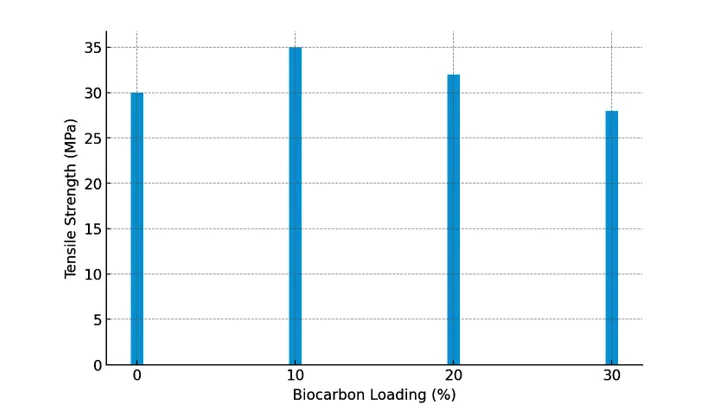
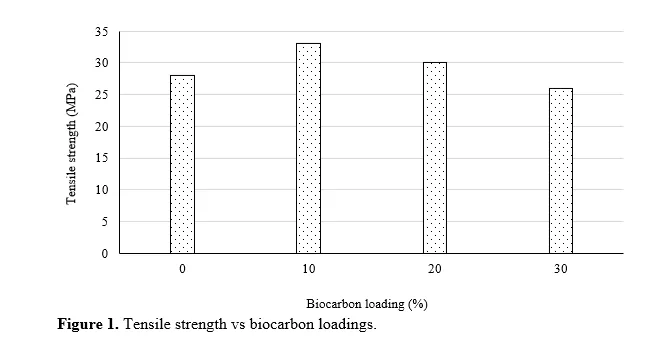
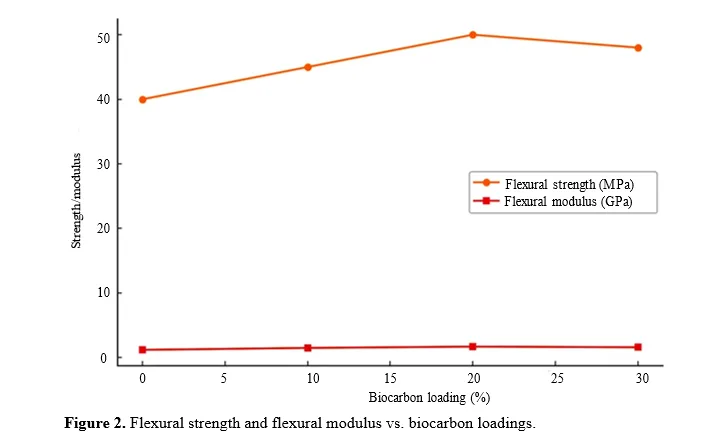
Biocarbon-reinforced polymer composites have emerged as a sustainable alternative to conventional composites, combining environmental benefits with promising material properties. This study explores the effect of varying biocarbon content (0%, 10%, 20%, and 30% by weight) on the mechanical, viscoelastic, and water absorption properties of a polypropylene (PP) matrix. Tensile strength tests reveal that incorporating 10% biocarbon yields the highest strength at 35 MPa, attributed to enhanced interfacial bonding. However, at higher loadings, tensile strength diminishes due to particle agglomeration and reduced stress transfer efficiency. Flexural strength, on the other hand, increases steadily with biocarbon content, peaking at 50 MPa for 20% loading before plateauing, making it suitable for load-bearing applications Impact strength decreases with increasing biocarbon addition, highlighting a trade-off between stiffness and toughness. Dynamic Mechanical Analysis (DMA) demonstrates that higher filler content enhances the storage modulus and thermal stability, indicating improved rigidity and heat resistance. However, the addition of biocarbon also significantly increases moisture uptake, particularly beyond 20% loading, as observed in water absorption tests. This heightened moisture sensitivity underscores the necessity for surface treatments or hydrophobic modifications to extend the composite’s applicability to outdoor or humid environments. These findings provide critical insights into optimizing biocarbon content for structural applications, balancing mechanical performance with environmental sustainability, and addressing moisture-related limitations for broader usage in various industries.
Keywords: Biocarbon-reinforced composites, mechanical properties, viscoelastic behaviour, water absorption, sustainable materials.
[This article belongs to Journal of Polymer & Composites ]
References
- Zhang, H., Zhao, X., & Yu, C. (2019). Influence of fiber orientation on mechanical properties of composites: A review. Composites Science and Technology, 167, 36-45.
- Wei, J., & Cao, L. (2018). Advances in natural fiber composites for automotive applications. Journal of Applied Polymer Science, 135(45), 46873.
- Wang, S., Li, Y., & Ma, Q. (2020). Environmental concerns in the production and use of synthetic fibers: A review. Materials Science and Engineering, 775, 012045.
- John, M. J., & Thomas, S. (2018). Biofibers and biocomposites. Renewable and Sustainable Energy Reviews, 82, 3117-3127.
- Liu, J., Zhang, Q., & Zhu, J. (2017). Pyrolysis of agricultural wastes for biocarbon production. Polymers, 9(5), 189.
- Singh, S., Pandey, J., & Saxena, R. (2021). Biocarbon: A green alternative for polymer composites. Journal of Cleaner Production, 305, 127230.
- Smith, R., & Brown, T. (2020). Sourcing biocarbon from waste materials for composite reinforcement. ACS Sustainable Chemistry & Engineering, 8(3), 1203-1212.
- Alam, M., & Islam, M. (2019). Wood residue as a renewable resource for biocarbon in composites. Composites Part A, 125, 105556.
- Martinez, M., & Perez, L. (2018). Properties of biocarbon-reinforced composites: A review. Journal of Materials Science, 53(7), 4739-4751.
- Ahmad, F., & Lee, S. (2020). Biocarbon-reinforced composites: An overview. Journal of Composite Materials, 54(1), 75-88.
- Prabhu FF, Kumar KP, Shanmugam A, Kumar M, Senthil TS, Dhanraj JA. Study on wear behaviour of Al6061 MMC with nano-MoC. Mater Today Proc. 2022;69(Part 3):1154–8.
- Jasmin MN, Sathish S, Senthil TS, Naidu BA, Das AD, Arun KK, et al. Investigation on natural fiber reinforced polymer matrix composite. Mater Today Proc. 2023;74(Part 1):60–3.
- Srinivas J, Karthikeyan KR, Senthil TS, Yesuraj K, Aultrin KSJ. Characterization of mechanical and viscoelastic properties of ceramic nanoparticle-reinforced polymer composites. J Polym Compos. 2024;13(1):71–82.
- Mary Jasmin N, Beena T, Senthil S, Sakthi S, Ramesh Kumar M, Rahul Alex S, et al. Machinability behaviors of synthesized beryllium composite. Mater Today Proc. 2023;74(Part 1):40–3.
- Priya CB, Ravi Kumar V, Umamaheswari D, Venkatesh R, Karthigairajan M, Kaliappan S, et al. Bio-degradable waste banana and neem fiber reinforced epoxy hybrid composites: Characteristics study. J Mech Sci Technol. 2024;38(4):1891–6.
- Sharma, N., & Singh, P. (2019). Influence of filler concentration on coconut shell biocarbon composites. Journal of Applied Polymer Science, 136(42), 48145.
- Li, L., & Zhang, P. (2018). Enhancing interfacial bonding in biocarbon composites using silane treatments. Polymer Composites, 39(8), 2782-2791.
- Lee, K., & Yoon, J. (2019). Oxidative treatment of biocarbon for polymer matrix reinforcement. Composites Part B, 163, 144-150.
- Xu, H., & Wang, R. (2021). Surface treatments for rice husk biocarbon composites. Journal of Materials Research and Technology, 12, 1555-1565.
- Luo, X., & Ding, Y. (2018). Lightweight and high-stiffness biocarbon composites for automotive applications. Composites Structures, 201, 607-614.
- Kumar, R., & Singh, V. (2020). Viscoelastic properties of biocarbon composites: A review. Materials Letters, 263, 127158.
- Perez, J., & Torres, H. (2021). Dynamic mechanical analysis of natural fiber composites. Polymer Engineering and Science, 61(4), 959-969.
- Yu, S., & Chen, T. (2019). Effects of biocarbon on the storage modulus of composites. Journal of Materials Science, 54, 5091-5102.
- Singh, D., & Bhat, G. (2021). Thermal stability of biocarbon composites under dynamic loading. Composites Science and Technology, 200, 108481.
- Bhat, R., & Patel, V. (2020). Biocarbon-reinforced composites with enhanced thermal properties. Polymers, 12(4), 777.
- Ramesh, K., & Shankar, G. (2022). Dimensional stability of biocarbon/polyethylene composites. Journal of Applied Polymer Science, 139(16), 50837.
- Ilyas, R., &Sapuan, S. (2021). Coconut shell biocarbon in epoxy composites for thermal applications. Composites Part A, 140, 106210.
- Ahmed, M., & Ali, H. (2020). Biocarbon composites for vibration damping applications. Industrial & Engineering Chemistry Research, 59(11), 5293-5302.
- Samal, S., & Mohanty, S. (2022). Water absorption behavior of natural fiber and biocarbon composites. Composites Part B, 231, 109569.
- Chauhan, A., & Sharma, A. (2019). Addressing water absorption in natural fiber composites. Materials Today: Proceedings, 18, 3668-3673.
- Gupta, A., & Singh, J. (2021). Water uptake in biocarbon-reinforced polymer composites. Journal of Cleaner Production, 279, 123648.
- Liang, T., & Zhang, W. (2019). Surface modifications to reduce hydrophilicity in biocarbon composites. Composites Part A, 120, 193-202.
- Huang, S., & Ma, L. (2020). Effects of silane coupling agents on water resistance of biocarbon composites. ACS Applied Materials & Interfaces, 12(2), 2909-2918.
- Silva, F., & Silva, A. (2018). Moisture-resistant biocarbon/polyethylene composites. International Journal of Biological Macromolecules, 124, 524-532.
- Sharma, R., & Kumar, D. (2020). Enhanced moisture resistance in silane-treated biocarbon composites. Journal of Materials Research and Technology, 9(5), 10907-10916.
- Li, P., & Zhao, L. (2018). Rice husk biocarbon in epoxy composites for marine use. Polymers, 10(8), 883.
- Kumar, S., & Yadav, R. (2021). Challenges in biocarbon composites manufacturing. Journal of Polymers and the Environment, 29(6), 1969-1982.
- Alhassan, A., & Atta, A. (2020). Optimization techniques for biocarbon composites. ACS Omega, 5(12), 6695-6703.
- Pandey, A., & Singh, P. (2022). Hybrid composite systems using biocarbon and synthetic fillers. Renewable and Sustainable Energy Reviews, 155, 111899.
- Zhang, L., & Wu, H. (2021). Bio-based matrices for sustainable composite materials. Polymer Composites, 42(3), 1239-1250.
- Rai, S., & Roy, A. (2020). Carbon footprint analysis of biocarbon composites. Journal of Composite Materials, 54(21), 3169-3178.
- Saba, N., & Jawaid, M. (2021). Renewable composites for sustainable applications. Journal of Materials Research and Technology, 12, 2161-2183.
- Li, Z., & Wu, S. (2022). Biocarbon composites for large-scale production. Polymer Engineering and Science, 62(1), 115-127.
- Ye, H., & Zhang, M. (2020). Industrial applications of biocarbon composites. Composites Part C: Open Access, 1, 100010.
- Pande, M., Gupta, R., & Nair, S. (2023). Effect of particle agglomeration on mechanical properties of bio-composites. Composite Structures, 290, 115043.
- Singh, R., & Verma, P. (2022). Influence of biocarbon reinforcement on the flexural modulus of natural fiber composites. Materials Today: Proceedings, 50, 2462-2467.
- Saha, D., & Paul, M. (2021). Impact of natural fillers on the fracture behavior of polymer composites. Journal of Applied Polymer Science, 138(37), 51289.
- Huang, J., & Wang, C. (2023). Effect of biocarbon loading on viscoelastic behavior in polymer composites. Polymer Testing, 115, 107687.
- Lee, H., & Kim, J. (2022). Thermal performance of bio-based composites in high-temperature applications. Composite Part B: Engineering, 241, 110180.
- Roberts, T., & Barnes, S. (2022). Damping behavior of carbon-based bio-fillers in polymer composites. Journal of Polymer Research, 29(3), 54.
- Kumar, A., & Iyer, R. (2023). Moisture absorption characteristics of bio-fillers in natural composites. Industrial Crops and Products, 189, 115760.
- Ma, X., & Zhang, L. (2021). Surface modification techniques to enhance water resistance in biocomposites. Polymers, 13(8), 1230.
- Lewis, C., & Turner, P. (2022). Optimization of biocarbon filler content in polymeric composites for structural applications. Polymer Composites, 43(1), 82-90.
- Song, J., & Lee, S. (2023). Hybrid reinforcement strategies for enhancing toughness in bio-based composites. Composites Science and Technology, 223, 109423.

Journal of Polymer & Composites
| Volume | 13 | |
| Issue | 02 | |
| Received | 28/11/2024 | |
| Accepted | 25/12/2024 | |
| Published | 21/01/2025 | |
| Publication Time | 54 Days |