
Akash Gehlot,
Pawan Kalla,
- Ph.D. Scholar, Department of Civil Engineering, Malaviya National Institute of Technology, Jaipur, Rajasthan, India
- Associate Professor, Department of Civil Engineering, Malaviya National Institute of Technology, Jaipur, Rajasthan, India
Abstract
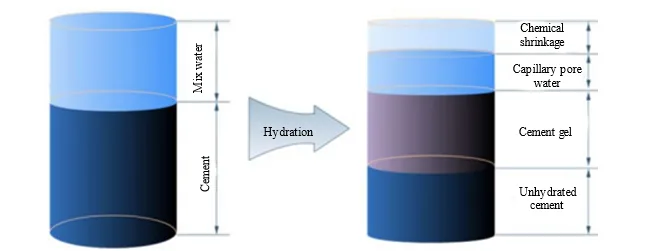
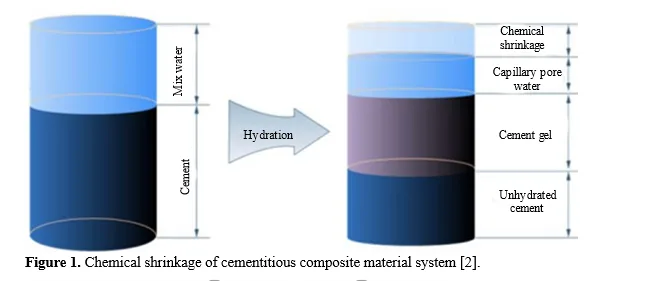
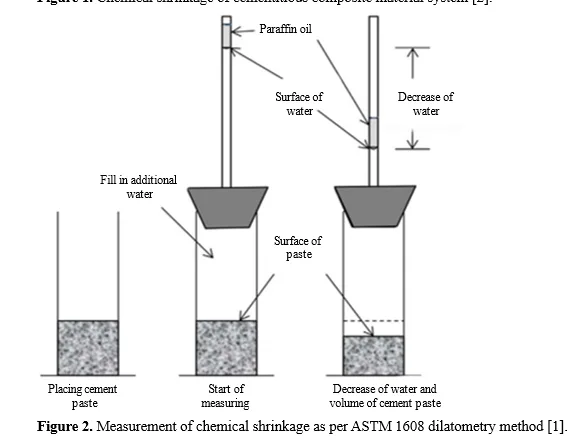
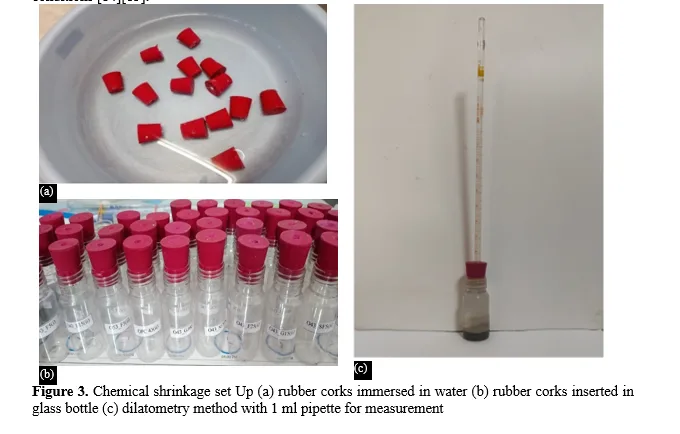
Chemical shrinkage is the volume reduction observed in cement during early hydration due to chemical reactions, which critically influences the internal stresses, cracking tendencies, and durability of cementitious system. Present study is focused on effect of supplementary cementitious material (SCM) on chemical shrinkage. Dilatometry method is used to assess the impacts of SCMs on chemical shrinkage, in this this study. The research incorporates experiments with laboratory-synthesized cement and three SCMs—fly ash, GGBS, and silica fume in various proportions. The experiments monitored the progression of chemical shrinkage in cement paste and drying shrinkage in mortar mixes over time, maintaining a water-to-cementitious materials ratio of 0.40. Shrinkage measurements were conducted using volumetric method. For their ability to provide reliable data on the material’s volume changes during hydration, this method was chosen. In addition to physical measurements, the study also employed Fourier Transform Infrared Spectroscopy (FTIR) to analyse the microstructural changes within the cement mixes. The findings validated results of dilatometry in measuring chemical shrinkage. The study revealed that the addition of silica fume tends to increase shrinkage strains, whereas higher amounts of fly ash and GGBS reduces the magnitude of chemical shrinkage across all cement types tested. This trend was consistent with the literature and underscores the potential of SCMs to modify the physical properties of cement. The FTIR analyses further gave better understanding of the different phases present during the hydration process, which offers deeper insights into how these changes affect the overall behaviour of the material.
Keywords: Chemical shrinkage, cement composite, fly ash, GGBS, silica fume
[This article belongs to Journal of Polymer & Composites ]
References
- Zhang T, Gao P, Luo R, et al. Measurement of chemical shrinkage of cement paste: Comparison study of ASTM C 1608 and an improved method. Constr Build Mater 2013;48:662–9. https://doi.org/10.1016/j.conbuildmat.2013.07.086.
- Zhutovsky S, Kovler K. Chemical Shrinkage of High-Strength / High-Performance Cementitious Materials. International Review of Chemical Engineering (IRECHE) 2018;10:1. https://doi.org/10.15866/ireche.v10i1.15794.
- Ghanem H, Ramadan R, Khatib J, Elkordi A. A Review on Chemical and Autogenous Shrinkage of Cementitious Systems. Materials 2024;17. https://doi.org/10.3390/ma17020283.
- Gonzalez am. An evaluation of the ASTM Mstandard method for measuring chemical shrinkage of hydraulic cementitious pastes. Toronto: 2007.
- Zhang T, Gao P, Luo R, Guo Y, Wei J, Yu Q. Measurement of chemical shrinkage of cement paste: Comparison study of ASTM C 1608 and an improved method. Constr Build Mater 2013; 48:662–9. https://doi.org/10.1016/j.conbuildmat.2013.07.086.
- Xiao KT, Yang HQ, Dong Y. Study on the influence of admixture on chemical shrinkage of cement based materials. Key Eng Mater 2009;405–406:226–33. https://doi.org/10.4028/www.scientific.net/kem.405-406.226.
- Mounanga P, Khelidj A, Loukili A, Mounanga P, et al. Predicting Ca ( OH ) 2 content and chemical shrinkage of hydrating cement pastes using analytical approach To cite this version : HAL Id : hal-01007190 Predicting Ca ( OH ) 2 content and chemical shrinkage of hydrating cement pastes using analytical appro 2004.
- Bouasker M, Mounanga P, Turcry P, Loukili A, Khelidj A. Chemical shrinkage of cement pastes and mortars at very early age: Effect of limestone filler and granular inclusions. Cem Concr Compos 2008;30:13–22. https://doi.org/10.1016/j.cemconcomp.2007.06.004.
- Khatib J, Ramadan R, Ghanem H, ElKordi A. Effect of using limestone fines on the chemical shrinkage of pastes and mortars. Environmental Science and Pollution Research 2023;30:25287–98. https://doi.org/10.1007/s11356-022-18496-5.
- Kheir J, Hilloulin B, Loukili A, De Belie N. Chemical shrinkage of low water to cement (W/c) ratio cem i and cem iii cement pastes incorporating silica fume and filler. Materials 2021;14:1–13. https://doi.org/10.3390/ma14051164.
- Miao Y, Zhang Y, Li B, Chai L, Ma G. Effect of Graphene Oxide on Chemical Shrinkage Behavior of Cement-Based Composite Paste. KSCE Journal of Civil Engineering 2022;26:1858–79. https://doi.org/10.1007/s12205-021-1013-x.
- Wang J, Cheng Y, Yuan L, Xu D, Du P, Hou P, et al. Effect of nano-silica on chemical and volume shrinkage of cement-based composites. Constr Build Mater 2020;247:118529. https://doi.org/10.1016/j.conbuildmat.2020.118529.
- Zhang Z, Scherer GW. Measuring chemical shrinkage of ordinary Portland cement pastes with high water-to-cement ratios by adding cellulose nanofibrils. Cem Concr Compos 2020;111:103625. https://doi.org/10.1016/j.cemconcomp.2020.103625.
- Saluja S, Kaur K, Goyal S, Bhattacharjee B. Assessing the effect of GGBS content and aggregate characteristics on drying shrinkage of roller compacted concrete. Constr Build Mater 2019;201:72–80. https://doi.org/10.1016/j.conbuildmat.2018.12.179.
- Rao GA. Long-term drying shrinkage of mortar Ð influence of silica fume and size of fine aggregate. Cem Concr Res 2001;31:171–5.
- [Tararushkin E V., Shchelokova TN, Kudryavtseva VD. A study of strength fluctuations of Portland cement by FTIR spectroscopy. IOP Conf Ser Mater Sci Eng 2020;919. https://doi.org/10.1088/1757-899X/919/2/022017.
- Chen B, Shao H, Li B, Li Z. Influence of silane on hydration characteristics and mechanical properties of cement paste. Cem Concr Compos 2020;113. https://doi.org/10.1016/j.cemconcomp.2020.103743.

Journal of Polymer & Composites
| Volume | 13 | |
| Issue | 01 | |
| Received | 17/09/2024 | |
| Accepted | 07/10/2024 | |
| Published | 24/10/2024 | |
| Publication Time | Days |