
Open Access
Indranil Maity,
Arighna Bhattacharjee,
Arijit Mondal,
- Assistant Professor, Department of Electronics and Communication Engineering (ECE), Institute of Engineering and Management (IEM), University of Engineering & Management (UEM), Kolkata, West Bengal, India
- Student, Department of Electronics and Communication Engineering (ECE), Institute of Engineering and Management (IEM), Kolkata, West Bengal, India
- Student, Department of Electronics and Communication Engineering (ECE), Institute of Engineering and Management (IEM), Kolkata, West Bengal, India
Abstract
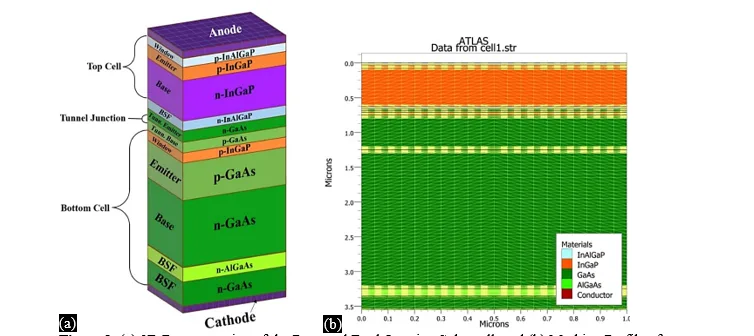
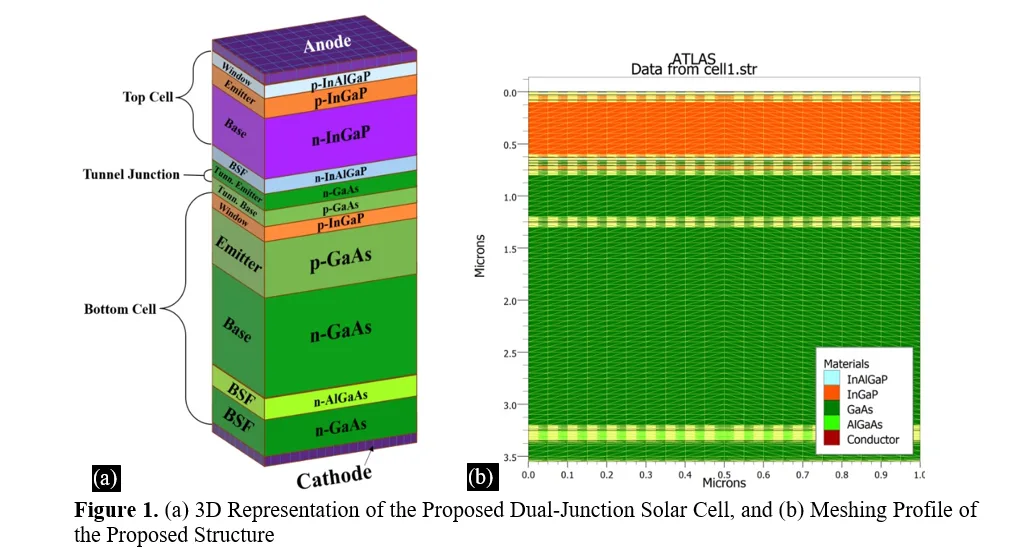
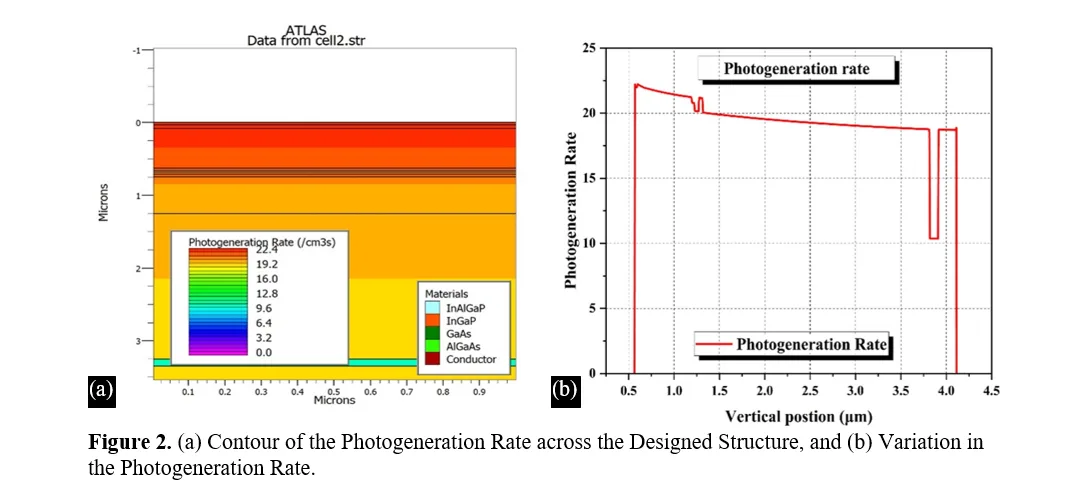
In the present work, a multi-junction solar cell was designed to obtain better performance over single-junction solar cells. The proposed structure is composed of different layers of diverse semiconductor materials stacked on each other. Here, an In0.51Ga0.49P/GaAs double-junction solar cell was outlined as having a distinctive composite material (GaAs) as the tunneling junction. To optimize the solar cell’s effectiveness, In0.47Ga0.15Al0.37P was used in the window layer and the back-surface field (BSF) layers. All the optimizations and computations were performed utilizing the Silvaco TCAD software (version: 5.26.1.R), under 1 sun (1370 W/m2). The light beam of the standard AM1.5G was fired at the solar cell at 300 K, room temperature. With the help of two subcells of the dual-junction solar cell, and by fine-tuning the layer parameters (viz. materials property and material thickness), notable operational parameters were accomplished for the modelled dual-junction solar cells. Our examination centered on the photogeneration rate, energy band diagrams, and the I-V characteristics of the proposed structure in standard test conditions (STC). By connecting the top subcell and the bottom subcell with the intermediate tunnel junction of Gallium Arsenide (GaAs), and by utilizing In0.47Ga0.15Al0.37P for both the BSF and window layers, an efficiency of 25.65% was achieved. The results of the solar cell show an open-circuit voltage (Voc) of 1.74 V, current density at short-circuit condition (Jsc) of 16.71 mA/cm² and a fill factor (FF) of 88.05%. All the considered layers were lattice-matched, guaranteeing compatibility with the current manufacturing innovations. This study illustrates that through key layer optimizations and progressed re-enactment methods, high-efficiency dual-junction solar cells can be created for their viable usage towards photovoltaic applications in the field of solar energy.
Keywords: Dual-junction solar cells, In0.51Ga0.49P composite material, TCAD modelling, Hybrid compound, Photovoltaic efficiency.
[This article belongs to Special Issue under section in Journal of Polymer & Composites (jopc)]
References
- Benlekhdim A, Cheknane A, Sfaxi L, Hilal HS. Efficiency improvement of single-junction InGaP solar cells by advanced photovoltaic device modeling. Optik. 2018 Jun 1;163:8–15.
- Salem MS, Saif OM, Shaker A, Abouelatta M, Alzahrani AJ, Alanazi A, Elsaid MK, Ramadan RA. Performance optimization of the InGaP/GaAs dual‐junction solar cell using SILVACO TCAD. International Journal of Photoenergy. 2021;2021(1):8842975.
- Bagheri S, Talebzadeh R, Sardari B, Mehdizadeh F. Design and simulation of a high efficiency InGaP/GaAs multi junction solar cell with AlGaAs tunnel junction. Optik. 2019 Dec 1;199:163315.
- Maity I, Acharyya D, Huang K, Chung P, Ho M, Bhattacharyya P. A comparative study on performance improvement of ZnO nanotubes based alcohol sensor devices by Pd and rGO hybridization. IEEE Transactions on Electron Devices. 2018 Jun 29;65(8):3528–34.
- Chawla R, Singhal P, Garg AK. Design and analysis of multi junction solar photovoltaic cell with graphene as an intermediate layer. Journal of nanoscience and nanotechnology. 2020 Jun 1;20(6):3693–702.
- Kumari M. A comparative study of acoustical phonon induced and optical phonon induced parametric gain in AIIIBV type semiconductor-magneto-plasmas. RP Materials: Proceedings. 2022 Aug 24;14:16.
- Maity I, Bhattacharyya P. Room temperature acetone sensing performance of rGO-ZnO nanotubes binary hybrid structure. Sensor Letters. 2019 Jun 1;17(6):417–22.
- Soley SS, Dwivedi AD. Numerical simulation and performance analysis of InGaP, GaAs, Ge single junction and InGaP/GaAs/Ge triple junction solar cells. Materials Today: Proceedings. 2021 Jan 1;39:2050–5.
- Singh HP. Nonlinear absorption of ternary and quaternary semiconductor nanocrystals. RP Cur. Tr. Eng. Tech. 2022; Vol. 1(Part 1):13–6.
- Suria BS, Hussain SH, Mehmood HA, ALI G. Nanocrystalline silicon (nc-Si: H) and amorphous silicon (a-Si: H) based thin-film multijunction solar cell. Sains Malaysiana. 2014;43(6):895–8.
- Maity I, Nagasawa H, Tsuru T, Bhattacharyya P. Correlation between ammonia selectivity and temperature dependent functional group tuning of GO. IEEE Transactions on Nanotechnology. 2020 Dec 18;20:129–136.
- Kowsar A, Billah M, Dey S, Debnath SC, Yeakin S, Farhad SF. Comparative study on solar cell simulators, 2nd International Conference on Innovation in Engineering and Technology (ICIET) 2019 Dec 23; 1–6.
- Hu Y, Chen B, Xu P. A comprehensive simulation study of multi-junction solar cell. Materials Research Express. 2024 May 9;11(5):056201.
- Benaicha M, Dehimi L, Pezzimenti F, Bouzid F. Simulation analysis of a high efficiency GaInP/Si multijunction solar cell. Journal of Semiconductors. 2020 Mar 1;41(3):032701.
- Maity I, Ghosh K, Rahaman H, Bhattacharyya P. Tuning of electronic properties of edge oxidized armchair graphene nanoribbon by the variation of oxygen amounts and positions. Journal of Materials Science: Materials in Electronics. 2017 Jun;28:9039–47.
- Nayak PP, Dutta JP, Mishra GP. Efficient InGaP/GaAs DJ solar cell with double back surface field layer. Engineering Science and Technology, an International Journal. 2015 Sep 1;18(3):325–35.
- Singh J. Simplified model to derive the statistics of photon propagation through an optical coupler and an optical fibre. RP Materials: Proceedings. 2022; 1, (Part 1); 17–21.
- Maity I. Cadence Virtuoso based circuit simulation of universal logic gates: A board tutorial. RP Cur. Tr. Eng. Tech. 2024; Vol. 3 (No. 1); 1–7.
- Djaafar F, Hadri B, Bachir G. Optimal parameters for performant heterojunction InGaP/GaAs solar cell. International Journal of Hydrogen Energy. 2017 Mar 30;42(13):8644–9.
- Maity I, Ghosh K, Rahaman H, Bhattacharyya P. Selectivity tuning of graphene oxide based reliable gas sensor devices by tailoring the oxygen functional groups: A DFT study based approach. IEEE Transactions on Device and Materials Reliability. 2017 Oct 25;17(4):738–45.
- Laoufi, A. M., Dennai, B., Kadi, O., & Fillali, M. Numerical modeling of multi-junction solar cell-based CIGS with two sub-cells in parallel using Silvaco TCAD. Chalcogenide Letters. 2021;18(6), 297–301.
- Boukortt NE, Patanè S, AlAmri AM, AlAjmi D, Bulayyan K, AlMutairi N. Numerical investigation of perovskite and u-CIGS based tandem solar cells using silvaco TCAD simulation. Silicon. 2023 Jan;15(1):293–303.
- Maka AO, O’Donovan TS. Effect of thermal load on performance parameters of solar concentrating photovoltaic: High-efficiency solar cells. Energy and Built Environment. 2022 Apr 1;3(2):201–9.

Journal of Polymer & Composites
| Volume | 13 | |
| Special Issue | 01 | |
| Received | 12/08/2024 | |
| Accepted | 24/10/2024 | |
| Published | 20/11/2024 | |
| Publication Time | 100 Days |