
Open Access
Ramya M,
Jitha P Marydasan,
Swathy Satheesh,
V P N Nampoori,
Kailasnath M,
- Assistant Professor on contract, Department of Physics, NSS College, Ottappalam, Palakkad, Kerala, India
- MSc Student, Department of Physics, Ansar Womens College, Perumpilavu, Thrissur, Kerala, India
- MSc Student, Department of Physics, Ansar Women’s College, Perumpilavu, Thrissur, Kerala, India
- Professor (Rtd), International School of Photonics, Cochin University of Science and Technology (CUSAT), Kerala, India
- Professor, International School of Photonics, Cochin University of Science and Technology (CUSAT), Kerala, India
Abstract
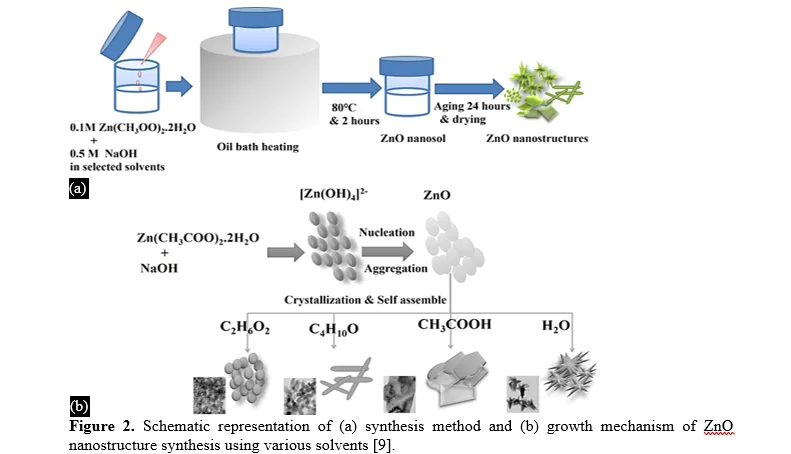
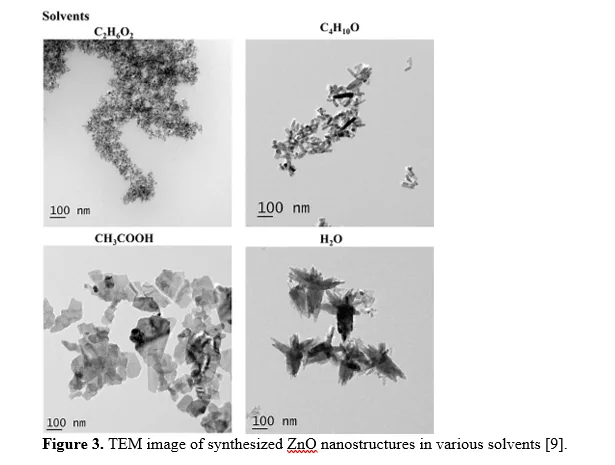
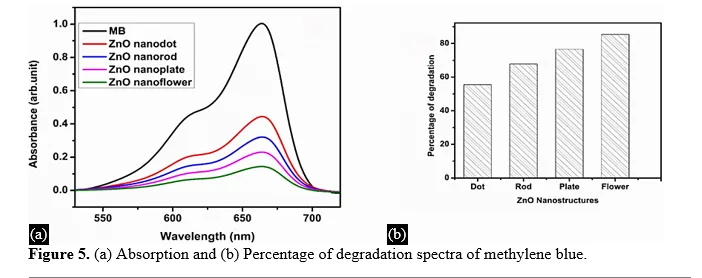
Nowadays, dyes are used in the food industry, textile industry, paper industry, hair coloring, light-harvesting arrays, photoelectrochemical cells, etc. Most of the dyes are nonbiodegradable, toxic, carcinogenic, and consist of organic compounds. These dye wastages are discharged into water bodies and the environment causing serious hazards to the marine ecosystem as well as the humans extensively. To treat toxic dyes traditional methods such as adsorption, activated carbon, ultrafiltration, and reverse osmosis are used for dye removal. But, in these processes pollution from one form transfers to another form causing secondary pollution. In the present study, efficient ZnO nanostructure nanodot, nanorod, nanoplate, and nanoflower) photocatalysts were prepared by ultrasonication-assisted solution method using ethylene glycol, 1-butanol, acetic acid, and water as solvent. ZnO has a wide band gap and it can be excited using UV light. For excellent photocatalysis, electron-hole recombination is suppressed by trapping charge carriers at defect states. Thus, the photocatalytic activity of ZnO is modified by changing its shape, size, and doping with transition metal ions. Here, we discussed the degradation of methylene blue (MB) using different dimensional ZnO nanostructures as a potential photocatalyst. The morphology and surface area of the synthesized samples were analyzed using TEM and BET analysis. Solvent physicochemical properties affect the growth kinetics and morphological evolution. ZnO nanoflower exhibits excellent photocatalytic performance than the other structures towards methylene blue degradation due to their larger surface area. Higher surface area enhances the dye adsorption and photodegradation efficiency to 85% under exposure to visible light after 20 minutes.
Keywords: ZnO Nanostructure, Methylene Blue, Photocatalysis, Degradation, Surface area.
[This article belongs to Special Issue under section in Journal of Polymer & Composites (jopc)]
References
- Viswanathan B. Photocatalytic Degradation of Dyes; An Overview. Current Catalysis. 2017; 7: 99–121p.
- Joseph M, Venkataraj R, Ramya M, Mani K P, Nampoori V P N and Kailasnath M. UV induced photocatalytic and antibacterial studies of zinc oxide nanoflowers prepared via casein assisted low-temperature method. Optik.2021; 247: 168034.
- Gopal Saini, Pinki Kumari, B S Sharma. Examination of nano-crysatlline Zinc oxide and Zinc oxide doped with aluminium using micro- raman technology. RP Current Trends In Applied Science. 2022; 1:21–25.
- M Ramya, M Kailasnath, T K Nideep, V P N Nampoori. ZnO: A key-functional Material for Nonlinear Optical Application. Encyclopedia of Materials: Electronics.2023; 41–66.
- Ramya M, Nideep T K, Nampoori V P N and Kailasnath M. Understanding the role of alcohols in the growth behaviour of ZnO nanostructures prepared by solution based synthesis and their application in solar cells. New Journal of Chemistry. 2019; 43:17980–90p.
- Ramya M, Nideep T K, Vijesh K R, Nampoori V P N and Kailasnath M. Synthesis of stable ZnO nanocolloids with enhanced optical limiting properties via simple solution method. Optical Materials. 2018; 81: 30–6p.
- S, Jebasingh J A, S. M V, Stanley P K, Ponmani P, Shekinah M E and Vasanthi J. Excellent Photocatalytic degradation of Methylene Blue, Rhodamine B and Methyl Orange dyes by Ag-ZnO nanocomposite under natural sunlight irradiation. Optik. 2021;231: 166518.
- Weerathunga H, Tang C, Brock A J, Sarina S, Wang T, Liu Q, Zhu H Y, Du A and Waclawik E R .Nanostructure Shape-Effects in ZnO heterogeneous photocatalysis. Journal of Colloid Interface Science. 2022; 606 :588–99p.
- Ramya M, Nideep T K, Nampoori V P N and Kailasnath M. Solvent assisted evolution and growth mechanism of zero to three dimensional ZnO nanostructures for dye sensitized solar cell applications. Scientific Reports. 2021; 11 :1–14p.
- Aldeen T S, Ahmed Mohamed H E and Maaza M. ZnO nanoparticles prepared via a green synthesis approach: Physical properties, photocatalytic and antibacterial activity. Journal of Physics and Chemistry of Solids. 2022; 160:110313.

Journal of Polymer & Composites
| Volume | 13 | |
| Special Issue | 01 | |
| Received | 26/07/2024 | |
| Accepted | 15/10/2024 | |
| Published | 10/12/2024 | |
| Publication Time | 137 Days |