
Open Access
Shivani S. kadam,
Randhir B. Lad,
Shilpa S. Ruikar,
Girish R. Pathade,
- Research Scholar, Department of Allied Sciences, Krishna institute of Allied sciences, Krishna Vishwa Vidyapeeth, Karad, Maharashtra, India
- MSc. Student, Department of Allied Sciences, Krishna institute of Allied sciences, Krishna Vishwa Vidyapeeth, Karad, Maharshtra, India
- Assistant professor, Department of Allied Sciences, Krishna institute of Allied sciences, Krishna Vishwa Vidyapeeth, Karad, Maharshtra, India
- Professor, Department of Allied Sciences, Krishna institute of Allied sciences, Krishna Vishwa Vidyapeeth, Karad, Maharshtra, India
Abstract
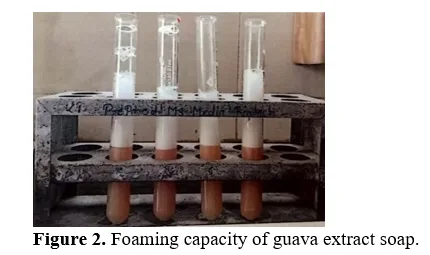
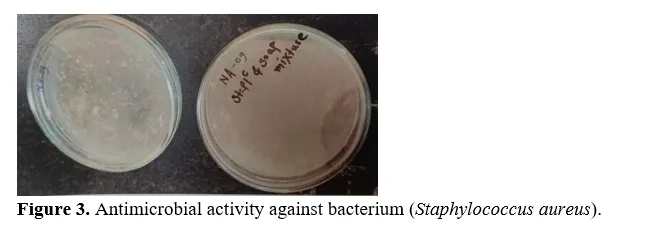
This study explores the formulation of an herbal soap using guava leaf extract as a primary ingredient. Guava leaves are a rich source of biopolymers like pectin and cellulose, which may contribute to the binding properties in the soap. The antimicrobial activity of the soap was evaluated against common skin pathogens (Staphylococcus aureus, Trichoderma spp., Aspergillus spp.). The formulated soap exhibited inhibitory effects against all tested pathogens. The weight, foaming capacity, and yield of the soap were also determined. While the natural biopolymers from guava leaves offer potential benefits, future research directions could involve incorporation of synthetic or biocompatible polymers to enhance the mechanical properties and durability of the soap. Additionally, characterization techniques like Fourier-transform infrared spectroscopy (FTIR) could be employed to analyze the interaction between guava leaf biopolymers and other soap components. Herbal soap is prepared to utilize guava leaf as a primary ingredient, numeric as a coloring agent, and lemongrass as a flavoring agent in the laboratory. The soap was subjected to physicochemical and microbiological analysis. The antimicrobial activity of the soap was evaluated against some common skin pathogens Staphylococcus aureus, Trichoderma spp. Aspergillus spp. herbal guava soap was formed to have had inhibitory effect against Staphylococcus aureus, Trichoderma spp. Aspergillus sp. The weight of the soap was 40.45. the foaming capacity of the soap was 22 minutes. The percentage of the yield of soap was found to be 86.52%. soap was found to be good. However, more studies regarding the formation and antimicrobial antifungal properties should be carried out.
Keywords: Biopolymers, pathogens, biocompatible polymers, herbal soap, polymeric linkage
[This article belongs to Special Issue under section in Journal of Polymer & Composites (jopc)]




References
- Thorpe, Jenalyn. “Waste Vegetable Oil Properties with Usage and Its Impact on Artisan Soap Making.” (2018).
- Mahran GH. Recent Research on Medicinal Plants in the African Region. The Medicinal Plant Industry. 2017 Jul 12:209-22.
- Jacob, Blessy, and V. Ciyamol. “Formulation and Evaluation of Herbal Soap.” A Journal of Pharmacology9, no. 2 (2019): 22-29.
- Martini A, Ramasamy US, Len M. Review of viscosity modifier lubricant additives. Tribology Letters. 2018 Jun;66:1-4.
- Hu M, Russell TP. Polymers with advanced architectures as emulsifiers for multi-functional emulsions. Materials Chemistry Frontiers. 2021;5(3):1205-20.
- Monie F, Vidil T, Grignard B, Cramail H, Detrembleur C. Self-foaming polymers: Opportunities for the next generation of personal protective equipment. Materials Science and Engineering: R: Reports. 2021 Jul 1; 145:100628.
- Barbalho, Sandra M., Flávia MV Farinazzi-Machado, Ricardo de Alvares Goulart, Anna Cláudia Saad Brunnati, A. M. Otoboni, and B. J. M. A. P. Ottoboni. “Psidium guajava (Guava): A plant of multipurpose medicinal applications.” Med Aromat Plants1, no. 4 (2012): 1-6.
- Vogelberg, Christian, Francisco Cuevas Schacht, Christopher P. Watling, Laura Upstone, and Georg Seifert. “Therapeutic principles and unmet needs in the treatment of cough in pediatric patients: review and expert survey.” BMC pediatrics23, no. 1 (2023): 34.
- Rusmiany, Putu, and Thomas Jonathan Senduk. “GUAVA (Psidium guajava L.) LEAF EXTRACTS CAN AS A GROWTH INHIBITOR Staphylococcus aureus.” (2021).
- Naseer S, Hussain S, Naeem N, Pervaiz M, Rahman M. The phytochemistry and medicinal value of Psidium guajava (guava). Clinical phytoscience. 2018 Dec;4(1):1-8.
- Babbar, Neha, Harinder Singh Oberoi, and Simranjeet Kaur Sandhu. “Therapeutic and nutraceutical potential of bioactive compounds extracted from fruit residues.” Critical Reviews in Food Science and Nutrition55, no. 3 (2015): 319-337.
- Yaun, Emma A., and Brian A. Vasquez. “Antibacterial activity of formulated Psidium guajava (guava) hand sanitizer gel on Staphylococcus aureus.” University of the Visayas-Journal of Research11, no. 1 (2017): 1-6.
- Babel, Sudha, and L. Sanchiher. “Finishing of cotton fabric with Psidium guajava herbal extract and testing its antimicrobial activity.” (2020).
- Rafiq, Shaik Jasmine Shahina. “Formulation of herbal soap against acne causing bacteria.” Asian Journal of Biological and Life Sciences10, no. 3 (2021): 609.
- Suwendar, S., L. Wahidah, Y. Krisnamurti, M. L. Ridwan, W. Lestari, D. Mardliyani, and N. Fitriani. “Development of Feminine Area Cleansers with Anti-fungal Properties Using Apple Rose Leaves as an Active Ingredient.” KnE Life Sciences(2022): 219-224.

Journal of Polymer & Composites
| Volume | 13 | |
| Special Issue | 01 | |
| Received | 02/04/2024 | |
| Accepted | 12/09/2024 | |
| Published | 04/12/2024 | |
| Publication Time | Days |