
Open Access
Sandeep Kumar. C,
Dr. Usha.S,
Shivaraju G. D,
- PG Student, Department of Civil Engineering, Sri Siddhartha Institute of Technology, Tumakuru, Karnataka, India
- Assistant Professor, Department of Civil Engineering, Sri Siddhartha Institute of Technology, Tumakuru, Karnataka, India
- Assistant Professor, Department of Civil Engineering, Sri Siddhartha Institute of Technology, Tumakuru, Karnataka, India
Abstract
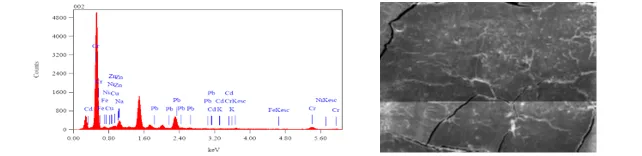
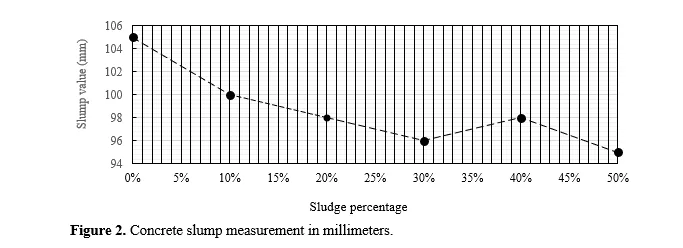
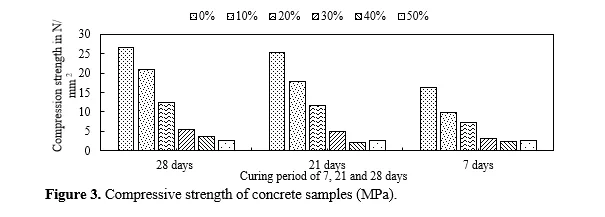
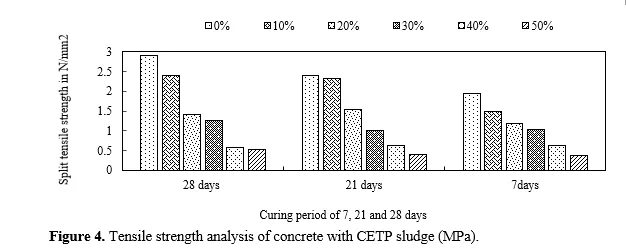
This study examines the utilization of sludge from common effluent treatment plants (CETP) as a fractional substitute for sand in M20 concrete mixtures. Its aim is to address disposal challenges associated with CETP sludge while promoting sustainable use of natural resources. The research assesses the structural and microstructural attributes of concrete mixes containing varying percentages of CETP sludge (0%, 10%, 20%, 30%, 40%, and 50%). Tests conducted include compressive, flexural, and split tensile strength, alongside durability assessments like dry and wet durability, sulphate resistance, and chloride penetration. Energy dispersive x-ray analysis (EDAX) identifies significant elements in CETP sludge, such as chromium, zinc, nickel, copper, iron, sodium, lead, cadmium, and potassium, influencing properties from improved corrosion resistance to potential structural reinforcement. Findings indicate that replacing 10% of sand with CETP sludge optimizes compressive strength, achieving an average of 21.01 N/mm² after 28 days, compared to 26.58 N/mm² for conventional concrete. Tensile strength at 10% replacement measures 2.40 N/mm², slightly lower than the control’s 2.90 N/mm², and flexural strength is 1.61 N/mm² after 28 days, compared to 2.11 N/mm² for the control mix. The slump test confirms good workability, with a slump value of 100 mm for the mix containing 10% CETP sludge replacement. This study validates the technical feasibility and economic viability of incorporating CETP sludge into concrete, potentially reducing fine aggregate costs by 10%. To further enhance the performance and safety of CETP sludge concrete, future research could explore the integration of geopolymer encapsulation techniques. Such encapsulation could effectively immobilize heavy metals, mitigating potential environmental and health risks associated with CETP sludge. This aligns with the journal’s focus on advanced materials and sustainable practices, offering a pathway for innovative, eco-friendly building materials and supporting sustainable development goals through improved waste management and resource conservation.
Keywords: CETP sludge, concrete strength, durability, EDAX, sustainable construction, waste management.
[This article belongs to Special Issue under section in Journal of Polymer & Composites (jopc)]




References
- Moradiya, K. K., Srisangari, C., Jadhav, S. V., & Marathe, K. V. (2024). Life cycle assessment of a common effluent treatment plant: Case study of Mahad, India. Waste Management Bulletin, 2(1), 67–74. https://doi.org/10.1016/j.wmb.2023.12.006
- Lakshmi, N. J., Gogate, P. R., & Pandit, A. B. (2023). Acoustic cavitation for the process intensification of biological oxidation of CETP effluent containing mainly pharmaceutical compounds: Understanding the effect of parameters and toxicity analysis. Ultrasonics Sonochemistry, 98, 106524. https://doi.org/10.1016/j.ultsonch.2023.106524
- Meenakshi, B. S., Indhiradevi, P., Jenifer Princy, A., & Sudhakaran, C. (2023). X-ray diffraction study on microbial calcite precipitation in concrete with Bacillus subtilis and Bacillus halodurans. Materials Today: Proceedings. https://doi.org/10.1016/j.matpr.2023.04.683
- Jena, S., Chakraborty, S., & Patra, N. (2023). Sustainable utilization of industrial sludge in concrete: A review of recent advances and environmental impacts. Journal of Environmental Management, 343, 118170. https://doi.org/10.1016/j.jenvman.2023.118170
- Zhan, Y., Yang, Z., & Xu, Y. (2023). Evaluation of the mechanical properties and durability of concrete incorporating recycled fine aggregate and industrial sludge. Journal of Building Materials, 34, 181–190. https://doi.org/10.1016/j.jbm.2023.181
- Choudhary, A., & Choudhary, K. (2023). Sustainable utilization of municipal solid waste and industrial sludge in concrete production: A review. Waste Management, 133, 152–163. https://doi.org/10.1016/j.wasman.2023.05.008
- Sharma, M., & Kumar, D. (2023). Characterization and evaluation of waste foundry sand in concrete for sustainable construction practices. Construction and Building Materials, 365, 130014. https://doi.org/10.1016/j.conbuildmat.2023.130014
- Bangaru, S. S., Wang, C., Zhou, X., & Hassan, M. (2022). Scanning electron microscopy (SEM) image segmentation for microstructure analysis of concrete using U-net convolutional neural network. Automation in Construction, 144, 104602. https://doi.org/10.1016/j.autcon.2022.104602
- Patel, H., Shah, M., & Bhatt, M. (2022). Microstructural analysis of concrete incorporating waste materials from textile industries. Journal of Building Engineering, 52, 104340. https://doi.org/10.1016/j.jobe.2022.104340
- Kumari, M., & Sharma, S. (2022). Feasibility study of using paper mill sludge as a partial replacement for cement in concrete. Journal of Cleaner Production, 356, 131771. https://doi.org/10.1016/j.jclepro.2022.131771
- Singh, P., Dhoke, A. D., & Choudhary, A. (2022). A review on advancements in concrete incorporating industrial waste for enhanced durability and eco-efficiency. Resources, Conservation and Recycling, 180, 106204. https://doi.org/10.1016/j.resconrec.2022.106204
- Kumar, P., & Singh, A. (2022). Performance assessment of concrete containing textile industry sludge as partial replacement for fine aggregate. Materials Science for Energy Technologies, 5, 639–646. https://doi.org/10.1016/j.mset.2022.04.003
- Kumari, M., & Sharma, S. (2022). Feasibility study of using paper mill sludge as a partial replacement for cement in concrete. Journal of Cleaner Production, 356, 131771. https://doi.org/10.1016/j.jclepro.2022.131771
- Sahu, R., & Tiwari, S. (2021). Review of the utilization of waste materials in cement and concrete. Resources, Conservation and Recycling, 164, 105092. https://doi.org/10.1016/j.resconrec.2020.105092
- Mohan, P., Kumar, V., & Gupta, R. (2021). Sustainable construction materials: Utilization of industrial sludge in concrete production. Journal of Cleaner Production, 328, 129536. https://doi.org/10.1016/j.jclepro.2021.129536
- Nagamani, K., & Lakshmi, R. (2021). Utilization of sludge from electroplating industries in cement composites: Impact on mechanical and durability characteristics. Journal of Cleaner Production, 324, 129323. https://doi.org/10.1016/j.jclepro.2021.129323
- Gupta, R., & Kumar, S. (2021). Assessing the performance of concrete using foundry sand and textile sludge as partial replacements for fine aggregate. Materials Today: Proceedings, 47, 1091–1096. https://doi.org/10.1016/j.matpr.2021.03.383
- Ghumra, D. P., Agarkoti, C., & Gogate, P. R. (2021). Improvements in effluent treatment technologies in common effluent treatment plants (CETPs): Review and recent advances. Process Safety and Environmental Protection, 147, 1018–1051. https://doi.org/10.1016/j.psep.2021.01.021
- Kaish, A. B. M., et al. (2021). Effects of different industrial waste materials as partial replacement of fine aggregate on strength and microstructure properties of concrete. Journal of Building Engineering, 35. https://doi.org/10.1016/j.jobe.2021.102049
- Ruviaro, A. S., Silvestro, L., Piccinini Scolaro, T., de Matos, P. R., & Pelisser, F. (2021). Use of calcined water treatment plant sludge for sustainable cementitious composites production. Journal of Cleaner Production, 327, 129484. https://doi.org/10.1016/j.jclepro.2021.129484
- Loganayagan, et al. (2020). Experimental study on concrete by partial replacement of fine aggregate by textile effluent treatment plant sludge. IOP Conference Series: Materials Science and Engineering, 764. https://doi.org/10.1088/1757-899X/764/1/012040 Narayan, R., & Sinha, M. (2020). The impact of industrial sludge on the mechanical properties of concrete: A review. Journal of Building Engineering, 32, 101335. https://doi.org/10.1016/j.jobe.2020.101335
- Shukla, P., & Sharma, V. (2020). Eco-friendly concrete with industrial by-products: Review on properties and durability. Construction and Building Materials, 253, 119140. https://doi.org/10.1016/j.conbuildmat.2020.119140
- Bhattacharya, P., & Rao, C. R. (2020). Influence of calcined sludge on the physic mechanical properties of eco-friendly concrete. Construction and Building Materials, 238, 117693. https://doi.org/10.1016/j.conbuildmat.2020.11769 Ghosh, S., & Ghosh, S. K. (2019). Wastewater treatment sludge in cementitious materials: A critical review on properties and applications. Construction and Building Materials, 223, 938–946. https://doi.org/10.1016/j.conbuildmat.2019.07.073
- Padalkar, A. V., & Kumar, R. (2018). Common effluent treatment plant (CETP): Reliability analysis and performance evaluation. Water Science and Engineering, 11(3), 205–213. https://doi.org/10.1016/j.wse.2018.10.002 Zhang, J., Li, Z., & Wang, H. (2018). Experimental study on the influence of waste sludge on the properties of concrete. Journal of Cleaner Production, 181, 477–487. https://doi.org/10.1016/j.jclepro.2018.01.098
- Bahoria, B. V., Parbat, D. K., & Nagar Naik, P. B. (2018). XRD analysis of natural sand, quarry dust, waste plastic (LDPE) to be used as a fine aggregate in concrete. Materials Today: Proceedings, 5(1), 1432–1438. https://doi.org/10.1016/j.matpr.2017.11.230
- Ahmad, T., Ahmad, K., & Alam, M. (2016). Sustainable management of water treatment sludge through 3‘R’ concept. Journal of Cleaner Production, 124, 1–13. https://doi.org/10.1016/j.jclepro.2016.02.073
- Zhan, B., et al. (2015). Study on feasibility of reutilizing textile effluent sludge for producing concrete blocks. Journal of Cleaner Production, 101, 174–179. https://doi.org/10.1016/j.jclepro.2015.03.082
28. Mathur, N., Bhatnagar, P., Mohan, K., Bakre, P., Nagar, P., & Bijarnia, M. (2007). Mutagenicity evaluation of industrial sludge from common effluent treatment plant. Chemosphere, 67(6), 1229–1235. https://doi.org/10.1016/j.chemosphere.2006.10.073

Journal of Polymer & Composites
| Volume | 13 | |
| Special Issue | 01 | |
| Received | 26/07/2024 | |
| Accepted | 05/11/2024 | |
| Published | 11/11/2024 | |
| Publication Time | Days |