
Open Access
Madhura Mahajan,
A. Arulmozhi,
- Research Scholar, Department of Printing Technology, School of Engineering, Avinashilingam Institute for Home Science and Higher Education for Women, Coimbatore, Tamil Nadu, India
- Associate Professor, Department of Printing Technology, School of Engineering, Avinashilingam Institute for Home Science and Higher Education for Women, Coimbatore, Tamil Nadu, India
Abstract
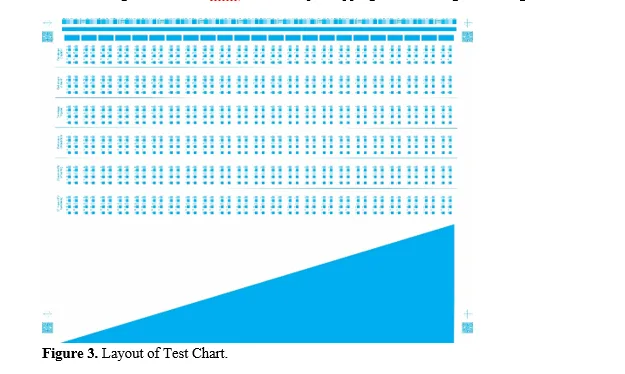
The pigment is the most expensive part of printing inks. The process of making ink involves physical processes that require even distribution of pigments in the surrounding vehicle. This process is known as “Dispersion”. The quality of the final dispersion decides print parameters like dot gain, density, print contrast, and gloss. In this work, the aim was to study how the ink behaves on the printing press based on the ink particle size during printing trials. It is well known that pigment particle size controls ink optical properties like print density, specular gloss, and color characteristics. In our project, we prepared four process cyan inks with two varying levels of pigment particle size obtained by varying the number of milling passes/milling time, i.e., single pass and double pass. The agglomerate particle sizes used were 0.5 microns and 3.5 microns. Rheological analysis including parameters such as viscosity, hysteresis loop area, and index of thixotropy was conducted using a Physica MCR 301 rheometer to understand the interaction between the pigment and the vehicle, and the flow behavior. Press trials were conducted to evaluate the behavior of the prepared inks on Solid Bleached Sulphate and Folding Box Board paperboards. The results showed that ink pigment particles with small sizes showed better printability results. Particle Size Analyzer equipment works on the principle of light scattering and was used to measure the pigment particle size distribution of the developed inks. The maximum density obtained by the test chart with the wedge shape represents the target color density that the developed ink and thus achieves printability.
Keywords: Pigment, particle size, ink rheology, printability, paperboard
[This article belongs to Special Issue under section in Journal of Polymer & Composites (jopc)]
References
- Parfitt GD. Dispersion of powders in liquids, with special reference to pigments. London, Applied Science Publishers; 1973.
- Nobuoka S. The Relation between Particle Size and Shape of the Pigments and Optical Properties. Color Mater. 1982;55(10):758-65.
- NOGUCHI N. Printing Ink/Offset Ink 2. Pigment Dispersion of Printing Ink. Journal of Printing Science and Technology. 2000;37(6):315-23.
- Bermel AD, Bugner DE. Particle Size Effects in Pigmented Inkjet Inks. Journal of imaging science and technology. 1999;43(4):320-4.
- Ferguson LD. Introduction to printing technology and ink chemistry. TAPPI DEINKING Seminar notes. Atlanta: TAPPI Press; 1996; p.19-28.
- Seyed Saeid Hosseini, Arjomand Mehrabani-Zeinabad, Ali Zadhoush. The effect of carrier molecular weight and pigment particle concentration on the rheological properties of suspension systems in polymeric medium. In: An Introduction to Emulsions and Suspensions from Different Perspective [Internet]. Nordic Rheology Society; 2007. Available from: https://nordicrheologysociety.org/AnnualTransactions/ShowAllTransactions?selectedYear=2007
- Hellinckx L, Mewis J. Rheological behaviour of pigment dispersions as related to roller passage. Rheologica Acta. 1969; 8:519-25.
- Micale FJ, Sharma MK, editors. Surface phenomena and fine particles in water-based coatings and printing technology [Internet]. New York, NY: Springer; 2012. Available from: http://dx.doi.org/10.1007/978-1-4615-3812-7
- Bastani S, Pishvaei MA, Jalili MO, Sorooshnia S. The Effect of Pigment Concentration and Particle Size Distribution on the Rheological Behavior of Lithography Inks. Journal of Color Science and Technology. 2010 Jun 22;4(2):91-103.
- Frimova A, Pekarovicova A, Fleming PD, Pekarovic J. Ink stability during printing. TAGA J. 2005 Dec;2:122-31.

Journal of Polymer & Composites
| Volume | 12 | |
| Special Issue | 05 | |
| Received | 04/03/2024 | |
| Accepted | 23/05/2024 | |
| Published | 05/08/2024 | |
| Publication Time | Days |