
Open Access
Pranjali Pokharkar,
Namrata Gaonkar,
Shashikiran N.D.,
Sachin Gugawad,
Swapnil Taur,
Savita Hadakar,
- PG Student, Dept. of Paedodontics, School of Dental Sciences, Krishna Vishwa Vidyapeeth Deemed to be University, Karad, Maharashtra, India
- Associate Professor, Dept. of Paedodontics, School of Dental Sciences, Krishna Vishwa Vidyapeeth Deemed to be University, Karad, Maharshtra, India
- Dean, Dept. of Paedodontics, School of Dental Sciences, Krishna Vishwa Vidyapeeth Deemed to be University, Karad, Maharshtra, India
- Associate Professor, Dept. of Paedodontics, School of Dental Sciences, Krishna Vishwa Vidyapeeth Deemed to be University, Karad, Maharshtra, India
- Assistant Professor, Dept. of Paedodontics, School of Dental Sciences, Krishna Vishwa Vidyapeeth Deemed to be University, Karad, Maharshtra, India
- Assistant Professor, Dept. of Paedodontics, School of Dental Sciences, Krishna Vishwa Vidyapeeth Deemed to be University, Karad, Maharshtra, India
Abstract
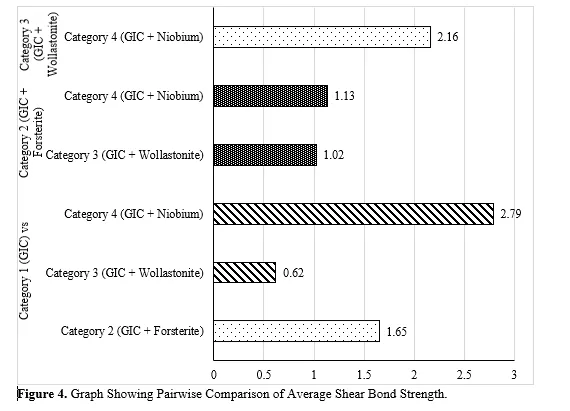
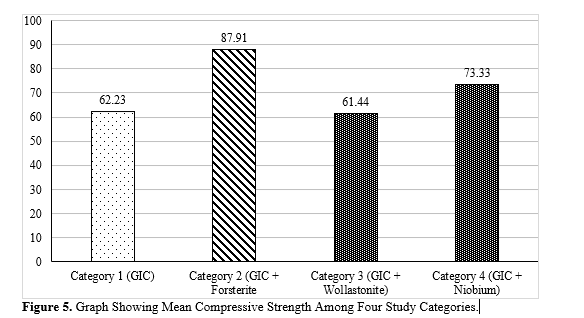
Dental caries remains a prevalent oral health concern worldwide, prompting ongoing research into innovative approaches for caries prevention and management. This experimental investigation endeavors to conduct a comparative assessment of the bioactivity, fluoride release kinetics, shear bond strength, and compressive strength of glass ionomer cement (GIC) augmented with three distinct types of inorganic bioactive nanoparticles. Bioactive nanoparticles have garnered interest in dental materials for their potential to enhance material properties and promote remineralization. Three types of inorganic bioactive nanoparticles were incorporated into GIC formulations, and their effects on bioactivity, fluoride release kinetics, shear bond strength to enamel, and compressive strength were investigated using standardized laboratory tests. Results revealed significant variations in bioactivity, fluoride release profiles, shear bond strength, and compressive strength among the GIC formulations containing different bioactive nanoparticles. This study underscores the potential of NTAPP and ErCr:YSGG laser activation in enhancing the remineralization efficacy of fluoride varnishes, thereby contributing to the development of more effective caries prevention strategies. By elucidating the qualitative and quantitative effects of these activation techniques on surface remineralization and fluoride release, this research offers valuable insights into their application in clinical practice. Further investigations, including in vitro and in vivo studies, are warranted to validate these findings and explore the long-term efficacy and safety of activated fluoride varnishes in preventing dental caries. Understanding the effects of bioactive nanoparticles on GIC properties can inform the development of novel dental materials with improved clinical performance and therapeutic benefits.
Keywords: Glass ionomer cement, inorganic bioactive nanoparticles, bioactivity, fluoride release, shear bond strength, compressive strength, dental materials.
[This article belongs to Special Issue under section in Journal of Polymer & Composites (jopc)]
References
- Huang WT, Shahid S, Anderson P. Validation of a real-time ISE methodology to quantify the influence of inhibitors of demineralization kinetics in vitro using a hydroxyapatite model system. Caries Research. 2018 Nov 9;52(6):598-603.
- Chen S, Cai Y, Engqvist H, Xia W. Enhanced bioactivity of glass ionomer cement by incorporating calcium silicates. Biomatter. 2016 Jan 1;6(1):e1123842.
- Sreenivasalu PK, Dora CP, Swami R, Jasthi VC, Shiroorkar PN, Nagaraja S, Asdaq SM, Anwer MK. Nanomaterials in dentistry: current applications and future scope. Nanomaterials. 2022 May 14;12(10):1676.
- Sayyedan FS, Fathi M, Edris H, Doostmohammadi A, Mortazavi V, Shirani F. Fluoride release and bioactivity evaluation of glass ionomer: Forsterite nanocomposite. Dental research journal. 2013 Jul;10(4):452.
- Leitune VC, Collares FM, Takimi A, de Lima GB, Petzhold CL, Bergmann CP, Samuel SM. Niobium pentoxide as a novel filler for dental adhesive resin. Journal of dentistry. 2013 Feb 1;41(2):106-13.
- Garcia IM, Leitune VC, Balbinot GD, Samuel SM, Collares FM. Influence of niobium pentoxide addition on the properties of glass ionomer cements. Acta Biomaterialia Odontologica Scandinavica. 2016 Dec 19;2(1):138-43.
- Spagnuolo G. Bioactive dental materials: the current status. Materials. 2022 Mar 9;15(6):2016.
- Bapat RA, Joshi CP, Bapat P, Chaubal TV, Pandurangappa R, Jnanendrappa N, Gorain B, Khurana S, Kesharwani P. The use of nanoparticles as biomaterials in dentistry. Drug discovery today. 2019 Jan 1;24(1):85-98.
- Bapat RA, Joshi CP, Bapat P, Chaubal TV, Pandurangappa R, Jnanendrappa N, Gorain B, Khurana S, Kesharwani P. The use of nanoparticles as biomaterials in dentistry. Drug discovery today. 2019 Jan 1;24(1):85-98.
- Kremer EA, Chen Y, Suzuki K, Nagase H, Gorski JP. Hydroxyapatite induces autolytic degradation and inactivation of matrix metalloproteinase‐1 and‐3. Journal of Bone and Mineral Research. 1998 Dec 1;13(12):1890-902.
- Kremer EA, Chen Y, Suzuki K, Nagase H, Gorski JP. Hydroxyapatite induces autolytic degradation and inactivation of matrix metalloproteinase‐1 and‐3. Journal of Bone and Mineral Research. 1998 Dec 1;13(12):1890-902.
- Sharafeddin F, Alavi AA, Siabani S, Safari M. Comparison of shear bond strength of three types of glass ionomer cements containing hydroxyapatite nanoparticles to deep and superficial dentin. Journal of dentistry. 2020 Jun;21(2):132.
- Kim DA, Abo-Mosallam HA, Lee HY, Kim GR, Kim HW, Lee HH. Development of a novel aluminum-free glass ionomer cement based on magnesium/strontium-silicate glasses. Materials Science and Engineering: C. 2014 Sep 1;42:665-71.
- Prentice LH, Tyas MJ, Burrow MF. The effect of ytterbium fluoride and barium sulphate nanoparticles on the reactivity and strength of a glass-ionomer cement. Dental Materials. 2006 Aug 1;22(8):746-51.

Journal of Polymer & Composites
| Volume | 12 | |
| Special Issue | 05 | |
| Received | 02/04/2024 | |
| Accepted | 14/07/2024 | |
| Published | 31/07/2024 | |
| Publication Time | 120 Days |