
Rohit P. Sarode,
Shilpa M. Vinchurkar,
Gagan Malik,
- Research Scholar, Department of Mechanical Engineering, G. H. Raisoni University, Amravati, Maharashtra, India
- Assistant Professor, Department of Mechanical Engineering, G. H. Raisoni College of Engineering, Nagpur, Maharashtra, India
- Research Scholar, Department of Mechanical Engineering, G. H. Raisoni University, Amravati, Maharashtra, India
Abstract
In industrial production processes, waste heat is an important consequence, especially in sectors that
rely significantly on composites and polymers. Frequently, this heat is released into the atmosphere
without being captured, which raises operating expenses in addition to wasting potential energy. In
these sectors, waste heat recovery, or WHR, has become a key tactic for raising sustainability and
energy efficiency. The WHR potential of multistage air compressors—essential parts of industrial
manufacturing setups—is examined in this study. Businesses can cut their energy use and carbon
footprint by recovering waste heat. The efficiency of two popular heat exchanger technologies—plate
heat exchangers and shell-and-tube heat exchangers—in recovering heat from multistage air
compressors is assessed in this paper. Important variables including temperature differentials, specific
heat capacities, and mass flow rates form the basis of the analysis. The total recoverable heat in the
system is determined by these variables, which are crucial. The multistage air compressor systems
exhibited an outstanding 4883.65 kJ/min of recoverable energy, indicating a large potential for heat
recovery, according to our findings. Comparing the two types of heat exchangers, it can be shown that
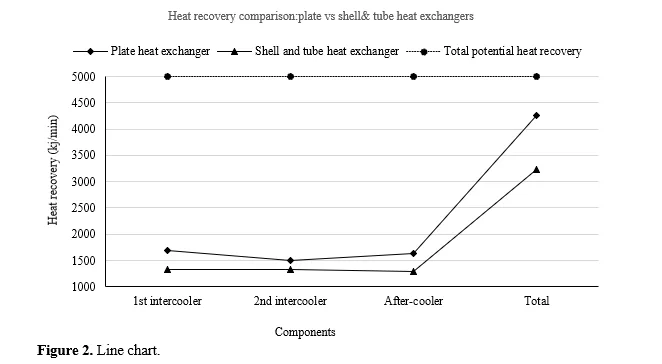
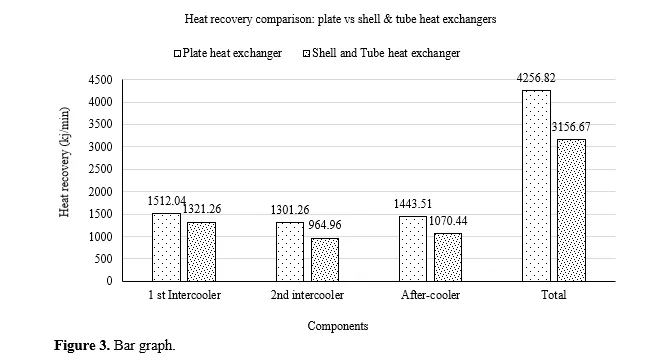
plate heat exchangers recover 4256.82 kJ/min at a substantially higher efficiency than shell-and-tube
heat exchangers, which recover 3156.67 kJ/min. These findings highlight how crucial it is to choose
the right WHR technology in order to optimize energy recovery. The study emphasizes how important
it is to use cutting-edge WHR technologies to improve industrial sustainability. Industries may
significantly cut energy consumption, greenhouse gas emissions, and operating expenses by recycling
waste heat in an efficient manner. This will help to create a more sustainable and energy-efficient
future.
Keywords: Waste heat recovery, multistage air compressors, polymer manufacturing, composite manufacturing, heat exchanger.
[This article belongs to Journal of Polymer & Composites ]


References
- Saidur R, Rahim NA, Hasanuzzaman M. A review on compressed-air energy use and energy savings. Renew Sust Energ Rev. 2010; 14(4):1135-53.
- U.S. Department of Energy. Waste heat recovery: Technology and opportunities in U.S. industry. 2020.
- Sarode RP, Vinchurkar SM. An approach to recovering heat from the compressed air system based on waste heat recovery: A review. Energy Sources Part A Recovery Util Environ Eff. 2023;45(3):9465-84.
- Sarode RP, Vinchurkar SM, Malik G. Towards sustainable energy practices: Experimental assessment of waste heat recovery from multistage air compressor operations. J Electr Syst. 2024;20(7s):2735-9.
- Thabet M, Sanders D, Becerra V, Tewkesbury G, Haddad M, Barker T. Intelligent energy management of compressed air systems. In: 2020 IEEE 10th International Conference on Intelligent Systems (IS); 2020. p. 153–8. doi:10.1109/IS48319.2020.9199977.
- Anderson A, Mageshwaran G, Vulchi RT, Tallapaneni S, Jeevahan J, Mohan S, et al. Energy saving in high-pressure reciprocating air compressor. Int J Ambient Energy. 2018;39(2):188-93. doi:10.1080/01430750.2016.1269684.
- Castellanos LM, Hernandez-Herrera H, Silva-Ortega JI, Diaz VLM, Sanchez ZG. Potential energy savings and CO2 emissions reduction in Colombia compressed air systems. Int J Energy Econ Policy. 2019;9(6):71-8. doi:10.32479/ijeep.8084.
- Jouhara H, Khordehgah N, Almahmoud S, Delpech B, Chauhan A, Tassou SA. Waste heat recovery technologies and applications. Therm Sci Eng Prog. 2018;6:268-89. doi:10.1016/j.tsep.2018.04.017.
- dos Santos Mascarenhas J, Chowdhury H, Thirugnanasambandam M, Chowdhury T, Saidur R. Energy, exergy, sustainability, and emission analysis of industrial air compressors. J Clean Prod. 2019; 231:183-95.
- Valenti G, Valenti A, Staboli S. Proposal of a thermally-driven air compressor for waste heat recovery. Energy Convers Manage. 2019;196:1113-25
- Wang J, Liu W, Liu G, Sun W, Li G, Qiu B. Theoretical design and analysis of the waste heat recovery system of turbine exhaust steam using an absorption heat pump for heating supply. Energies. 2020;13(23):6256.
- Taheri K, Gadow R. Industrial compressed air system analysis: Exergy and thermoeconomic analysis. CIRP J Manuf Sci Technol. 2017; 18:10-7.

Journal of Polymer & Composites
| Volume | 13 | |
| Issue | 01 | |
| Received | 12/08/2024 | |
| Accepted | 23/09/2024 | |
| Published | 07/10/2024 | |
| Publication Time | Days |