
Open Access
Aparna J. Nadgowda,
Shashi B Pandey,
Chitra S Khade,
Purushotam K. Naktode,
- Research Scholar, Department of Physics,G. H. Raisoni University, Amravati, Maharashtra, India
- Research Scholar, Department of Physics,G. H. Raisoni University, Amravati, Maharashtra, India
- Research Scholar, Department of Physics , G. H. Raisoni Institute of Engineering and Technology, Nagpur, Maharashtra, India
- Assistant Professor, Department of Physics , G. H. Raisoni Institute of Engineering and Technology, Nagpur,, Maharashtra, India
Abstract
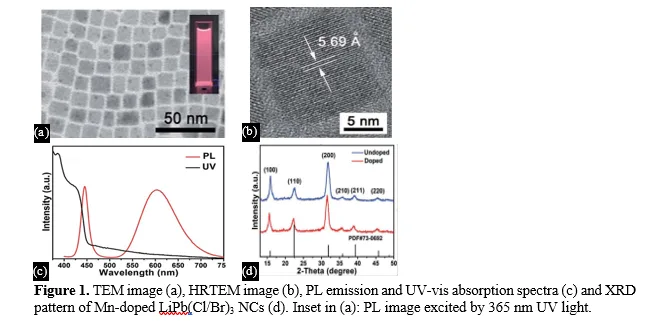
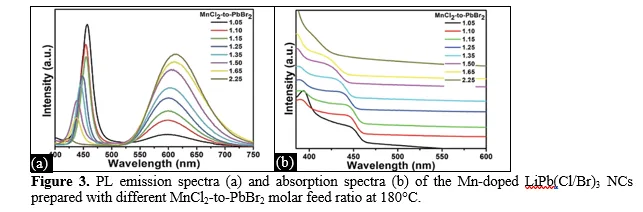
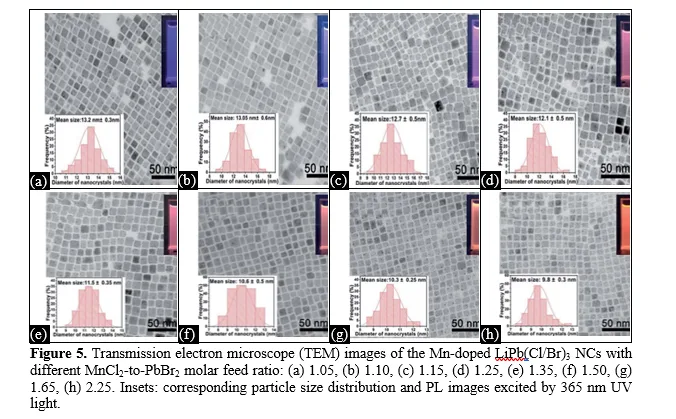
In this paper the structural, electronic and optical properties of Mn doped Pb based cubic perovskites LiPbX3(X= Cl, Br and I) were studied by wet chemical method (sol gel method). For Mn doped LiPbX3(X= Cl, Br and I) NCs, MnCl2 and PbBr2 were added in molar feed ratio 1.35 mole% and nan crystal were examine with the help of TEM and their structure were confirmed by X-ray diffraction (XRD). Additionally, the Mn2+ ions in the LiPb(Cl/Br)3 are responsible for the wide emission at 603 nm, which has been attributed to a transition between the 4T1 and 6A1 energy level of Mn2+ 3d states. This emission characteristic indicates the potential of these Mn-doped perovskites for applications in optoelectronic devices, such as light-emitting diodes (LEDs) and phosphors. This study highlights the importance of dopant incorporation in tuning the electronic and optical properties of perovskite materials, paving the way for further exploration and development in the field of nanomaterials and optoelectronics. This paper investigates the structural, electronic, and optical properties of Mn-doped Pb-based cubic perovskites LiPbX₃ (X= Cl, Br, and I) synthesized using the sol-gel method. TEM and XRD were employed to confirm the nanocrystals’ structure, while the Mn²⁺ ions in LiPb(Cl/Br)₃ were found to emit at 603 nm, due to transitions between the 4T₁ and 6A₁ energy levels of Mn²⁺ 3d states.
Keywords: Perovskites, luminescent properties, lighting application, nanomaterial, optoelectronic applications
[This article belongs to Special Issue under section in Journal of Polymer & Composites (jopc)]




References
- Elangovan NK, Kannadasan R, Beenarani BB, Alsharif MH, Kim MK, Inamul ZH. Recent developments in perovskite materials, fabrication techniques, band gap engineering, and the stability of perovskite solar cells. 2024;11:1171–1190.
- Chilvery A, Palwai S, Guggilla P, Wren K, Edinburgh D. Perovskite Materials: Recent Advancements and Challenges. Submitted: 22 March 2019 Reviewed: 09 July 2019 Published: 05 September 2019.
- Kojima A. Organometal Halide Perovskites as Visible-Light Sensitizers for Photovoltaic Cells. J Am Chem Soc. 2009 May;131(17):6050–1.
- Li J, Duan J, Yang X, Duan Y, Yang P, Tang Q. Review on recent progress of lead-free halide perovskites in optoelectronic applications. 2021;80:105526.
- Miaha MH, Khandaker MU, Rahman MB, Nur-E-Alamd M, Islam MA. Band gap tuning of perovskite solar cells for enhancing the efficiency and stability: issues and prospects. RSC Adv. 2024;14:15876–15906.
- Rehman MA, ur Rehman J, Tahir MB. A DFT study of structural, electronic, optical, mechanical, thermoelectric, and magnetic properties of Pb-halide perovskites LiPbX3 (X = Cl, Br, and I) for photovoltaic applications. 2023;1223:114085.
- Mohammed, Koh SCL, Reaney IM, Acquaye A, Schileo G, Mustapha KB, Greenough R. Perovskite solar cells: An integrated hybrid lifecycle assessment and review in comparison with other photovoltaic technologies. 2017;80:1321–1344.
- Noman M, Khan Z, Jan ST. A comprehensive review on the advancements and challenges in perovskite solar cell technology. RSC Adv. 2024;14:5085–5131.
- Huang YT, Kavanagh SR, Scanlon DO, Walsh A, Hoye RLZ. Perovskite-inspired materials for photovoltaics and beyond—from design to devices. Nanotechnology. 2021;32(13).
- Zhu T, Yang Y, Gong X. Recent Advancements and Challenges for Low-Toxicity Perovskite Materials. ACS Appl Mater Interfaces. 2020;12(24):26776–26811.
- Ikram M, Malik R, Raees R, Imran M, Wang F, Ali S, Khan M, Khan Q, Maqbool M. Recent advancements and future insight of lead-free non-toxic perovskite solar cells for sustainable and clean energy production: A review. 2022;53(Part A):102433.
- Yang D, Cao M, Zhong Q, Li P, Zhang X, Zhang Q. All-inorganic cesium lead halide perovskite nanocrystals: synthesis, surface engineering and applications. J Mater Chem C. 2019;7(4).
- Sun S. Mechanical Properties of Organic-Inorganic Halide Perovskites, CH3NH3PbX3 (X=I, Br and Cl) by Nanoindentation. 2015;3(36):18450–18455.
- Kumar D, Yadav RS, Monika, Singh AK, Rai SB. Synthesis Techniques and Applications of Perovskite Materials. Submitted: 12 March 2019 Reviewed: 13 May 2019 Published: 10 June 2020.
- Atta NF, Galal A, El-Ads EH. Perovskite Nanomaterials – Synthesis, Characterization, and Applications. Submitted: 31 March 2015 Reviewed: 18 August 2015 Published: 03 February 2016.
- Wang P, Dong B, Cui Z, Gao R, Su G, Wang W, et al. Synthesis and characterization of Mn-doped CsPb(Cl/Br)3 perovskite nanocrystals with controllable dual-color emission. RSC Adv. 2018;8(4):1940–1947.

Journal of Polymer & Composites
| Volume | 12 | |
| Special Issue | 06 | |
| Received | 14/05/2024 | |
| Accepted | 19/07/2024 | |
| Published | 08/08/2024 | |
| Publication Time | Days |