
Subham Paul,
- Research Scholar, Department of Economics, University of North Bengal, Darjeeling, West Bengal, India
Abstract
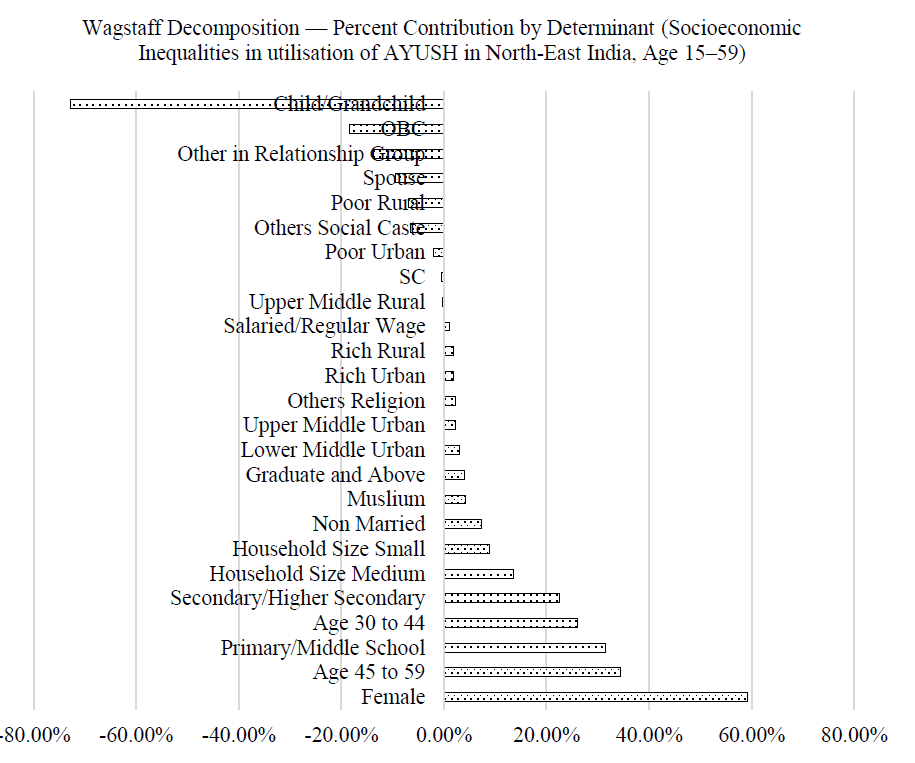
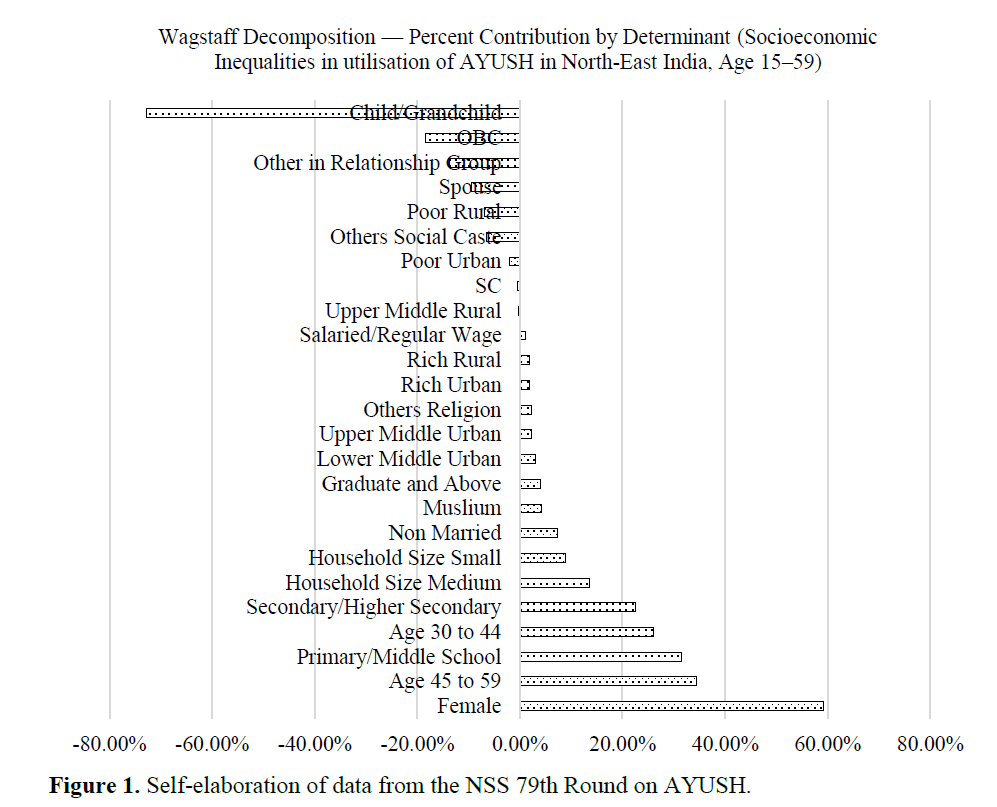
Background: Socioeconomic inequality in healthcare Utilisation continues despite policy focus on universal health coverage and Sustainable Development Goal 3. India’s traditional, complementary, and alternative medicine systems are generally termed as AYUSH. AYUSH has been consolidated into the national health policy; however, empirical findings on its distributive equity persist as limited. This study estimates and decomposes socioeconomic inequality in Utilisation of AYUSH systems of medicine among the adult age group 15 to 59 years in North-East India. Methods: Data were taken from the National Sample Survey (NSS) 79th round on AYUSH. The sample consists of 64,211 individuals aged 15 to 59years in North-East India. Descriptive statistics presented the population profile. The logit regression was applied to estimate the odds of AYUSH Utilisation by socioeconomic variables. The degree and factors of inequality were analyse using the Concentration Index and Wagstaff decomposition (2005). Results: The logit analysis exhibits that AYUSH Utilisation is associated with age, gender, education, and region-specific economic status. Older adults (45–59 years) and females showed higher odds of Utilisation. The Concentration Index (CI) indicated a significant pro-rich inequality (CI = 0.0211) in AYUSH Utilisation. Decomposition analysis exhibited that around 94 per cent of overall inequality was explained by observed factors. The age, gender and education factors contribute a major part to overall inequality. Conclusion: Utilisation of AYUSH healthcare in North-East India remains socially unequal, with preference for affluent classes. To achieve equity, supply-side measures should expand the AYUSH infrastructure in rural and tribal areas, enrich human resources, and start more community-based AYUSH health insurance schemes to reduce out-of-pocket expenditure. Demand-side interventions may include structured awareness programs, cultural initiatives, and incorporating AYUSH education in the school curriculum, etc. Such demand and supply-side drivers are important not only for achieving “Health for All” but also for appreciating AYUSH’s full competence as a public health equaliser.
Keywords: AYUSH, socioeconomic inequalities, concentration index, decomposition analysis, logit regression
[This article belongs to Journal of AYUSH: Ayurveda, Yoga, Unani, Siddha and Homeopathy ]
References
- Targets of Sustainable Development Goal 3 [Internet]. [cited 2025 Oct 24]. Available from: https://www.who.int/europe/about-us/our-work/sustainable-development-goals/targets-of-sustainable-development-goal-3.
- Traditional, Complementary and Integrative Medicine [Internet]. [cited 2025 Oct 24]. Available from: https://www.who.int/health-topics/traditional-complementary-and-integrative-medicine.
- James PB, Wardle J, Steel A, Adams J. Traditional, complementary and alternative medicine use in Sub-Saharan Africa: A systematic review. BMJ Glob Health [Internet]. 2018 Oct [cited 2025 May 14];3(5):e000895. Available from: https://gh.bmj.com/lookup/doi/10.1136/bmjgh-2018-000895.
- Kretchy IA, Owusu-Daaku F, Danquah S. Patterns and determinants of the use of complementary and alternative medicine: A cross-sectional study of hypertensive patients in Ghana. BMC Complement Altern Med [Internet]. 2014 Dec [cited 2025 Oct 24];14(1):44. Available from: https://bmccomplementalternmed.biomedcentral.com/articles/10.1186/1472-6882-14-44.
- Gu H, Kou Y, You H, Xu X, Yang N, Liu J, et al. Measurement and decomposition of income-related inequality in self-rated health among the elderly in China. Int J Equity Health [Internet]. 2019 Dec [cited 2025 Oct 24];18(1):4. Available from: https://equityhealthj.biomedcentral.
com/articles/10.1186/s12939-019-0909-2. - Xu R, Mu T, Liu Y, Ye Y, Xu C. Trends in the disparities and equity of the distribution of traditional Chinese medicine health resources in China from 2010 to 2020. Yang J, editor. PLOS ONE [Internet]. 2022 Oct 10 [cited 2025 Oct 24];17(10):e0275712. Available from: https://dx.plos.org/10.1371/journal.pone.0275712.
- Cai J, Coyte PC, Zhao H. Decomposing the causes of socioeconomic-related health inequality among urban and rural populations in China: A new decomposition approach. Int J Equity Health [Internet]. 2017 Dec [cited 2025 Oct 24];16(1):128. Available from: http://equityhealthj.
com/articles/10.1186/s12939-017-0624-9. - Zhou M. Equity and prediction of health resource allocation of traditional Chinese medicine in China. Zúniga-González CA, editor. PLOS ONE [Internet]. 2023 Aug 24 [cited 2025 Oct 24];18(8):e0290440. Available from: https://dx.plos.org/10.1371/journal.pone.0290440.
- Dai G, Li R, Ma S. Research on the equity of health resource allocation in TCM hospitals in China based on the Gini coefficient and agglomeration degree: 2009–2018. Int J Equity Health [Internet]. 2022 Oct 6 [cited 2025 Oct 24];21(1):145. Available from: https://equityhealthj. com/articles/10.1186/s12939-022-01749-7.
- Ostermaier A, Barth N, Linde K. How German general practitioners justify their provision of complementary and alternative medicine – a qualitative study. BMC Complement Med Ther [Internet]. 2020 Dec [cited 2025 Oct 24];20(1):111. Available from: https://
biomedcentral.com/articles/10.1186/s12906-020-02907-6. - WHO traditional medicine strategy: 2014–2023 [Internet]. [cited 2025 Nov 4]. Available from: https://www.who.int/publications/i/item/9789241506096.
- WHO, draft-traditional-medicine-strategy-2025–2034.
- Rudra S, Kalra A, Kumar A, Joe W. Utilisation of alternative systems of medicine as health care services in India: Evidence on AYUSH care from NSS 2014. Virgili G, editor. PLOS ONE [Internet]. 2017 May 4 [cited 2025 Oct 24];12(5):e0176916. Available from: https://dx.plos.org
/10.1371/journal.pone.0176916. - Rana MdJ, Kumar M, Rahaman M, Rahman MHU. Awareness, preference, and utilisation of Ayush in India: Evidence from National Sample Survey, 2022–23. Adv Integr Med [Internet]. 2025 June [cited 2025 Oct 24];12(2):100476. Available from: https://linkinghub.elsevier.com/
retrieve/pii/S2212958825000357. - India – AYUSH of NSS 79th round: 2022–23 [Internet]. [cited 2025 Nov 4]. Available from: https://microdata.gov.in/NADA/index.php/catalog/219.
- Xu M, Gao X, Wu H, Ding M, Zhang C, Du S, et al. Measuring and decomposing socioeconomic‐related inequality in the use of oral health services among Chinese adults. Community Dent Oral Epidemiol [Internet]. 2021 Feb [cited 2025 Oct 24];49(1):47–54. Available from: https://onlinelibrary.wiley.com/doi/10.1111/cdoe.12575.
- Soleimanvandiazar N, Mohaqeqi Kamal SH, Basakha M, Karimi SE, Ahmadi S, Ghaedamini Harouni G, et al. Decomposition of Healthcare Utilisation Inequality in Iran: The Prominent Role of Health Literacy and Neighborhood Characteristics. Inq J Health Care Organ Provis Financ [Internet]. 2024 Jan [cited 2025 Oct 24];61:00469580241229622. Available from: https://journals.sagepub.com/doi/10.1177/00469580241229622.
- Ray J, Chakrabarty D, Paul R, Som K. Prevalence of the use of complementary and alternative medicine in an eastern Indian population with emphasis on tribal/ethnic minority groups. J Taibah Univ Med Sci [Internet]. 2018 Aug [cited 2025 Oct 24];13(4):384–9. Available from: https://linkinghub.elsevier.com/retrieve/pii/S1658361218300350.
- Das M, Angeli F, Krumeich AJSM, Van Schayck OCP. The gendered experience with respect to health-seeking behaviour in an urban slum of Kolkata, India. Int J Equity Health [Internet]. 2018 Dec [cited 2025 Oct 24];17(1):24. Available from: https://equityhealthj.biomedcentral.
com/articles/10.1186/s12939-018-0738-8. - Svendsen MT, Bak CK, Sørensen K, Pelikan J, Riddersholm SJ, Skals RK, et al. Associations of health literacy with socioeconomic position, health risk behavior, and health status: A large national population-based survey among Danish adults. BMC Public Health [Internet]. 2020 Dec [cited 2025 Oct 24];20(1):565. Available from: https://bmcpublichealth.biomedcentral.com/articles/
1186/s12889-020-08498-8. - Bayati T, Dehghan A, Bonyadi F, Bazrafkan L. Investigating the effect of education on health literacy and its relation to health-promoting behaviors in health center. J Educ Health Promot [Internet]. 2018 [cited 2025 Oct 24];7(1):127. Available from: https://journals.lww.com/10.4103/
jehp_65_18. - Chatterjee P, Chen J, Yousafzai A, Kawachi I, Subramanian SV. When social identities intersect: Understanding inequities in growth outcomes by religion-caste and religion-tribe as intersecting strata of social hierarchy for Muslim and Hindu children in India. Int J Equity Health [Internet]. 2023 June 14 [cited 2025 Oct 24];22(1):115. Available from: https://equityhealthj.biomedcentral.
com/articles/10.1186/s12939-023-01917-3. - Thapa R, Van Teijlingen E, Regmi PR, Heaslip V. Caste Exclusion and Health Discrimination in South Asia: A Systematic Review. Asia Pac J Public Health [Internet]. 2021 Nov [cited 2025 Oct 24];33(8):828–38. Available from: https://journals.sagepub.com/doi/10.1177/10105395211014648.
- Banerjee S, Roy Chowdhury I. Inequities in curative healthcare utilisation among the adult population (20–59 years) in India: A comparative analysis of NSS 71st (2014) and 75th (2017–18) rounds. Khan HTA, editor. PLOS ONE [Internet]. 2020 Nov 25 [cited 2025 Oct 24];15(11):e0241994. Available from: https://dx.plos.org/10.1371/journal.pone.0241994.
- Van Malderen C, Ogali I, Khasakhala A, Muchiri SN, Sparks C, Van Oyen H, et al. Decomposing Kenyan socioeconomic inequalities in skilled birth attendance and measles immunisation. Int J Equity Health [Internet]. 2013 [cited 2025 Oct 24];12(1):3. Available from: http://equityhealthj.
com/articles/10.1186/1475-9276-12-3. - Aizawa T. Inequality in health opportunities in Indonesia: Long-term influence of early-life circumstances on health. BMC Public Health [Internet]. 2022 July 12 [cited 2025 Oct 24];22(1):1334. Available from: https://bmcpublichealth.biomedcentral.com/articles/10.1186
/s12889-022-13714-8. - Jaffré Y, Suh S. Where the lay and the technical meet: Using an anthropology of interfaces to explain persistent reproductive health disparities in West Africa. Soc Sci Med [Internet]. 2016 May [cited 2025 Oct 24];156:175–83. Available from: https://linkinghub.elsevier.com/retrieve/
pii/S0277953616301368. - Wagstaff A. The bounds of the concentration index when the variable of interest is binary, with an application to immunisation inequality. Health Econ [Internet]. 2005 Apr [cited 2025 Oct 25];14(4):429–32. Available from: https://onlinelibrary.wiley.com/doi/10.1002/hec.953.
- Van Doorslaer E, Wagstaff A, Bleichrodt H, Calonge S, Gerdtham UG, Gerfin M, et al. Income-related inequalities in health: Some international comparisons. J Health Econ [Internet]. 1997 Feb [cited 2025 Oct 24];16(1):93–112. Available from: https://linkinghub.elsevier.com/retrieve/
pii/S0167629696005322. - Wagsta A, van Doorslaer E, Watanabe N. On decomposingthe causes of health sector inequalities with an application to malnutrition inequalities in Vietnam.
- O’Donnell O, Van Doorslaer E, Wagstaff A, Lindelow M. Analyzing Health Equity Using Household Survey Data: A Guide to Techniques and their Implementation [Internet]. The World Bank; 2007 [cited 2025 Oct 24]. Available from: https://documents.worldbank.org/en/
publication/documents-reports/documentdetail/633931468139502235/analyzing-health-equity-using-household-survey-data-a-guide-to-techniques-and-their-implementation. - Xin B, Mu S, Tan T, Yeung A, Gu D, Feng Q. Belief in and use of traditional Chinese medicine in Shanghai older adults: A cross-sectional study. BMC Complement Med Ther [Internet]. 2020 Dec [cited 2025 Oct 24];20(1):128. Available from: https://bmccomplementalternmed.
com/articles/10.1186/s12906-020-02910-x. - Gyasi R, Buor D, Adu-Gyamfi S, Adjei POW, Amoah PA. Socio-cultural hegemony, gendered identity, and use of traditional and complementary medicine in Ghana. Women Health [Internet]. 2018 May 28 [cited 2025 Oct 24];58(5):598–615. Available from: https://www.tandfonline.
com/doi/full/10.1080/03630242.2017.1321608. - Ampomah IG, Malau-Aduli BS, Seidu AA, Malau-Aduli AEO, Emeto TI. The practice of integrated healthcare and the experiences of people in Ghana’s Ashanti region. BMC Health Serv Res [Internet]. 2022 Jan 5 [cited 2025 Oct 24];22(1):32. Available from: https://bmchealthservres.biomedcentral.com/articles/10.1186/s12913-021-07340-0.
- Suharmiati, Laksono, Nantabah, Kristiana. Traditional health services utilisation in rural Indonesia: does socioeconomic status matter? Rural Remote Health [Internet]. 2023 July 25 [cited 2025 Oct 24]; Available from: https://www.rrh.org.au/journal/article/7701.
- Joseph Nnaemeka Chukwuma Et Al., JNCEAl, TJPRC. An Ethical Analysis of the Disparities in Health Outcomes Among Nigeria’s Ethnic Group. Int J Mech Prod Eng Res Dev [Internet]. 2020 [cited 2025 Oct 24];10(3):7493–500. Available from: http://tjprc.org/publishpapers/2-67-1597220656-709IJMPERDJUN2020709.pdf.
- Yang M, Erreygers G. Income-Related Inequality in Health Care Utilisation and Out-of-Pocket Payments in China: Evidence from a Longitudinal Household Survey from 2000 to 2015. Economies [Internet]. 2022 Dec 13 [cited 2025 Apr 27];10(12):321. Available from: https://www.mdpi.com/2227-7099/10/12/321.
- Goli S, Singh L, Jain K, Pou LMA. Socioeconomic Determinants of Health Inequalities Among the Older Population in India: A Decomposition Analysis. J Cross-Cult Gerontol [Internet]. 2014 Dec [cited 2025 Oct 24];29(4):353–69. Available from: http://link.springer.com/10.1007/s10823-014-9251-8.
- Barik D, Thorat A. Issues of Unequal Access to Public Health in India. Front Public Health [Internet]. 2015 Oct 27 [cited 2025 Oct 24];3. Available from: http://journal.frontiersin.org/
Article/10.3389/fpubh.2015.00245/abstract. - Ezeome ER, Anarado AN. Use of complementary and alternative medicine by cancer patients at the University of Nigeria Teaching Hospital, Enugu, Nigeria. BMC Complement Altern Med [Internet]. 2007 Dec [cited 2025 Oct 24];7(1):28. Available from: https://
biomedcentral.com/articles/10.1186/1472-6882-7-28. - Adisa O. Investigating determinants of catastrophic health spending among poorly insured elderly households in urban Nigeria. Int J Equity Health [Internet]. 2015 Dec [cited 2025 Oct 24];14(1):79. Available from: http://www.equityhealthj.com/content/14/1/79.
- Lu L, Zeng J. Inequalities in the geographic distribution of hospital beds and doctors in traditional Chinese medicine from 2004 to 2014. Int J Equity Health [Internet]. 2018 Dec [cited 2025 Oct 24];17(1):165. Available from: https://equityhealthj.biomedcentral.com/articles/10.1186/s12939-018-0882-1.
- Oreagba IA, Oshikoya KA, Amachree M. Herbal medicine use among urban residents in Lagos, Nigeria. BMC Complement Altern Med [Internet]. 2011 Dec [cited 2025 Oct 24];11(1):117. Available from: https://bmccomplementalternmed.biomedcentral.com/articles/10.1186/1472-6882-11-117.
- Jeitler M, Ortiz M, Brinkhaus B, Sigl M, Hoffmann R, Trübner M, et al. Use and acceptance of traditional, complementary and integrative medicine in Germany—an online representative cross-sectional study. Front Med [Internet]. 2024 Mar 13 [cited 2025 Oct 24];11:1372924. Available from: https://www.frontiersin.org/articles/10.3389/fmed.2024.1372924/full.
- Kemppainen LM, Kemppainen TT, Reippainen JA, Salmenniemi ST, Vuolanto PH. Use of complementary and alternative medicine in Europe: Health-related and sociodemographic determinants. Scand J Public Health [Internet]. 2018 June [cited 2025 Oct 24];46(4):448–55. Available from: https://journals.sagepub.com/doi/10.1177/1403494817733869.
- Joos S, Musselmann B, Miksch A, Rosemann T, Szecsenyi J. The role of complementary and alternative medicine (CAM) in Germany – A focus group study of GPs. BMC Health Serv Res [Internet]. 2008 Dec [cited 2025 Aug 3];8(1):127. Available from: https://bmchealthservres.
com/articles/10.1186/1472-6963-8-127.
Journal of AYUSH: Ayurveda, Yoga, Unani, Siddha and Homeopathy
| Volume | 15 | |
| Issue | 01 | |
| Received | 08/11/2025 | |
| Accepted | 10/01/2026 | |
| Published | 12/01/2026 | |
| Publication Time | 65 Days |