
Patel Harshilkumar Mukeshkumar,
Parwez Ahmad Ansari,
Ankit Kumar Gupta,
Desai Ravina Chandu Bhai,
- Post Graduate Scholar, Department of Rasa Shastra and Bhaishajya Kalpana, Government P.G. Ayurvedic College and Hospital, Varanasi, Uttar Pradesh, India
- Lecturer, Department of Rasa Shastra and Bhaishajya Kalpana, Shri Lal Bahadur Shastri Ayurvedic College and Hospital, Handia, Allahabad, Uttar Pradesh, India
- Reader, Department of Rasa Shastra and Bhaishajya Kalpana, Government P.G. Ayurvedic College and Hospital, Varanasi, Uttar Pradesh, India
- Post Graduate Scholar, Department of Roga Nidan and Vikriti Vigyan, Government Ayurveda Medical College, Bangalore, Karnataka, India
Abstract
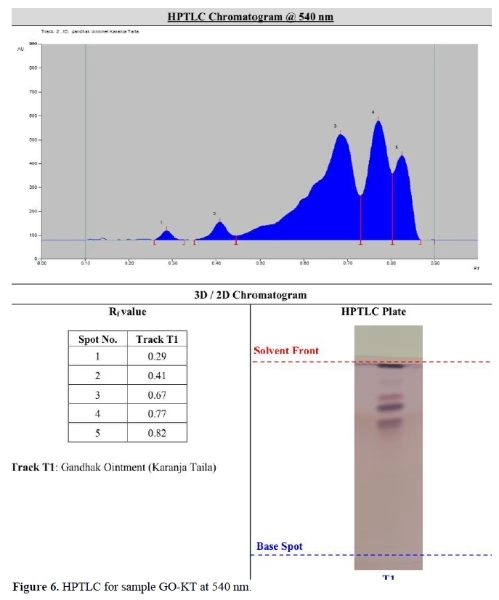
Gandhaka (purified sulphur) is broadly used in Ayurvedic dermatological preparations, particularly in Malahara Kalpana (ointment formulations), due to its well-known antimicrobial and skin-healing properties. Although classical Ayurvedic texts, such as Rasa Shastra and Bhaishajya Kalpana, do not directly mention Gandhaka ointment, Rasatarangini by Acharya Sadanand Sharma describes four discrete methods for preparing Gandhaka Taila (sulphur-infused oil). In this study, the third method was selected to prepare Gandhaka Taila using two different base oils: Tila Taila (sesame oil) and Karanja Taila (Pongamia oil). After the initial preparation, both types of Gandhaka Taila were converted into ointments—GO-TT (Gandhaka Ointment with Tila Taila) and GO-KT (with Karanja Taila)—by including beeswax in a ratio of one-fourth of the total volume. These formulations were then subjected to comprehensive analysis, including organoleptic evaluation, physicochemical testing, microbiological safety assessment, and HPTLC profiling. The results revealed that GO-KT had a significantly higher sulphur content (57.27%) and lower moisture loss on drying (0.09%), suggesting enhanced formulation stability. On the other hand, GO-TT demonstrated superior spreadability and showed more HPTLC spots, indicating better application characteristics and a possibly richer profile of active constituents. Both ointments maintained a pH suitable for topical application and were found to be microbiologically safe for external use. Based on these findings, GO-KT may be more effective in conditions requiring higher sulphur content and long-term stability, while GO-TT may be preferred for its better spreadability and ease of use. Therefore, both formulations can be considered effective for managing skin conditions, such as Dadru Kushtha, each offering specific advantages based on clinical requirements.
Keywords: Gandhaka, gandhaka taila, malahara kalpana, tila taila, karanja taila, ayurvedic ointment
[This article belongs to Journal of AYUSH: Ayurveda, Yoga, Unani, Siddha and Homeopathy ]


References
- Shastri K. Ras Tarangini. 8th ed. Varanasi: Motilal Banarasidas; 2014.
- Mishra S. Rasendrachudamani of Acharya Somadeva (Sidhhiprada Hindi commentary). Varanasi: Chaukhambha Orientalia; 1970. p. 11/5.
- Kulkarni DAA. Rasa Ratna Samuchhaya (Vighayan Bodhini Hindi commentary). New Delhi: Mehar Chandradas Publications; 1957. p. 3/88.
- Tripathi I. Rajanighantu (Dravyagunaprakashika). Varanasi: Krishnadas Academy; 1942. p. S.V/69.
- Sharma P, Sharma G. Kaiyadevanighantu (Pathyapathy avibodhaka). Varanasi: Chaukhambha Orientalia; 1979. p. D.V./33–34.
- Tripathi I. Rasendrasarasangraha (Rasavidhyotini Hindi commentary). Varanasi: Chaukhambha Orientalia; 1934. p. 1/130.
- Pandey G. Bhavaprakasha Nighantu. In: Chunekara K, editor. Varanasi: Chaukhambha Bharti Academy; 1916. p. D.V./111.
- Sharma G. Ayurveda Prakasha (Arthavidyotini & Arthaprakasini Sanskrit & Hindi commentaries). Varanasi: Chaukhambha Bharti Academy; 1959. p. 2/15–16.
- Sharma HS. Rasendra Mangala of Nagarjuna. Varanasi: Chaukhambha Orientalia; 1899. p. 3/161.
- Kulkarni DAA. Rasa Ratna Samuchhaya (Vighayan Bodhini Hindi commentary). New Delhi: Mehar Chandradas Publications; 1946. p. 3/26.
- Shastri AD, Sen GD. Bhaishajya Ratnavali. Varanasi: Chaukhambha Prakashana; 1943. p.38/10.
- Sharma S. Rasa Tarangini. Delhi, Mumbai, Varanasi, Pune, Patna: Motilal Banarasidas; 1882. p. 8/41–58.
Journal of AYUSH: Ayurveda, Yoga, Unani, Siddha and Homeopathy
| Volume | 14 | |
| Issue | 03 | |
| Received | 10/07/2025 | |
| Accepted | 18/08/2025 | |
| Published | 19/08/2025 | |
| Publication Time | 40 Days |