
Ninoshka Francis,
- Research Intern, Department of Bioinformatics, BioNome, Bengaluru, Karnataka, India
Abstract
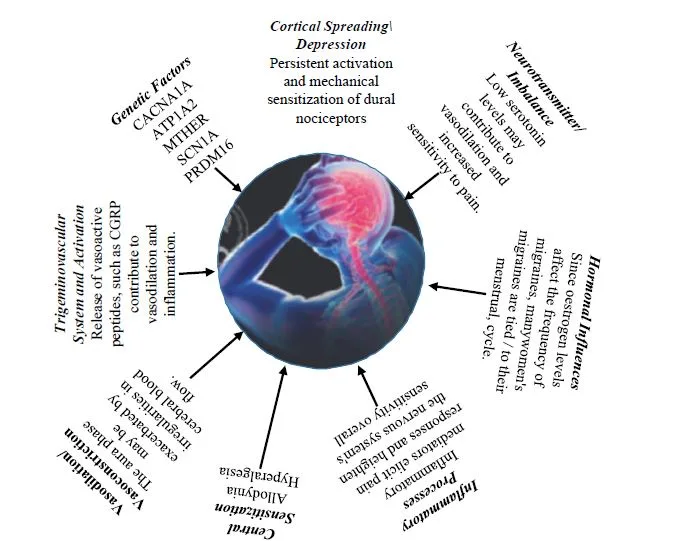
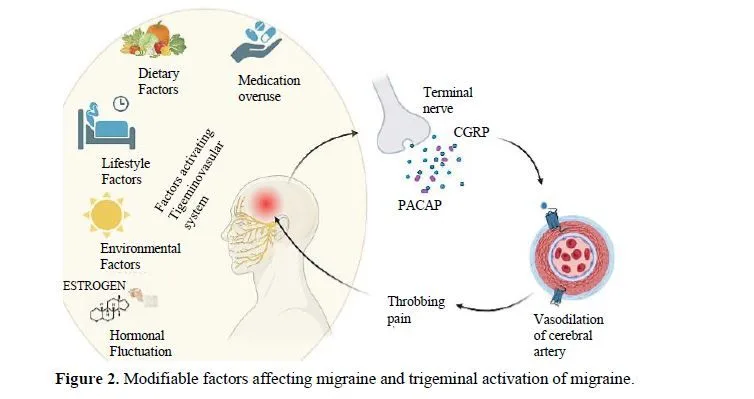
Migraine, a prevalent and disabling neurological condition, manifests in distinct phases: premonitory, aura, headache, postdrome, and interictal. Being a primary contributor to adult disability, it presents a substantial economic challenge on a global scale. Even with extensive research spanning centuries, the complete grasp of its root causes continues to evade us. This intricate neurovascular disorder primarily involves local vasodilation of intracranial and extracerebral blood vessels, coupled with simultaneous stimulation of the trigeminal sensory pain pathway, resulting in headaches. Activation of the ‘trigeminovascular system’ prompts the release of various vasodilators, notably calcitonin gene-related peptide (CGRP), triggering a pain response. Emerging anti-migraine medications target CGRP signaling by either stimulating 5-HT1F receptors on trigeminovascular nerves (inhibiting CGRP release) or directly blocking CGRP or its receptor. Enhanced delineation of pathophysiological processes holds promise for identifying novel therapeutic targets in migraine prevention. This review thoroughly investigates the physiological processes involved in migraines, highlighting the stimulation of the trigeminovascular system and cortical spreading depression (CSD). Furthermore, it explores the impact of the gut-brain axis on the development of migraines. Inflammation within the trigeminovascular system is believed to contribute to the physiological processes of migraines and might be influenced by inflammation and immune modulation in the gastrointestinal (GI) tract, as suggested by recent studies. Similarly, there is compelling evidence suggesting that the gut microbiota plays a significant role in the bidirectional communication between the brain and the gut, and disruptions in this interaction could be associated with neurological conditions like migraines. A significant source of energy for colonic epithelial cells is the short-chain fatty acids (SCFA); acetate, propionate, and butyrate, which are created in the colon by bacterial fermentation of dietary fiber. Researchers utilized the NTG mouse model to explore the correlation between gut microbiota and migraine. Bridging the knowledge gap between our understanding of migraine pathophysiology and the development of enhanced treatments and strategies for patient management is a critical objective in migraine research.
Keywords: Migraine, neurological condition, trigeminovascular system, CGRP, cortical spreading depression
[This article belongs to International Journal of Molecular Biotechnological Research ]

References
- Amiri P, Kazeminasab S, Nejadghaderi SA, Mohammadinasab R, Pourfathi H, Araj-Khodaei M, et al. Migraine: A review on its history, global epidemiology, risk factors, and comorbidities. Front Neurol. 2021;12:800605. DOI: 10.3389/fneur.2021.800605, PubMed: 35281991.
- Wang Y, Wang Y, Yue G, Zhao Y. Energy metabolism disturbance in migraine: From a mitochondrial point of view. Front Physiol. 2023;14:1133528. DOI: 10.3389/fphys.2023.1133528, PubMed: 37123270.
- Aurora SK, Shrewsbury SB, Ray S, Hindiyeh N, Nguyen L. A link between gastrointestinal disorders and migraine: Insights into the gut–brain connection. Headache. 2021;61(4):576–89. DOI: 10.1111/head.14099, PubMed: 33793965.
- Holland PR, Saengjaroentham C, Vila-Pueyo M. The role of the brainstem in migraine: Potential brainstem effects of CGRP and CGRP receptor activation in animal models. Cephalalgia. 2019;39:390–402. DOI: 10.1177/0333102418756863, PubMed: 29411638.
- Mungoven TJ, Henderson LA, Meylakh N. Chronic migraine pathophysiology and treatment: A review of current perspectives. Front Pain Res. 2021;2:705276. DOI: 10.3389/fpain.2021.705276, PubMed: 35295486.
- Fila M, Chojnacki C, Chojnacki J, Blasiak J. Nutrients to improve mitochondrial function to reduce brain energy deficit and oxidative stress in migraine. Nutrients. 2021;13:4433. DOI: 10.3390/nu13124433, PubMed: 34959985.
- Pietrobon D, Moskowitz MA. Pathophysiology of migraine. Annu Rev Physiol. 2013;75:365–91. DOI: 10.1146/annurev-physiol-030212-183717, PubMed: 23190076.
- Russo AF. Calcitonin gene-related peptide (CGRP): A new target for migraine. Annu Rev Pharmacol Toxicol. 2015;55:533–52. DOI: 10.1146/annurev-pharmtox-010814-124701, PubMed: 25340934.
- Witten A, Marotta D, Cohen-Gadol A. Developmental innervation of cranial dura mater and migraine headache: A narrative literature review. Headache. 2021;61(4):569–75. DOI: 10.1111/head.14102, PubMed: 33749824.
- Defaye M, Gervason S, Altier C, Berthon JY, Ardid D, Filaire E, et al. Microbiota: A novel regulator of pain. J Neural Transm (Vienna). 2020;127:445–65. DOI: 10.1007/s00702-019-02083-z, PubMed: 31552496.
- Anderson G. Integrating pathophysiology in migraine: Role of the gut microbiome and melatonin. Curr Pharm Des. 2019;25:3550–62. DOI: 10.2174/1381612825666190920114611, PubMed: 31538885.
- Puledda F, Silva EM, Suwanlaong K, Goadsby PJ. Migraine: From pathophysiology to treatment. J Neurol. 2023;270(7):3654–66. DOI: 10.1007/s00415-023-11706-1, PubMed: 37029836.
- Spekker E, Tanaka M, Szabó Á, Vécsei L. Neurogenic inflammation: The participant in migraine and recent advancements in translational research. Biomedicines. 2021;10:76. DOI: 10.3390/biomedicines10010076, PubMed: 35052756.
- Guo R, Chen LH, Xing C, Liu T. Pain regulation by gut microbiota: Molecular mechanisms and therapeutic potential. Br J Anaesth. 2019;123(5):637–54. DOI: 10.1016/j.bja.2019.07.026, PubMed: 31551115.
- Arzani M, Jahromi SR, Ghorbani Z, Vahabizad F, Martelletti P, Ghaemi A, et al. Gut-brain axis and migraine headache: A comprehensive review. J Headache Pain. 2020;21(1):15. DOI: 10.1186/s10194-020-1078-9, PubMed: 32054443.
- Arzani M, Jahromi SR, Ghorbani Z, Vahabizad F, Martelletti P, Ghaemi A, et al. Gut-brain axis and migraine headache: A comprehensive review. J Headache Pain. 2020;21(1):15. DOI: 10.1186/s10194-020-1078-9, PubMed: 32054443.
- Fila M, Chojnacki J, Pawlowska E, Szczepanska J, Chojnacki C, Blasiak J. Kynurenine pathway of tryptophan metabolism in migraine and functional gastrointestinal disorders. Int J Mol Sci. 2021;22:10134. DOI: 10.3390/ijms221810134, PubMed: 34576297.
- LenglarT LT, Caula C, Moulding T, Lyles A, Wohrer D, Titomanlio L. Brain to Belly: Abdominal variants of migraine and functional abdominal pain disorders associated with migraine. J Neurogastroenterol Motil. 2021;27:482–94. DOI: 10.5056/jnm20290, PubMed: 34642268.
- Simonetta I, Riolo R, Todaro F, Tuttolomondo A. New insights on metabolic and genetic basis of migraine: Novel impact on management and therapeutical approach. Int J Mol Sci. 2022;23:3018. DOI: 10.3390/ijms23063018, PubMed: 35328439.
- Dodick DW. A phase-by-phase review of migraine pathophysiology. Headache. 2018;58(Suppl 1):4–16. DOI: 10.1111/head.13300, PubMed: 29697154.
- Puledda F, Silva EM, Suwanlaong K, Goadsby PJ. Migraine: From pathophysiology to treatment. J Neurol. 2023;270(7):3654–66. DOI: 10.1007/s00415-023-11706-1, PubMed: 37029836.
- Spekker E, Laborc KF, Bohár Z, Nagy-Grócz G, Fejes-Szabó A, Szűcs M, et al. Effect of dural inflammatory soup application on activation and sensitization markers in the caudal trigeminal nucleus of the rat and the modulatory effects of sumatriptan and kynurenic acid. J Headache Pain. 2021;22:17. DOI: 10.1186/s10194-021-01229-3, PubMed: 33789568.
- Dodick DW. A phase-by-phase review of migraine pathophysiology. Headache. 2018;58(Suppl 1):4–16. DOI: 10.1111/head.13300, PubMed: 29697154.
- Messlinger K, Fischer MJM, Lennerz JK. Neuropeptide effects in the trigeminal system: Pathophysiology and clinical relevance in migraine. Keio J Med. 2011;60:82–9. DOI: 10.2302/kjm.60.82.
- Yamanaka G, Suzuki S, Morishita N, Takeshita M, Kanou K, Takamatsu T, et al. Role of neuroinflammation and blood–brain barrier permutability on migraine. Int J Mol Sci. 2021;22:8929. DOI: 10.3390/ijms22168929.
- Stanak M, Wolf S, Jagoš H, Zebenholzer K. The impact of external trigeminal nerve stimulator (e-TNS) on prevention and acute treatment of episodic and chronic migraine: A systematic review. J Neurol Sci. 2020;412:116725. DOI: 10.1016/j.jns.2020.116725, PubMed: 32087428.
- Labastida-Ramírez A, Rubio-Beltrán E, Haanes KA, Chan KY, Garrelds IM, Johnson KW, et al. Lasmiditan inhibits calcitonin gene-related peptide release in the rodent trigeminovascular system. Pain. 2020;161:1092–9. DOI: 10.1097/j.pain.0000000000001801, PubMed: 31977930.
- de Vries T, Villalón CM, MaassenVanDenBrink A. Pharmacological treatment of migraine: CGRP and 5-HT beyond the triptans. Pharmacol Ther. 2020;211:107528. DOI: 10.1016/j.pharmthera.2020.107528, PubMed: 32173558.
- Iyengar S, Johnson KW, Ossipov MH, Aurora SK. CGRP and the trigeminal system in migraine. Headache. 2019;59:659–81. DOI: 10.1111/head.13529.
- Fila M, Chojnacki J, Sobczuk P, Chojnacki C, Blasiak J. Nutrition and calcitonin gene related peptide (CGRP) in migraine. Nutrients. 2023;15. DOI: 10.3390/nu15020289.
- Durham PL, Masterson CG. Two mechanisms involved in trigeminal CGRP release: Implications for migraine treatment. Headache. 2013;53:67–80. DOI: 10.1111/j.1526-4610.2012.02262.x.
- Vécsei L, Tuka B, Tajti J. Role of PACAP in migraine headaches. Brain. 2014;137(3):650–1. DOI: 10.1093/brain/awu014, PubMed: 24549810.
- Guo S, Jansen-Olesen I, Olesen J, Christensen SL. Role of PACAP in migraine: An alternative to CGRP? Neurobiol Dis. 2023;176:105946. DOI: 10.1016/j.nbd.2022.105946, PubMed: 36481434.
- Waschek JA, Baca SM, Akerman S. PACAP and migraine headache: Immunomodulation of neural circuits in autonomic ganglia and brain parenchyma. J Headache Pain. 2018;19(1):23. DOI: 10.1186/s10194-018-0850-6, PubMed: 29536279.
- Schytz HW, Olesen J, Ashina M. The PACAP receptor: A novel target for migraine treatment. Neurotherapeutics. 2010;7:191–6. DOI: 10.1016/j.nurt.2010.02.003, PubMed: 20430318.
- Tanaka M, Szabó Á, Körtési T, Szok D, Tajti J, Vécsei L. From CGRP to PACAP, VIP, and beyond: Unraveling the next chapters in migraine treatment. Cells. 2023;12:2649. DOI: 10.3390/cells12222649, PubMed: 37998384.
- Pellesi L, Al-Karagholi MAM, De Icco R, Coskun H, Elbahi FA, Lopez-Lopez C, et al. Effect of vasoactive intestinal polypeptide on development of migraine headaches: A randomized clinical trial. JAMA Netw Open. 2021;4. DOI: 10.1001/jamanetworkopen.2021.18543, PubMed: 34357396.
- Silvestro M, Iannone LF, Orologio I, Tessitore A, Tedeschi G, Geppetti P, et al. Migraine treatment: Towards new pharmacological targets. Int J Mol Sci. 2023;24(15). DOI: 10.3390/ijms241512268, PubMed: 37569648.
- Costa C, Tozzi A, Rainero I, Cupini LM, Calabresi P, Ayata C, et al. Cortical spreading depression as a target for anti-migraine agents. J Headache Pain. 2013;14:62. DOI: 10.1186/1129-2377-14-62, PubMed: 23879550.
- Westfall S, Lomis N, Kahouli I, Dia SY, Singh SP, Prakash S. Microbiome, probiotics and neurodegenerative diseases: Deciphering the gut brain axis. Cell Mol Life Sci. 2017;74(20):3769–87. DOI: 10.1007/s00018-017-2550-9, PubMed: 28643167.
- Rajput C, Sarkar A, Sachan N, Rawat N, Singh MP. Is gut dysbiosis an epicenter of Parkinson’s disease? Neurochem Res. 2021;46:425–38. DOI: 10.1007/s11064-020-03187-9.
- Shaw C, Hess M, Weimer BC. Microbial-derived tryptophan metabolites and their role in neurological disease: Anthranilic acid and anthranilic acid derivatives. Microorganisms. 2023;11(7). DOI: 10.3390/microorganisms11071825, PubMed: 37512997.
- Sgro M, Ray J, Foster E, Mychasiuk R. Making migraine easier to stomach: The role of the gut−brain−immune axis in headache disorders. Eur J Neurol. 2023;30(11):3605–21. DOI: 10.1111/ene.15934, PubMed: 37329292.
- Kappéter Á, Sipos D, Varga A, Vigvári S, Halda-Kiss B, Péterfi Z. Migraine as a disease associated with dysbiosis and possible therapy with fecal microbiota transplantation. Microorganisms. 2023;11. DOI: 10.3390/microorganisms11082083.
- Socała K, Doboszewska U, Szopa A, Serefko A, Włodarczyk M, Zielińska A, et al. The role of microbiota-gut-brain axis in neuropsychiatric and neurological disorders. Pharmacol Res. 2021;172:105840. DOI: 10.1016/j.phrs.2021.105840, PubMed: 34450312.
- Nguyen L, Hindiyeh N, Ray S, Vann RE, Aurora SK. The gut-brain connection and episodic migraine: An update. Curr Pain Headache Rep. 2023;27:765–74. DOI: 10.1007/s11916-023-01175-6, PubMed: 37792173.
- Kappéter Á, Sipos D, Varga A, Vigvári S, Halda-Kiss B, Péterfi Z. Migraine as a disease associated with dysbiosis and possible therapy with fecal microbiota transplantation. Microorganisms. 2023;11. DOI: 10.3390/microorganisms11082083.
- Holzer P, Farzi A. Neuropeptides and the Microbiota-Gut-Brain Axis. Adv Exp Med Biol. 2014;817:195–219. DOI: 10.1007/978-1-4939-0897-4_9.
- Staurengo-Ferrari L, Deng L, Chiu IM. Interactions between nociceptor sensory neurons and microbial pathogens in pain. Pain. 2022;163(Suppl 1):S57–68. DOI: 10.1097/j.pain.0000000
000002721, PubMed: 36252233. - Ho TW, Edvinsson L, Goadsby PJ. CGRP and its receptors provide new insights into migraine pathophysiology. Nat Rev Neurol. 2010;6:573–82. DOI: 10.1038/nrneurol.2010.127, PubMed: 20820195.
- Xing Y, Liu Z, Wang LH, Huang F, Wang HJ, Li ZZ. Butyrate sensitizes the release of substance P and calcitonin gene-related peptide evoked by capsaicin from primary cultured rat dorsal root ganglion neurons. Neuro Endocrinol Lett. 2006 Dec;27(6):695-701. PMID: 17187013.
- Grider JR, Piland BE. The peristaltic reflex induced by short-chain fatty acids is mediated by sequential release of 5-HT and neuronal CGRP but not BDNF. Am J Physiol Gastrointest Liver Physiol. 2007;292–37. DOI: 10.1152/ajpgi.00376.2006.
- Van Hemert S, Breedveld AC, Rovers JMP, Vermeiden JPW, Witteman BJM, Smits MG, et al. Migraine associated with gastrointestinal disorders: Review of the literature and clinical implications. Front Neurol. 2014;5(NOV):241. DOI: 10.3389/fneur.2014.00241, PubMed: 25484876.
- Gulrandhe P, Acharya S, Shukla S, Patel M. Neuropsychiatric and neurological diseases in relation to the microbiota-gut-brain axis: From research to clinical care. Cureus. 2023;15. DOI: 10.7759/cureus.44819, PubMed: 37809229.

| Volume | 02 | |
| Issue | 01 | |
| Received | 21/04/2024 | |
| Accepted | 10/05/2024 | |
| Published | 27/05/2024 | |
| Publication Time | 36 Days |