
Evilla Olabiyi Badiru,
Ibrahim Nasiru,
Ernest C. Ajaegbu,
Anita Oketa,
- Assistant Director, Department of Agricultural Biotechnology, National Biotechnology Research and Development Agency, Umaru Musa Yar’Adua way, Abuja, Nigeria
- Director, North Eastbioresources Development Centre, National Biotechnology Research and Development Agency, Umaru Musa Yar’Adua way, Abuja, Nigeria
- Research Scholar, Department of Agricultural Biotechnology, National Biotechnology Research and Development Agency, Umaru Musa Yar’Adua way, Abuja, Nigeria
- Research Scholar, Department of Agricultural Biotechnology, National Biotechnology Research and Development Agency, Umaru Musa Yar’Adua way, Abuja, Nigeria
Abstract
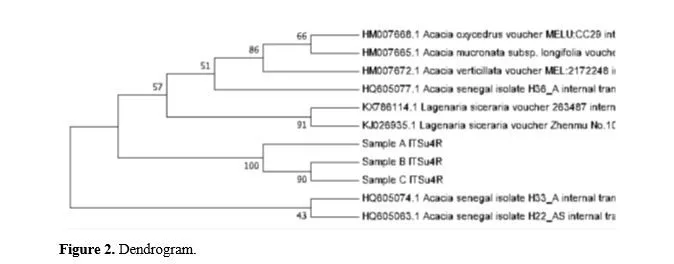
A study was carried out to ascertain the taxonomic identity and phylogenetic lineage of three presumed Acacia senegalensis using molecular markers. Three (3) varieties of seeds presumed to belong to Acacia spp. were collected from the Rubber Research Institute of Nigeria (RRIN) Benin City and three BP haplotypes (A, B, and C) was used as control for the analysis. These seeds were processed at the Applied Biotech International Laboratory Nigeria in January 2018 for molecular identification and analysis. Genomic DNA was carefully extracted from the harvested embryos of the 6 seed samples by standard mechanical crushing in sterile tubes, cell harvest and enzymatic lysis, followed by chemical purification, using Mo Bio Power Soil DNA Isolation kit. The intergenic spacer of partial CPLST gene was amplified using the cplst gene primers at 250bp. The nucleotide sequences generated from the 3 samples were then blasted against the sequences in the gene Bank using the NCBI Blast tool to identify the nucleotide sequences like the Acacia samples and the sequences were analyzed on CLUSTAL W 2.0 multiple sequence alignment. From the blast result for sample A, 5 hits were generated, 3 out of the 5 hits had 46% query cover and 81% identity to the nucleotide sequence of sample A. This gives a clue that sample A could be Acacia senegal. sample B was blasted against the nucleotide sequences in the gene bank; only one isolate had nucleotide sequence like sample B with 18% query cover and 86% identity. This led to the assumption that sample B could be Canjanus cajan isolate. Sample C had a nucleotide sequence like that of Acacia estrophiolata with 63% query cover and 78% identity. The phylogenetic analysis of the sequences from the 3 Samples (A, B, C) showed that sample A appeared to be more closely related to Acacia senegal isolate being that it evolved from the same ancestors. Sample A is identified as Acacia senegal (Also now referred to as Senegalia senegal) with a high confidence and E –value.
Keywords: Nucleotide sequences, phylogenetic analysis, gum Arabic, intergenic spacer of partial CPLST gene.
[This article belongs to International Journal of Genetic Modifications and Recombinations ]

References
1. Orchard A, Maslin B. Proposal to conserve the name Acacia (Leguminosae: Mimosoideae) with a conserved type. Taxon. 2003;52:362–363.
2. Omokhafe KO, Imoren EA, Samuel OG. Climate change, Sahel Savanna, gum arabic and biotechnology. GSC Adv Res Rev. 2019;1(1):1–3.
3. Al-Assaf S, Phillips G, Aoki H, Sasaki Y. Characterization and properties of Acacia senegal (L.) Willd. var. senegal with enhanced properties (Acacia (sen) SUPER GUM™): Part 1—Controlled maturation of Acacia senegal var. senegal to increase viscoelasticity, produce a hydrogel form, and convert a poor into a good emulsifier. Food Hydrocoll. 2007;21(2):319–328.
4. Omokhafe KO, Emuedo OA, Nasiru I. Evaluation of influence of tapping incisions on gum yield of Acacia senegal (L.) Willd. in Nigeria. J Sustain Trop Agric Res. 2007;23:36–39.
5. Fakuta NM, Ojiekpon IF, Gashua IB, Ogunremi OC. Quantitative genetic variation in gum Arabic (Acacia senegal (L) Willd) provenances. Am J Plant Sci. 2015;6:2826–2831.
6. Jamal A, Huntsinger LC. Deterioration of sustainable agro-silvi-pastoral system in the Sudan: The gum gardens of Kordofan. Agrofor Syst. 1993;23:23–38.
7. Macrae J, Merlin G. The prospects and constraints of development of gum Arabic in Sub-Saharan Africa. Washington, DC: World Bank; 2002.
8. Elfadl M, Luukkanen O, Kaarakka V. Environmental conservation and economic development in the Sudan: a case study of gum Arabic. Kehitystutkimus-Utvecklingsforskning: Yearbook of the Finnish Society for Development Studies. 2000;7:117–137.
9. CBI. The European market potential for gums [Online]. Ministry of Foreign Affairs, Netherlands. 2022. Available from: https://www.cbi.eu/market-information/natural-food-additives/gums.
10. TrendEconomy. Gum Arabic imports and exports [Online]. Trade statistics. 2022. Available from: https://trendeconomy.com/data/hscodes?code=130120.
11. CleverPort Global Services Nigeria Limited. (2022). Nigeria is the third-largest exporter of gum Arabic, largely due to the volume produced in its Sahelian zones [Online]. Available from: Explore more from CleverPort Global.
12. Daily Trust. Confirmed Nigeria’s rank as the largest producer of gum arabic in West Africa and third globally. The article outlines the primary Nigerian states involved in production and mentions initiatives for improved plantation practices to meet international demand. Read the article on Daily Trust. 2022.
13. Voice of Nigeria. Reported that Nigeria is the third-largest producer and exporter of gum arabic worldwide, positioned after Sudan and Chad. The article highlights Nigeria’s significant production areas and discusses ongoing challenges impacting optimal production. Read more on Voice of Nigeria. 2022.
14. Yitebitu M. Gum and incense: Recommendations for improved production and income generation. Consultancy Sub-report No. 6FARM Africa/SOS Sahel Tropical Forestry. 2004. Available from: http://www.pfmpfarmsos.org/Docs/gum_incense_borana.pdf.
15. Alkali UU. Silvicultural practices of gum Arabic trees (Acacia senegal): A review. J Environ Issues Agric Dev Ctries. 2010.
16. Giroh DY, Moses J, Umar HY. Analysis of farmers’ awareness on gum Arabic production in selected local government areas of Jigawa State, Nigeria. Niger J Rural Ext Dev. 2007;2(1):21–24.
17. Ballal ME, El Siddig EA, Elfadl MA. Gum Arabic yield in differently managed Acacia senegal stands in western Sudan. Agrofor Syst. 2005;63(1):27–34.
18. Sprent JI, Fagg CW, Allison M. Acacia species: Their contribution to the production of gum Arabic in Africa. In: Environmental Sustainability: Challenges and Solutions for the Future. Cham: Springer; 2010. p.23–45.
19. Lelon J, Kimiti G, Kiptarus P. Assessment of physical properties of gum Arabic from Acacia senegal varieties in Baringo District, Kenya. Afr J Plant Sci. 2010;4(3):95–98.
20. Kesawat MS, Das Kumar B. Molecular markers: Its application in crop improvement. J Crop Sci Biotechnol. 2009;12(4):169–180.
| Volume | 02 | |
| Issue | 02 | |
| Received | 07/11/2024 | |
| Accepted | 29/11/2024 | |
| Published | 24/12/2024 | |
| Publication Time | Days |