
Pankaj Kumar Tripathi,
Chakresh Kumar Jain,
- Research Scholar, Department of Biotechnology, Jaypee Institute of Information Technology, Uttar Pradesh, India
- Assistant Professor, Department of Biotechnology, Jaypee Institute of Information Technology, Uttar Pradesh, India
Abstract
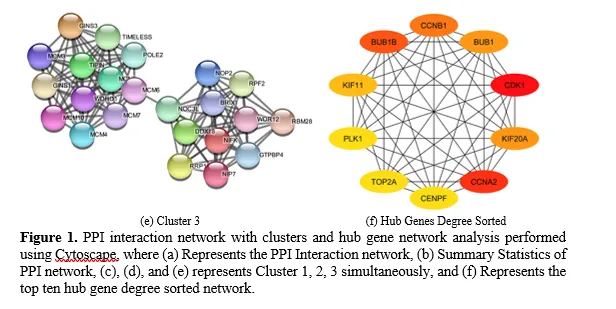
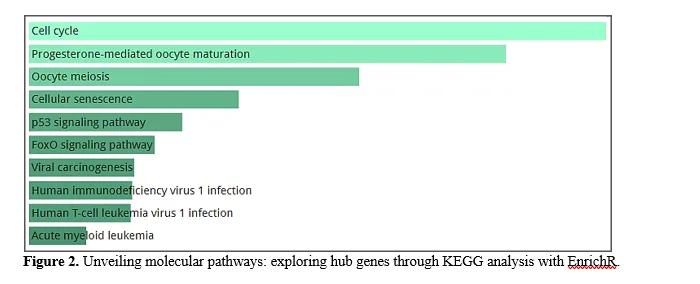
Colorectal cancer (CRC) continues to be a major worldwide health issue, underscoring the need to pinpoint crucial genetic elements influencing its initiation and advancement. In this investigation, we utilize sophisticated computational methods to prioritize potential genes linked to CRC development. Through the utilization of various bioinformatics tools and comprehensive methodologies, we systematically examine extensive microarray datasets to identify potential genetic contributors. Initially, a vast amount of CRC microarray data (approximately more than 175 GSE datasets) was collected for gene expression analysis and applied filters such as unavailability of sample vs control, non-significant genes, untreated, non-published data, etc. After applying filters, we selected 25 datasets for further analysis. From these datasets, we find the common upregulated and downregulated genes and perform the network analysis to prioritize the genes based on their topological analysis, functional relevance, and biological interactions in CRC tissues. By integrating information from various sources, and applying different filters, we aim to identify key molecular players who may serve as biomarkers for CRC treatments. After applying our gene prioritizing method, we filter out the top ten genes (CDK1, CCNA2, BUB1B, CCNB1, KIF20A, BUB1, KIF11, CENPF, TOP2A, PLK1) have been identified, which are crucial for the development and proliferation of tumor cells, either directly or indirectly. Although CENPF gene role in CRC is unclear, this study shows it’s significantly involved in cell division, spindle assembly checkpoint, chromosome segregation, microtubule binding, chromatin binding, and protein binding. Therefore, our finding proposed CENPF as a novel biomarker for CRC progression. This extensive computational gene prioritization study enhances the current comprehension of the molecular landscape of CRC, offering valuable insights for subsequent experimental validation and potential clinical applications.
Keywords: Colorectal Cancer, Microarray data, Bioinformatics, Gene Identification, Pathway analysis, Network analysis.
[This article belongs to International Journal of Bioinformatics and Computational Biology ]
References
1. Jayarathna DK, Rentería ME, Kho PF, Batra J, Gandhi NS. Dehydroepiandrosterone sulfate and colorectal cancer risk: a Mendelian randomization analysis. Twin Res Hum Genet. 2022;25:180–6. DOI: 10.1017/thg.2022.31.
2. Dunn J, Lynch B, Rinaldis M, Pakenham K, McPherson L, Owen N, et al. Dimensions of quality of life and psychosocial variables most salient to colorectal cancer patients. Psychooncology. 2006;15:20–30. DOI: 10.1002/pon.919.
3. Han W, Xing W, Wang K, Wang B, Bai K. Alisol A attenuates malignant phenotypes of colorectal cancer cells by inactivating PI3K/Akt signaling. Oncol Lett. 2022;24:249. DOI: 10.3892/ol.2022.
13369.
4. Woolcott CG, Wilkens LR, Nomura AMY, Horst RL, Goodman MT, Murphy SP, et al. Plasma 25-hydroxyvitamin D levels and the risk of colorectal cancer: the multiethnic cohort study. Cancer Epidemiol Biomarkers Prev. 2010;19:130–4. DOI: 10.1158/1055-9965.EPI-09-0475.
5. Guertin KA, Li XS, Graubard BI, Albanes D, Weinstein SJ, Goedert JJ, et al. Serum trimethylamine N-oxide, carnitine, choline, and betaine in relation to colorectal cancer risk in the alpha tocopherol, beta carotene cancer prevention study. Cancer Epidemiol Biomarkers Prev. 2017;26:945–52. DOI: 10.1158/1055-9965.EPI-16-0948.
6. Zhou JJ, Zheng S. Colorectal cancer: basic and translational research. Gastrointest Tumors. 2014;1:18–24. DOI: 10.1159/000354994.
7. Liang X, Hendryx M, Qi L, Lane D, Luo J. Association between prediagnosis depression and mortality among postmenopausal women with colorectal cancer. PLoS One. 2020;15. DOI: 10.1371/journal.pone.0244728.
8. Corbo C, Cevenini A, Salvatore F. Biomarker discovery by proteomics‐based approaches for early detection and personalized medicine in colorectal cancer. Proteomics Clin Appl. 2017;11. DOI: 10.1002/prca.201600072.
9. Janani B, Vijayakumar M, Priya K, Kim JH, Geddawy A, Shahid M, et al. A network-based pharmacological investigation to identify the mechanistic regulatory pathway of andrographolide against colorectal cancer. Front Pharmacol. 2022;13. DOI: 10.3389/fphar.2022.967262.
10. Qiang R, Zhao Z, Tang L, Wang Q, Wang Y, Huang Q. Identification of 5 hub genes related to the early diagnosis, tumour stage, and poor outcomes of hepatitis B virus-related hepatocellular carcinoma by bioinformatics analysis. Comput Math Methods Med. 2021;2021:1–20. DOI: 10.1155/2021/9991255.
11. Barrett T, Edgar R. Mining microarray data at NCBI’s gene expression omnibus (GEO). In: Bina M, editor. Gene mapping, discovery, and expression. Methods Mol Biol. Vol 338. Humana Press; 2006. p. 175–90. DOI: 10.1385/1-59745-097-9:175.
12. Kolur V, Vastrad B, Vastrad C, Kotturshetti S, Tengli A. Identification of candidate biomarkers and therapeutic agents for heart failure by bioinformatics analysis. BMC Cardiovasc Disord. 2021;21:329. DOI: 10.1186/s12872-021-02146-8.
13. Doncheva NT, Morris JH, Gorodkin J, Jensen LJ. Cytoscape StringApp: network analysis and visualization of proteomics data. J Proteome Res. 2019;18:623–32. DOI: 10.1021/acs.jproteome.
8b00702.
14. Assenov Y, Ramírez F, Schelhorn S-E, Lengauer T, Albrecht M. Computing topological parameters of biological networks. Bioinformatics. 2008;24:282–4. DOI: 10.1093/bioinformatics/btm554.
15. Chin C-H, Chen S-H, Wu H-H, Ho C-W, Ko M-T, Lin C-Y. cytoHubba: identifying hub objects and sub-networks from complex interactome. BMC Syst Biol. 2014;8. DOI: 10.1186/1752-0509-8-S4-S11.
16. Yan X, Liu XP, Guo ZX, Liu TZ, Li S. Identification of hub genes associated with progression and prognosis in patients with bladder cancer. Front Genet. 2019;10. DOI: 10.3389/fgene.2019.00408.
17. Bader GD, Hogue CW. An automated method for finding molecular complexes in large protein interaction networks. BMC Bioinformatics. 2003;4:2. DOI: 10.1186/1471-2105-4-2.
18. Dennis G, Sherman BT, Hosack DA, Yang J, Gao W, Lane HC, et al. DAVID: database for annotation, visualization, and integrated discovery. Genome Biol. 2003;4. DOI: 10.1186/gb-2003-4-9-r60.
19. Kuleshov MV, Jones MR, Rouillard AD, Fernandez NF, Duan Q, Wang Z, et al. Enrichr: a comprehensive gene set enrichment analysis web server 2016 update. Nucleic Acids Res. 2016;44:W90–7. DOI: 10.1093/nar/gkw377.
20. Tang Z, Kang B, Li C, Chen T, Zhang Z. GEPIA2: an enhanced web server for large-scale expression profiling and interactive analysis. Nucleic Acids Res. 2019;47:W556–60. DOI: 10.1093/nar/gkz430.
21. Greene AN, Nguyen ET, Paranjpe A, Lane A, Privette Vinnedge LM, Solomon MB. In silico gene expression and pathway analysis of DEK in the human brain across the lifespan. Eur J Neurosci. 2022;56:4720–43. DOI: 10.1111/ejn.15791.
22. Lind GE, Danielsen SA, Ahlquist T, Merok MA, Andresen K, Skotheim RI, et al. Identification of an epigenetic biomarker panel with high sensitivity and specificity for colorectal cancer and adenomas. Mol Cancer. 2011;10:85. DOI: 10.1186/1476-4598-10-85.
23. Zhang P, Kawakami H, Liu W, Zeng X, Strebhardt K, Tao K, et al. Targeting CDK1 and MEK/ERK overcomes apoptotic resistance in BRAF-mutant human colorectal cancer. Mol Cancer Res. 2018;16:378–89. DOI: 10.1158/1541-7786.MCR-17-0404.
24. Liu P, Kao TP, Huang H. CDK1 promotes cell proliferation and survival via phosphorylation and inhibition of FOXO1 transcription factor. Oncogene. 2008;27:4733–44. DOI: 10.1038/onc.2008.
104.
25. Ding X, Duan H, Luo H. Identification of core gene expression signature and key pathways in colorectal cancer. Front Genet. 2020;11. DOI: 10.3389/fgene.2020.00045.
26. Li Z, Zhang Y, Zhou Y, Wang F, Yin C, Ding L, et al. Tanshinone IIA suppresses the progression of lung adenocarcinoma through regulating CCNA2-CDK2 complex and AURKA/PLK1 pathway. Sci Rep. 2021;11:23681. DOI: 10.1038/s41598-021-03166-2.
27. Burum‐Auensen E, DeAngelis PM, Schjølberg AR, Røislien J, Mjåland O, Clausen OPF. Reduced level of the spindle checkpoint protein BUB1B is associated with aneuploidy in colorectal cancers. Cell Prolif. 2008;41:645–59. DOI: 10.1111/j.1365-2184.2008.00539.x.
28. Zhuang L, Yang Z, Meng Z. Upregulation of BUB1B, CCNB1, CDC7, CDC20, and MCM3 in tumor tissues predicted worse overall survival and disease-free survival in hepatocellular carcinoma patients. Biomed Res Int. 2018;2018:1–8. DOI: 10.1155/2018/7897346.
29. Fang Y, Yu H, Liang X, Xu J, Cai X. Chk1-induced CCNB1 overexpression promotes cell proliferation and tumor growth in human colorectal cancer. Cancer Biol Ther. 2014;15:1268–79. DOI: 10.4161/cbt.29691.
30. Xiong M, Zhuang K, Luo Y, Lai Q, Luo X, Fang Y, et al. KIF20A promotes cellular malignant behavior and enhances resistance to chemotherapy in colorectal cancer through regulation of the JAK/STAT3 signaling pathway. Aging. 2019;11:11905–21. DOI: 10.18632/aging.102505.
31. Zhang W, He W, Shi Y, Gu H, Li M, Liu Z, et al. High expression of KIF20A is associated with poor overall survival and tumor progression in early-stage cervical squamous cell carcinoma. PLoS One. 2016;11. DOI: 10.1371/journal.pone.0167449.
32. Li H, Zhang W, Sun X, Chen J, Li Y, Niu C, et al. Overexpression of kinesin family member 20A is associated with unfavorable clinical outcome and tumor progression in epithelial ovarian cancer. Cancer Manag Res. 2018;Volume 10:3433–50. DOI: 10.2147/CMAR.S169214.
33. Jiang N, Liao Y, Wang M, Wang Y, Wang K, Guo J, et al. BUB1 drives the occurrence and development of bladder cancer by mediating the STAT3 signaling pathway. J Exp Clin Cancer Res. 2021;40:378. DOI: 10.1186/s13046-021-02179-z.
34. Jiang W, Yu Y, Bhandari A, Hirachan S, Dong X, Huang X, et al. Budding uninhibited by benzimidazoles 1 might be a poor prognosis biomarker promoting the progression of papillary thyroid cancer. Environ Toxicol. 2023;38:2047–56. DOI: 10.1002/tox.23812.
35. Zhou J, Chen WR, Yang LC, Wang J, Sun JY, Zhang WW, et al. KIF11 functions as an oncogene and is associated with poor outcomes from breast cancer. Cancer Res Treat. 2019;51:1207–21. DOI: 10.4143/crt.2018.460.
36. Pei Y, Li G, Ran J, Wan X, Wei F, Wang L. Kinesin family member 11 enhances the self-renewal ability of breast cancer cells by participating in the Wnt/β-catenin pathway. J Breast Cancer. 2019;22:522. DOI: 10.4048/jbc.2019.22.e51.
37. Neska-Długosz I, Buchholz K, Durślewicz J, Gagat M, Grzanka D, Tojek K, et al. Prognostic impact and functional annotations of KIF11 and KIF14 expression in patients with colorectal cancer. Int J Mol Sci. 2021;22:9732. DOI: 10.3390/ijms22189732.
38. Brase JC, Schmidt M, Fischbach T, Sültmann H, Bojar H, Koelbl H, et al. ERBB2 and TOP2A in breast cancer: a comprehensive analysis of gene amplification, RNA levels, and protein expression and their influence on prognosis and prediction. Clin Cancer Res. 2010;16:2391–401. DOI: 10.1158/1078-0432.CCR-09-2471.
39. Heestand GM, Schwaederle M, Gatalica Z, Arguello D, Kurzrock R. Topoisomerase expression and amplification in solid tumours: analysis of 24,262 patients. Eur J Cancer. 2017;83:80–7. DOI: 10.1016/j.ejca.2017.06.019.
40. Ding X, Duan H, Luo H. Identification of core gene expression signature and key pathways in colorectal cancer. Front Genet. 2020;11. DOI: 10.3389/fgene.2020.00045.
41. Weng Ng WT, Shin JS, Roberts TL, Wang B, Lee CS. Molecular interactions of polo-like kinase 1 in human cancers. J Clin Pathol. 2016;69:557–62. DOI: 10.1136/jclinpath-2016-203656.
42. Tan J, Li Z, Lee PL, Guan P, Aau MY, Lee ST, et al. PDK1 signaling toward PLK1–MYC activation confers oncogenic transformation, tumor-initiating cell activation, and resistance to mTOR-targeted therapy. Cancer Discov. 2013;3:1156–71. DOI: 10.1158/2159-8290.CD-12-0595.
43. Yu C, Luo D, Yu J, Zhang M, Zheng X, Xu G, et al. Genome-wide CRISPR-Cas9 knockout screening identifies GRB7 as a driver for MEK inhibitor resistance in KRAS mutant colon cancer. Oncogene. 2022;41:191–203. DOI: 10.1038/s41388-021-02077-w.

| Volume | 02 | |
| Issue | 01 | |
| Received | 30/04/2024 | |
| Accepted | 13/05/2024 | |
| Published | 15/06/2024 | |
| Publication Time | Days |