This is an unedited manuscript accepted for publication and provided as an Article in Press for early access at the author’s request. The article will undergo copyediting, typesetting, and galley proof review before final publication. Please be aware that errors may be identified during production that could affect the content. All legal disclaimers of the journal apply.
Sandeep S Sarnobat,
Sandeep M Shiyekar,
Kiran Choudhary,
- Professor, Department of Robotics and Automation, D Y College of Engineering Akurdi, Pune, India; Savitribai Phule Pune University, Pune, Maharashtra, India
- Professor, Department of Civil Engineering, D Y College of Engineering Akurdi, Pune, India; Savitribai Phule Pune University, Pune, Maharashtra, India
- Research Scholar, Department of Robotics and Automation, D Y College of Engineering Akurdi, Pune, India; Savitribai Phule Pune University, Pune, Maharashtra, India
Abstract
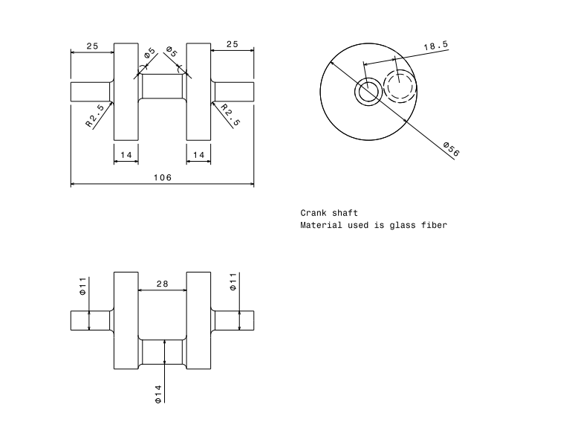
The present paper aims towards the weight reduction of crankshaft by replacing conventional medium carbon steel for a two-wheeler with composite material. The replacement is such that it significantly reduces load on other components without compromising structural integrity. It will also serves in terms of operating reliability or durability over its life span. A geometric specifications and dimensions were obtained using a 3D CAD model developed in CATIA V5. The model was later imported to HyperMesh, where the mesh generation process took place correspondently achieving high quality discretization for finite element analysis. ANSYS APDL was then used to perform static structural and fatigue analyses of the crankshafts made from steel, glass fiber composite, and carbon fibre composite considering realistic service loading conditions.
The comparative analysis shows that the crankshaft made of glass fiber composite has better performance. The performance was compared with the normal steel crankshaft and von Mises stress were decreased by 26.99%, and a better load-carrying capacity is obtained owing to good macroscopic distribution of loads on it. Additionally, 16.66% fatigue life improvement for the glass fiber configuration indicates higher resistance to cyclic loading and longer service-life. Most notably, a substantial weight reduction of 75.88% was achieved, highlighting the potential of glass fiber composites as a high-performance, lightweight alternative for crankshaft applications. There is an improvement in terms of fuel efficiency, inertial forces affecting performance and emissions. These results indicate a great scope for utilizing glass fiber composites material system in future two-wheeler crankshaft applications.
Keywords: crankshaft, composite materials, structural integrity, stress analysis, deformation, fatigue life
References
1. Suganthini Rekha R, Nallusamy S, Vijayakumar R, Saravanan S. Modelling and analysis of crankshaft with metal matrix composites. Int J Appl Eng Res. 2015;10(62):1-5.
2. Pore EB, Kotkar DR. Modeling and analysis of aluminum alloy crankshaft for optimization of weight using FEA. Int J Tech Res Appl. 2016;4(2):156-162.
3. Gopal G, Suresh Kumar L, VijayaBahskar Reddy K, Uma Maheshwara Rao M, Srinivasulu G. Analysis of piston, connecting rod, and crankshaft assembly. Mater Today Proc. 2017;4:7810-7819.
4. Witek L, Sikora M, Stachowicz F, Trzepiecinski T. Stress and failure analysis of the crankshaft of diesel engine. Eng Fail Anal. 2017. doi:10.1016/j.engfailanal.2017.06.001.
5. Witek L, Stachowicz F, Załęski A. Failure investigation of the crankshaft of diesel engine. Struct Integr Procedia. 2016;1:1-7.
6. Jamalkhani Khameneh M, Azadi M. Evaluation of high-cycle bending fatigue and fracture behaviors in EN-GJS700-2 ductile cast iron of crankshafts. Eng Fail Anal. 2018;85:189-200.
7. Zhenpeng H, Wenqin G, Weisong X, Junhong Z, Guichang Z, Hong Z. NVH and reliability analyses of the engine with different interaction models between the crankshaft and bearing. Appl Acoust. 2016;101:185-200.
8. Satishkumar S, Kannan M. Structural, thermal, and thermo-mechanical analysis of four-stroke petrol engine piston using CAE tools. ICICET. 2018:978-93-5291-751-8.
9. Fonte M, Infante V, Freitas M, Reis L. Failure mode analysis of two diesel engine crankshafts. Procedia Struct Integr. 2016;1:313-318.
10. Senthilkumar M, Ragunathan S, Suresh M, Srinivashan VR. A study of crankpin failure in IC engine. Mech Eng Int J. 2014;1(3):1-7.
11. Bagde BJ, Raut LP. Finite element structural and fatigue analysis of single-cylinder engine crankshaft. Int J Eng Res Technol. 2013;2(7):1-6.
12. Thejasree P, Dileep Kumar G, LeelaPrasanna Lakshmi S. Modelling and analysis of crankshaft for passenger car using FEA. Mater Today Proc. 2017;4:11292-11299.
13. Kahate C, Keche A. Failure analysis of crankshaft using finite element approach. Int J Eng Appl Sci. 2016;3(4):1-6.
14. Patil S, Pawar SR. Static analysis of composite crankshaft of single-cylinder petrol engine using ANSYS software. J Emerg Technol Innov Res. 2018;5(6):1-7.
15. Mathapati NC, Dhamejani CL. FEA of a crankshaft in crank-pin web fillet region for improving fatigue life. Int J Innov Eng Res Technol. 2015;2(6):1-5.
16. Devara AK. Finite element analysis of crankshaft. Natl Conf Adv Mech Eng. Manipal; 2011.
17. Kolhe SK, Ghare P, Chaudhari A. Diesel engine crankshaft high-cycle fatigue life estimation and improvement through FEA. Int J Eng Res Technol. 2016;1(1):1-6.
18. Ramani J, Ramani H, Suhagiya S. FE-analysis of crankshaft of IC engine for increasing the breathing capacity. Int J Eng Res Appl. 2013;3(2):1-6.
19. Kakade P, Pasarkar MD. Analyzing and identifying various approaches for crankshaft failures. J Multidiscip Eng Sci Technol. 2015;2(2):1-5.
20. Kumbhar AU, Kumbhar SR, Diwate VS. Design and failure analysis of four-stroke six-cylinder diesel engine crankshaft. Tech Res Organ India. 2016;3(6):1-6.
21. Naik SA. Failure analysis of crankshaft by finite element method: A review. Int J Eng Trends Technol. 2015;19(5):1-5.
22. Marpudi VS, Mehra RS. Fatigue failure analysis of an automotive crankshaft and its behavior under different operating loads. Int J Eng Res Technol. 2014;3(1):1-6.
23. Ayrilmis N, Kanat G, Yildiz Avsar E, Palanisamy S, Ashori A. Utilizing waste manhole covers and fibreboard as reinforcing fillers for thermoplastic composites. J Reinf Plast Compos. 2025;44(17-18):1108-1118. doi:10.1177/07316844241238507.
24. Almeshaal M, Palanisamy S, Murugesan TM, Palaniappan M, Santulli C. Physico-chemical characterization of Grewia monticola Sond (GMS) fibers for prospective application in biocomposites. J Nat Fibers. 2022;19(17):15276-15290. doi:10.1080/15440478.2022.2123076.
25. Palanisamy S, Mayandi K, Palaniappan M, Alavudeen A, Rajini N, Vannucchi de Camargo F, et al. Mechanical properties of Phormium tenax reinforced natural rubber composites. Fibers. 2021;9(2):11. doi:10.3390/fib9020011.
26. Rajkumar R, Kayambu A, Palanisamy S, Ayrilmis N. Mechanical properties of epoxy composites reinforced with Areca catechu fibers containing silicon carbide. BioResources. 2024;19(2):2353-2370. doi:10.15376/biores.19.2.2353-2370.
27. Palanisamy S, Mayandi K, Dharmalingam S, Rajini N, Santulli C, Mohammad F, et al. Tensile properties and fracture morphology of Acacia caesia bark fibers treated with different alkali concentrations. J Nat Fibers. 2022;19(15):11258-11269. doi:10.1080/15440478.2021.2022562.

Journal of Polymer & Composites
| Volume | 14 | |
| 04 | ||
| Received | 22/05/2026 | |
| Accepted | 05/06/2026 | |
| Published | 08/07/2026 | |
| Publication Time | 47 Days |