This is an unedited manuscript accepted for publication and provided as an Article in Press for early access at the author’s request. The article will undergo copyediting, typesetting, and galley proof review before final publication. Please be aware that errors may be identified during production that could affect the content. All legal disclaimers of the journal apply.
Gaurav Pramodrao Taywade,
Mahendra D. Ingole,
Rajkumar Jha,
- Research Scholar, School of Management Studies, G. H. Raisoni University, Amravati, Maharashtra, India
- Dean and Associate Professor, School of Management Studies, G. H. Raisoni University, Amravati, Maharashtra, India
- Associate Professor, School of Management Studies, G. H. Raisoni University, Amravati, Maharashtra, India
Abstract
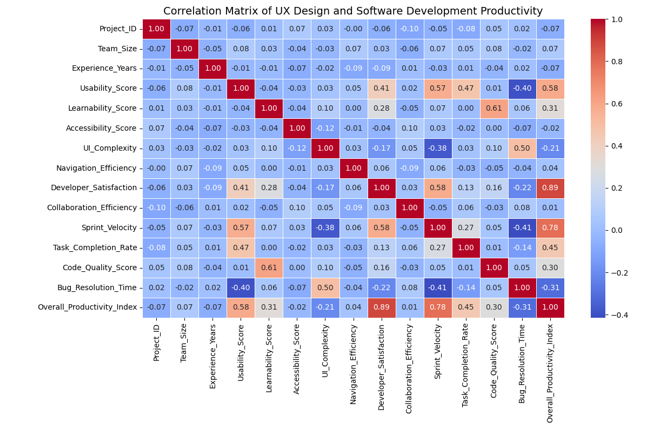
Within engineering software platforms that involve the design, simulation and characterization of composite materials, user experience (UX) design has become a key determinant for efficient use. This research aims to quantify how user experience design parameters relate to productivity in composite engineering workflows by analyzing the relationship between usability, learnability, accessibility, complexity of the UI, navigation efficiency and users engineering results satisfaction. Computational techniques in python were used in the analysis of a dataset of 400 observations that can be used for design and analysis of composite materials. Both explanatory and predictive relationships were investigated using descriptive statistics, reliability analysis, Pearson correlation analysis, multiple linear regression, mediation, machine-learning prediction models, and analysis of variance. The results suggest that the factors of usability and user satisfaction positively affect the productivity of composite engineering platforms, and that interface complexity negatively affects the productivity to a high degree. The relationship between learnability and productivity was found to have a statistically significant positive contribution, while accessibility represented a relatively minor direct contribution to productivity. This mediation analysis showed that the link between usability and engineering productivity is partially mediated by user satisfaction, demonstrating both direct and indirect benefits of good interface design. Among the various predictive models tested, the Random Forest model yielded the greatest coefficient of determination (R2 = 0.949), showing outstanding predictive power. The results highlight the significance of user-centered interface design in composite material modeling and characterization systems and reveal that UX based metrics may be used as a good proxy for engineering productivity. It offers practical advice to anyone who develops composite engineering software, works with composite materials, and is designing software or hardware to perform effectively in design processes and make sound decisions, with a focus on improving user experience.
Keywords: User experience, software development efficiency, usability, developer satisfaction, machine learning, productivity analysis.
Gaurav Pramodrao Taywade, Mahendra D. Ingole, Rajkumar Jha. Evaluating UX Design Factors Affecting Efficiency of Composite Material Design and Analysis Platforms. Journal of Polymer & Composites. 2026; 14(04):-.
Gaurav Pramodrao Taywade, Mahendra D. Ingole, Rajkumar Jha. Evaluating UX Design Factors Affecting Efficiency of Composite Material Design and Analysis Platforms. Journal of Polymer & Composites. 2026; 14(04):-. Available from: https://journals.stmjournals.com/jopc/article=2026/view=249309
References
- Abbas, A. M., Ghauth, K. I., & Ting, C.-Y. (2022). User experience design using machine learning: A systematic review. IEEE Access, 10, 51501–51514.
- Al Naqbi, H., Bahroun, Z., & Ahmed, V. (2024). Enhancing work productivity through generative artificial intelligence: A comprehensive literature review. Sustainability, 16(3), 1166.
- Albert, B., & Tullis, T. (2022). Measuring the user experience: Collecting, analyzing, and presenting UX metrics. Morgan Kaufmann. https://books.google.com/books?hl=en&lr=&id=L5xBEAAAQBAJ&oi=fnd&pg=PP1&dq=Examination+of+How+UX+Design+Impacts+Software+Development+Productivity&ots=SVr2Uzpu-t&sig=Gj-VkIJaR-WkSVmuipC41Qx_OEo
- Algarni, A., & Magel, K. (2019). Applying software design metrics to developer story: A supervised machine learning analysis. 2019 IEEE First International Conference on Cognitive Machine Intelligence (CogMI), 156–159. https://ieeexplore.ieee.org/abstract/document/8998779/
- Alimbayeva, D. (2024). Machine Learning Algorithms in UX Design: Enhancing User Experience in Digital Products. ResearchGate. https://www.researchgate.net/profile/Dilnaz-Alimbayeva/publication/386565253_Machine_Learning_Algorithms_in_UX_Design_Enhancing_User_Experience_in_Digital_Products/links/6756c5d5b558f41d0fc6e762/Machine-Learning-Algorithms-in-UX-Design-Enhancing-User-Experience-in-Digital-Products.pdf
- Alomari, H. W., Ramasamy, V., Kiper, J. D., & Potvin, G. (2020). A User Interface (UI) and User eXperience (UX) evaluation framework for cyberlearning environments in computer science and software engineering education. Heliyon, 6(5). https://www.cell.com/heliyon/fulltext/S2405-8440(20)30762-3
- Amershi, S., Begel, A., Bird, C., DeLine, R., Gall, H., Kamar, E., Nagappan, N., Nushi, B., & Zimmermann, T. (2019). Software engineering for machine learning: A case study. 2019 IEEE/ACM 41st International Conference on Software Engineering: Software Engineering in Practice (ICSE-SEIP), 291–300. https://ieeexplore.ieee.org/abstract/document/8804457/
- Arpteg, A., Brinne, B., Crnkovic-Friis, L., & Bosch, J. (2018). Software engineering challenges of deep learning. 2018 44th Euromicro Conference on Software Engineering and Advanced Applications (SEAA), 50–59. https://ieeexplore.ieee.org/abstract/document/8498185/
- Atoum, I. (2023). Measurement of key performance indicators of user experience based on software requirements. Science of Computer Programming, 226, 102929.
- Biringa, C., & Kul, G. (2021). Automated user experience testing through multi-dimensional performance impact analysis. 2021 IEEE/ACM International Conference on Automation of Software Test (AST), 125–128. https://ieeexplore.ieee.org/abstract/document/9462978/
- Botchkarev, A. (2019). A new typology design of performance metrics to measure errors in machine learning regression algorithms. Interdisciplinary Journal of Information, Knowledge, and Management, 14, 045–076.
- Choudhury, N. (2023). Can Artificial Intelligence be used to improve productivity by automating elements of the User Experience design processes? https://www.preprints.org/manuscript/202202.0057/download/final_file
- Colin, C., & Martin, A. (2023). The user experience of low-techs: From user problems to design principles. Journal of User Experience, 18(2), 68–85.
- Cruz-Benito, J., Vázquez-Ingelmo, A., Sánchez-Prieto, J. C., Theron, R., García-Peñalvo, F. J., & Martin-Gonzalez, M. (2017). Enabling adaptability in web forms based on user characteristics detection through A/B testing and machine learning. IEEE Access, 6, 2251–2265.
- Dudley, J. J., & Kristensson, P. O. (2018). A Review of User Interface Design for Interactive Machine Learning. ACM Transactions on Interactive Intelligent Systems, 8(2), 1–37. https://doi.org/10.1145/3185517
- Elemam, Y. A., Subaih, R. A., Elhefnawy, H. I., Saada, M. A., Abdelkareem, S. T., & Hassabo, A. G. (2025). The usage of modelling and polymers in industrial design. Journal of Textiles, Coloration and Polymer Science, 22(1), 267–279.
- Elgazzar, M. A. G., & Dawood, M. (2023). Usability: Improving UI/UX in Design by challenges of Materials Innovations. International Design Journal, 13(1), 37–56.
- Guennes, M., Cunha, J., & Cabral, I. (2025). Smart Textile Design: A Systematic Review of Materials and Technologies for Textile Interaction and User Experience Evaluation Methods. Technologies, 13(6), 251.
- Harle, S. M. (2024). Advancements and challenges in the application of artificial intelligence in civil engineering: A comprehensive review. Asian Journal of Civil Engineering, 25(1), 1061–1078. https://doi.org/10.1007/s42107-023-00760-9
- Hinricher, N., Schröer, C., & Backhaus, C. (2023). Design of control elements in virtual reality—Investigation of factors influencing operating efficiency, user experience, presence, and workload. Applied Sciences, 13(15), 8668.
- Kumar, S., Gopi, T., Harikeerthana, N., Gupta, M. K., Gaur, V., Krolczyk, G. M., & Wu, C. (2023). Machine learning techniques in additive manufacturing: A state of the art review on design, processes and production control. Journal of Intelligent Manufacturing, 34(1), 21–55. https://doi.org/10.1007/s10845-022-02029-5
- Nakamura, W. T., de Oliveira, E. H. T., & Conte, T. (2017). Usability and user experience evaluation of learning management systems-a systematic mapping study. International Conference on Enterprise Information Systems, 2, 97–108. https://www.scitepress.org/PublishedPapers/2017/63631/
- Nawar, S. H., Etawy, M. S., Nassar, G. E., Mohammed, N., & Hassabo, A. G. (2024). The impact of cmf design on product design. Journal of Textiles, Coloration and Polymer Science, 21(2), 259–272.
- Pandey, A., Batta, K., Arora, S., Raj, P., Chakraborthy, S., & Kaliappan, S. (2024). Machine Learning Evaluation of Key Aspects of User Preferences and Usability of E-Commerce Websites. Library of Progress-Library Science, Information Technology & Computer, 44(3). https://search.ebscohost.com/login.aspx?direct=true&profile=ehost&scope=site&authtype=crawler&jrnl=09701052&AN=180917520&h=ibsJRWatEFSZWtE2InJWtooTtPPM%2FhsC1l24g84OFwuPJd59CUNK0J4prCsb2rVwqJ%2Bhyk6PaDEs3WULh0ZCUQ%3D%3D&crl=c
- Qiu, J., Xu, Z., Luo, H., Zhou, J., & Zhang, Y. (2024). User experience of digital science and education evaluation platform: Identification and analysis of key influencing factors. Library Hi Tech, 42(6), 1839–1862.
- Sauro, J., & Lewis, J. R. (2016). Quantifying the user experience: Practical statistics for user research. Morgan Kaufmann. https://books.google.com/books?hl=en&lr=&id=USPfCQAAQBAJ&oi=fnd&pg=PP1&dq=Evaluating+the+Influence+of+User+Experience+Design+on+Software+Development+Productivity+Using+Statistical+and+Machine+Learning+Approaches&ots=Vz2bX5cnNe&sig=Pa6pUi6iBRHp53gvF3gUR98cGc4
- Soares, T. S., Costa, R. L. H., Soares, E., Calderon, I., Lunardi, G. M., Valle, P. H. D., Guedes, G. T., & Silva, W. (2025). Machine learning-assisted tools for user experience evaluation: A systematic mapping study. Simpósio Brasileiro de Sistemas de Informaçao (SBSI), 379–388.
- Usuga Cadavid, J. P., Lamouri, S., Grabot, B., Pellerin, R., & Fortin, A. (2020). Machine learning applied in production planning and control: A state-of-the-art in the era of industry 4.0. Journal of Intelligent Manufacturing, 31(6), 1531–1558. https://doi.org/10.1007/s10845-019-01531-7
- Van Remmen, J., Wartzack, S., & Miehling, J. (2025). A systematic literature analysis of influencing factors affecting the balance between usability and emotional product design. Journal of Engineering Design, 36(10), 1711–1751. https://doi.org/10.1080/09544828.2025.2455365
- Wang, X., & Hu, B. (2024). Machine learning algorithms for improved product design user experience. IEEE Access, 12, 112810–112821.
- Wu, C.-J., Brooks, D., Chen, K., Chen, D., Choudhury, S., Dukhan, M., Hazelwood, K., Isaac, E., Jia, Y., & Jia, B. (2019). Machine learning at facebook: Understanding inference at the edge. 2019 IEEE International Symposium on High Performance Computer Architecture (HPCA), 331–344. https://ieeexplore.ieee.org/abstract/document/8675201/
- Yang, Q., Scuito, A., Zimmerman, J., Forlizzi, J., & Steinfeld, A. (2018). Investigating How Experienced UX Designers Effectively Work with Machine Learning. Proceedings of the 2018 Designing Interactive Systems Conference, 585–596. https://doi.org/10.1145/3196709.3196730
- Zhou, J., Gandomi, A. H., Chen, F., & Holzinger, A. (2021). Evaluating the quality of machine learning explanations: A survey on methods and metrics. Electronics, 10(5), 593.
- Almeshaal, M., Palanisamy, S., Murugesan, T. M., Palaniappan, M., & Santulli, C. (2022). Physico-chemical characterization of Grewia Monticola Sond (GMS) fibers for prospective application in biocomposites. Journal of Natural Fibers, 19(17), 15276–15290. https://doi.org/10.1080/15440478.2022.2123076
- Ayrilmis, N., Kanat, G., Yildiz Avsar, E., Palanisamy, S., & Ashori, A. (2025). Utilizing waste manhole covers and fibreboard as reinforcing fillers for thermoplastic composites. Journal of Reinforced Plastics and Composites, 44(17–18), 1108–1118. https://doi.org/10.1177/07316844241238507
- Palanisamy, S., Mayandi, K., Dharmalingam, S., Rajini, N., Santulli, C., Mohammad, F., & Al-Lohedan, H. A. (2022). Tensile Properties and Fracture Morphology of Acacia Caesia Bark Fibers Treated with Different Alkali Concentrations. Journal of Natural Fibers, 19(15), 11258–11269. https://doi.org/10.1080/15440478.2021.2022562
- Ramasubbu, R., Kayambu, A., Palanisamy, S., & Ayrilmis, N. (2024). Mechanical Properties of Epoxy Composites Reinforced with Areca catechu Fibers Containing Silicon Carbide. BioResources, 19(2). https://search.ebscohost.com/login.aspx?direct=true&profile=ehost&scope=site&authtype=crawler&jrnl=19302126&AN=175734865&h=wsI1vYdKycAELxHLUA5rcW0k3tKY8OLffkI%2BuCKeAUzyhmzzFjq9jZurGf7jcXsHWj7mVRndFREwPRfcmZFNKA%3D%3D&crl=c

Journal of Polymer & Composites
| Volume | 14 |
| 04 | |
| Received | 10/06/2026 |
| Accepted | 22/06/2026 |
| Published | 07/07/2026 |
| Publication Time | 27 Days |
Login
PlumX Metrics