
This is an unedited manuscript accepted for publication and provided as an Article in Press for early access at the author’s request. The article will undergo copyediting, typesetting, and galley proof review before final publication. Please be aware that errors may be identified during production that could affect the content. All legal disclaimers of the journal apply.
Akshay Kumar K S,
Suhas Narayan Sakarkar,
Vijeta Bhattacharya,
Maneshwar Thippani,
L. Karpagavalli,
Deepha V,
Shiny George,
Nitin S. Bhajipale,
Manish R. Bhise,
- Assistant Professor, Department of Pharmaceutics, KLE College of Pharmacy, Rajajinagar, Bengaluru 560010, KLE Academy of Higher Education and Research, Deemed-to-be-University, Belagavi, Bengaluru, Karnataka, India
- Professor, Department of Pharmaceutics, Maharashtra Institute of Pharmacy Betala Bramhapuri, Chandrapur, Maharashtra, India
- Assistant Professor, Department of Pharmaceutics, ITM University, Gwalior, Madhya Pradesh, India
- Assistant Professor, Department of Pharmaceutical Chemistry, School Pharmacy, Anurag University, Venkatapur, Hyderabad, Telangana, India
- Professor, Department of Pharmaceutics, Meenakshi College of Pharmacy, MAHER University, Kanchipuram, Tamil Nadu, India
- Assistant Professor, Department of Chemistry, Bannari Amman Institute of Technology, Sathyamangalam, Tamil Nadu, India
- Principal, Department of Pharmaceutical Chemistry, Hindustan College of Pharmacy, Kottayam, Kerala, India
- Principal, Department of Pharmaceutical Chemistry, SGSPS, Institute of Pharmacy, Akola, Affiliated to SGBAU, Amravati, Maharashtra, India
- Professor, Department of Pharmaceutics, SGSPS, Institute of Pharmacy, Akola, Affiliated to SGBAU, Amravati, Maharashtra, India
Abstract
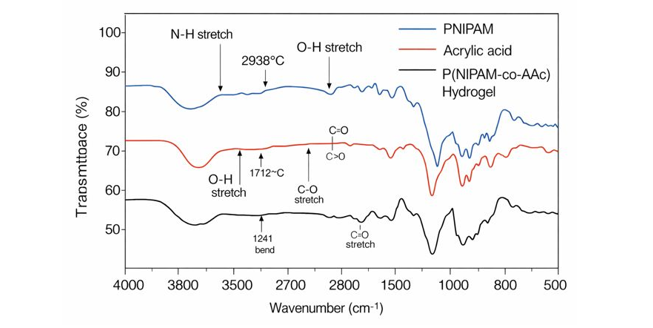
pH-responsive polymeric hydrogels have attracted significant attention as intelligent biomaterials for site-specific and controlled drug delivery in cancer therapy due to their ability to respond to the acidic tumor microenvironment. In the present study, poly (N-isopropylacrylamide-co-acrylic acid) [P(NIPAM-co-AAc)] hydrogels were synthesized via free radical copolymerization and systematically characterized to evaluate their suitability for controlled delivery of doxorubicin, a widely used chemotherapeutic agent. The copolymer hydrogels were prepared using N-isopropylacrylamide and acrylic acid as monomers, N,N′-methylenebisacrylamide as a crosslinking agent, and ammonium persulfate as a thermal initiator. The formation and structural integrity of the hydrogels were confirmed by Fourier transform infrared spectroscopy, while thermal behavior was assessed using differential scanning calorimetry. Surface morphology and internal network structure were examined by scanning electron microscopy, revealing a porous architecture favorable for drug loading and diffusion. Swelling studies demonstrated pronounced pH-dependent behavior, with significantly higher swelling ratios under mildly acidic conditions compared to physiological pH, confirming the successful incorporation of pH-responsive functional groups. Doxorubicin loading efficiency was determined using equilibrium swelling methods, and in vitro release studies were conducted at pH 7.4 and 5.5 to simulate normal physiological and tumor microenvironments, respectively. The release profiles indicated sustained and controlled drug release over an extended period, with accelerated release under acidic conditions due to enhanced network expansion. The release kinetics suggested diffusion-controlled and swelling-assisted mechanisms. Overall, the findings demonstrate that P(NIPAM-co-AAc) hydrogels exhibit desirable physicochemical properties, efficient drug encapsulation, and pH-triggered release behavior, highlighting their potential as promising carriers for targeted and controlled anticancer drug delivery applications.
Keywords: pH-sensitive hydrogel; poly (N-isopropylacrylamide-co-acrylic acid); controlled drug release; doxorubicin; smart polymer; cancer drug delivery.
References
- Xiong W, Wang W, Wang Y, Zhao Y, Chen H, Xu H, Yang X. Dual temperature/pH-sensitive drug delivery of poly(N-isopropylacrylamide-co-acrylic acid) nanogels conjugated with doxorubicin for potential application in tumor hyperthermia therapy. Colloids Surf B Biointerfaces. 2011 Jun 1;84(2):447-53. doi: 10.1016/j.colsurfb.2011.01.040.
- Xu X, Sun J, Bing L, Cui X, Jia B, Bai S. Fractal features of dual temperature/pH-sensitive poly(N-isopropylacrylamide-co-acrylic acid) hydrogels and resultant effects on the controlled drug delivery performances. Eur Polym J. 2022 May 15;171:111203. doi: 10.1016/j.eurpolymj.2022.111203.
- Işıklan N, Küçükbalcı G. Synthesis and characterization of pH- and temperature-sensitive materials based on alginate and poly(N-isopropylacrylamide/acrylic acid) for drug delivery. Polym Bull. 2016 May;73(5):1321-42. doi: 10.1007/s00289-015-1550-x.
- Keservani R, Sharma AK, editors. Nanoparticulate drug delivery systems. CRC Press; 2019 Jan 23.
- Samchenko YM, Konovalova VV, Kryklya SO, Pasmurceva NO, Poltoracka TP, Scherbakov SM, Boldescul IE, Burban AF, Ulberg ZR. Synthesis and characterization of multi-responsive nano-sized ferrogel based on n-isopropylacrylamide and acrylic acid. Журнал Хроматографічного товариства. 2015;15(1-4):30-40.
- Xu X, Wang X, Cui X, Jia B, Xu B, Sun J. Dispersion performances of naphthalimides doped in dual temperature- and pH-sensitive poly(N-isopropylacrylamide-co-acrylic acid) shell assembled with vinyl-modified mesoporous SiO2 core for fluorescence cell imaging. Polymers. 2023 May 17;15(10):2339. doi: 10.3390/polym15102339.
- Antoniraj MG, Kumar CS, Kandasamy R. Synthesis and characterization of poly(N-isopropylacrylamide)-g-carboxymethyl chitosan copolymer-based doxorubicin-loaded polymeric nanoparticles for thermoresponsive drug release. Colloid Polym Sci. 2016 Mar;294(3):527-35.
- Keservani RK, Ahire ED, Kesharwani RK, editors. Pharmaceutical Polymer Formulations and its Applications. John Wiley & Sons; 2025 Jul 22.
- Simeonov M, Apostolov AA, Georgieva M, Tzankov D, Vassileva E. Poly(acrylic acid-co-acrylamide)/Polyacrylamide pIPNs/Magnetite composite hydrogels: synthesis and characterization. Gels. 2023 Apr 26;9(5):365. doi: 10.3390/gels9050365.
- Parvathy PA, Ayobami AV, Raichur AM, Sahoo SK. Methacrylated alkali lignin grafted P(NIPAM-co-AAc) copolymeric hydrogels: tuning the mechanical and stimuli-responsive properties. Int J Biol Macromol. 2021 Dec 1;192:180-96. doi: 10.1016/j.ijbiomac.2021.09.058.
- Haider I, Siddiq M, Shah SM, Ur Rehman S. Synthesis and characterization of multi-responsive poly(NIPAm-co-AAc) microgels. IOP Conf Ser: Mater Sci Eng. 2014;60(1):012046. doi: 10.1088/1757-899X/60/1/012046.
- Geever LM, Cooney CC, Lyons JG, Kennedy JE, Nugent MJ, Devery S, Higginbotham CL. Characterisation and controlled drug release from novel drug-loaded hydrogels. Eur J Pharm Biopharm. 2008 Aug 1;69(3):1147-59. doi: 10.1016/j.ejpb.2008.01.014.
- Peppas NA, Korsmeyer RW. Dynamically swelling hydrogels in controlled release applications. Hydrogels in medicine and pharmacy. 1987 Jul;3:109-36.
- Pimenta AF, Ascenso J, Fernandes JC, Colaço R, Serro AP, Saramago B. Controlled drug release from hydrogels for contact lenses: drug partitioning and diffusion. Int J Pharm. 2016 Dec 30;515(1-2):467-75. doi: 10.1016/j.ijpharm.2016.10.081.
- Satish C, Satish K, Shivakumar H. Hydrogels as controlled drug delivery systems: synthesis, crosslinking, water and drug transport mechanism. Indian J Pharm Sci. 2006 Mar 1;68(2).
- Talei Franzesi G, Ni B, Ling Y, Khademhosseini A. A controlled-release strategy for the generation of cross-linked hydrogel microstructures. J Am Chem Soc. 2006 Nov 29;128(47):15064-5. doi: 10.1021/ja066064k.
- Karam F. Swelling behavior of poly(aam_ma) hydrogel matrix and study effects pH and ionic strength, enforcement in controlled release system. Int J Appl Pharm. 2018 Jan 1.
- Uvaraja VC, Keservani RK, Maurya NK, Pendakur B, Adhoni SA. Formulation and development of gel with essential oils and effect of polymer on their antimicrobial activity. Biochem. Cell. Arch. 2024 Oct 1;24:0000-. https://doi.org/10.51470/bca.2024.24.2.2269
- Antoniraj MG, Kumar CS, Kandasamy R. Synthesis and characterization of poly (N-isopropylacrylamide)-g-carboxymethyl chitosan copolymer-based doxorubicin-loaded polymeric nanoparticles for thermoresponsive drug release. Colloid and Polymer Science. 2016 Mar;294(3):527-35.https://doi.org/10.1007/s00396-015-3804-4
- Fan T, Li M, Wu X, Li M, Wu Y. Preparation of thermoresponsive and pH-sensitivity polymer magnetic hydrogel nanospheres as anticancer drug carriers. Colloids and Surfaces B: Biointerfaces. 2011 Dec 1;88(2):593-600.https://doi.org/10.1016/j.colsurfb.2011.07.048
- Saeedi M, Moghbeli MR, Vahidi O. Dual-responsive semi-IPN hydrogels based on poly (N-isopropyl acrylamide-co-acrylic acid)/glycyrrhizin cross-linked chitosan for controlled drug release. Journal of Polymer Research. 2025 Apr;32(4):1-7. https://doi.org/10.1007/s10965-025-04367-3
- Simeonov M, Apostolov AA, Georgieva M, Tzankov D, Vassileva E. Poly (acrylic acid-co-acrylamide)/Polyacrylamide pIPNs/Magnetite Composite Hydrogels: Synthesis and Characterization. Gels. 2023 Apr 26;9(5):365.https://doi.org/10.3390/gels9050365
- Zhao Y, Sun W, Saldaña MD. Nanogels of poly-N-isopropylacrylamide, poly-N, N-diethylacrylamide and acrylic acid for controlled release of thymol. Journal of Polymer Research. 2018 Dec;25(12):253. https://doi.org/10.1007/s10965-018-1644-x
- Zdravković A, Nikolić L, Ilić-Stojanović S, Nikolić V, Najman S, Mitić Ž, Ćirić A, Petrović S. The removal of heavy metal ions from aqueous solutions by hydrogels based on N-isopropylacrylamide and acrylic acid. Polymer Bulletin. 2018 Oct;75(10):4797-821.https://doi.org/10.1007/s00289-018-2295-0

Journal of Polymer & Composites
| Volume | 14 | |
| 01 | ||
| Received | 27/01/2026 | |
| Accepted | 07/02/2026 | |
| Published | 17/02/2026 | |
| Publication Time | 21 Days |