Open Access
Nideep T K,
Ramya M,
Ayswaria Deepti,
Prabha Prakash,
Baby Chakrapani P. S.,
Kailasnath M,
- Assistant Professor , Department of Physics, PTM Government College, Perinthalmanna, Malappuram, Kerala, India
- Assistant Professor on contract, Department of Physics, NSS College, Ottappalam, Palakkad, Kerala, India
- Research Associate, Department of Biotechnology, Cochin University of Science and Technology (CUSAT), Kerala, India
- Research Scholar, Department of Biotechnology, Cochin University of Science and Technology (CUSAT), Kerala, India
- Assistant Professor, Department of Biotechnology, Cochin University of Science and Technology (CUSAT), Kerala, India
- Professor, International School of Photonics, Cochin University of Science and Technology (CUSAT), Kerala, India
Abstract
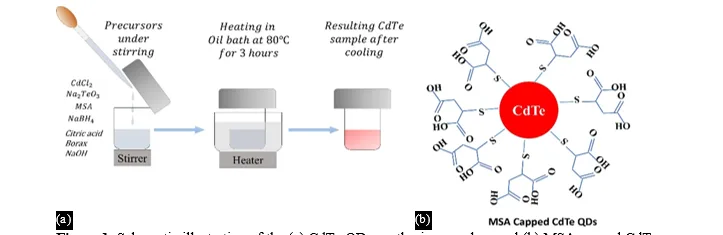
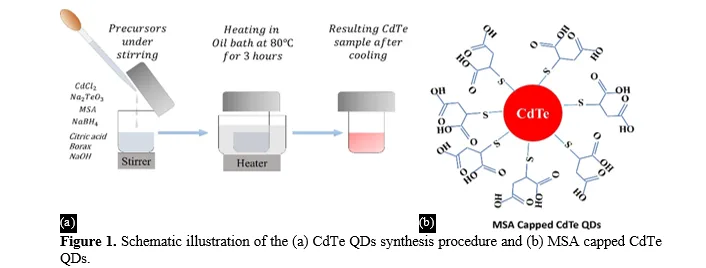
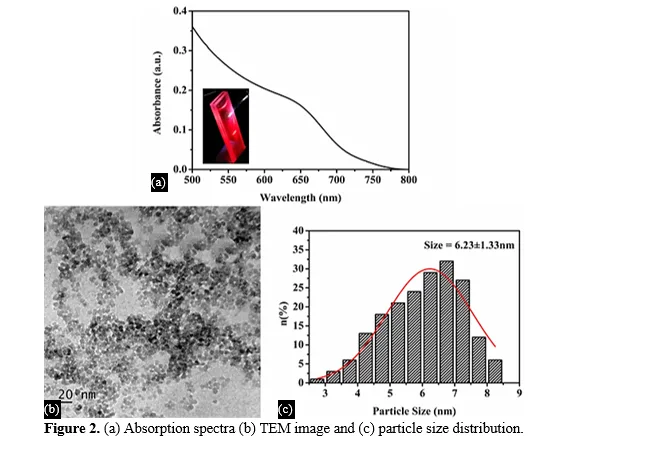
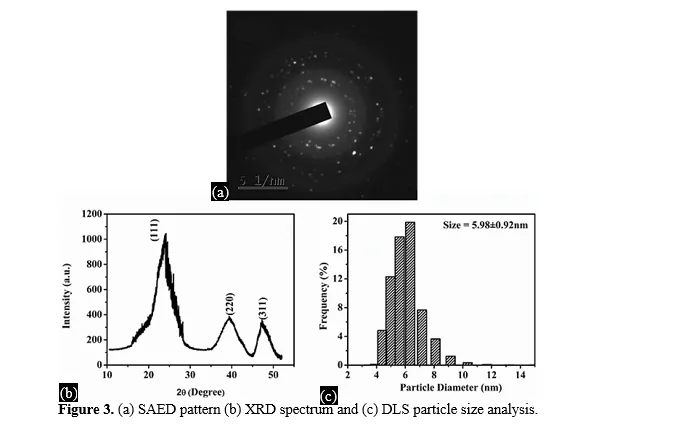
The changes in the optical and electronic properties of the materials due to the quantum confinement effect in semiconductor nanoparticles have attracted huge interest in the scientific community. Within the semiconductor nanoparticles, the quantum dots (QDs) deserve a special position due to their high quantum confinement effect and unique optoelectronic properties. Among the semiconductor quantum dots, CdTe attracts more attention due to its easy manufacturing, large Bohr exciton radius, and wide range of absorption and emission tunability. These unique properties make them useful in a wide range of areas, like solar cells, sensing, bioimaging, lasing, nonlinear optical applications, etc. In the present work, MSA-capped water-soluble CdTe QDs are prepared using a simple colloidal method for cell imaging. The XRD spectrum,UV-vis absorption spectrum, PL spectrum, DLS analysis, and HR-TEM analysis are applied for the characterization of synthesized CdTe QDs. Here, we synthesized red emissive spherical CdTe QDs of average size 6nm which was confirmed using TEM and DLS analysis. The obtained particle size is found to lie in the strong confinement regime. The X-ray diffraction result reveals the successful formation of crystalline CdTe QDs. These QDs exhibit a Zinc blende cubic structure with well-defined crystallinity. The bioimaging efficiency of MSA-capped CdTe QDs is examined on N2A Cells. These results show that CdTe QDs are a promising material for cell imaging.
Keywords: Quantum dot, CdTe, MSA, water soluble, bioimaging
[This article belongs to Special Issue under section in Journal of Polymer & Composites (jopc)]
References
- Ken-Tye Yong, Wing-Cheung Law, Indrajit Roy, Zhu Jing, Huijie Huang, Mark T Swihart, and Paras N Prasad. Aqueous phase synthesis of CdTe quantum dots for biophotonics. Journal of Biophotonics.2011;4:9–20.
- Stephen J. Byrne, Serena A.Corr, Tatsiana Y. Rakovich, Yurii K. Gunko, Yury P. Rakovich, John F. Donegan, Siobhan Mitchell and Yuri Volkov. Optimisation of the synthesis and modification of CdTe quantum dots for enhanced live cell imaging. Journal of Materials Chemistry. 2006;16: 2896–2902.
- Vijayaraj Venkatachalam, Sasikakla Ganapathy, Thirunavukkarasu Subramani, Ilaiyaraja Perumal. Aqueous CdTe colloidal quantum dots for bio-imaging of Artemia sp. Inorganic Chemistry Communications. 2021; 128: 108510.
- Anne S. Schulze, Isabella Tavernaro, Friederike Machka, Olga Dakischew, Katrin S. Lip, Mathias S. Wickleder. Tuning optical properties of water soluble CdTe quantum dots for biological applications. J Nanopart Res. 2017; 19:70.
- Pandey, D.Mukherjee, P.Kshirsagar, C.Patra, D.Bodas. Multiplexed bio-imaging using cadmium telluride quantum dots synthesized by mathematically derived process parameters in a continuous flow active microreactor. Materials Today Bio. 2021; 11: 100123.
- Pandey S, Mukherjee D, Kshirsagar P, Patra C, Bodas D. Multiplexed bio-imaging using cadmium telluride quantum dots synthesized by mathematically derived process parameters in a continuous flow active microreactor. MaterialsToday Bio.2021; 11 :100123.
- Jin S, Hu Y, Gu Z, Liu L, Wu H . Application of Quantum Dots in Biological Imaging. Journal of Nanomaterials.2011; 1:834139.
- Chen X, Guo Z , Miao P. One-pot synthesis of GSH- Capped CdTe quantum dots with excellent biocompatibility for direct cell imaging. Heliyon. 2018; 4(3): e00576.
- Venkatachalam V, Ganapathy S, Subramani T. Aqueous CdTe colloidal quantum dots for bio-imaging of Artemia. Inorganic Chemical Communication.2021;128: 108510.
- Structural and optical characterization of Sm3+ ions and CdTe crystallites doped in silica matrices using sol-gel method. RP Currents Trends In Engineering and Technology. 2022; 1:54–56.
- Nideep T K, Ramya M, Sony U, Kailasnath M. MSA capped CdTe quantum dots for pH sensing application. Material Research Express.2019; 6 :1–9p.
- Ding Zhou, Min Lin, Zhaolai Chen, Haizhu Sun, Hao Zhang , Hangchen Sun & Bai Yang. Simple synthesis of highly luminescent water-soluble CdTe quantum dots with controllable surface functionality.Chemistry of Materials.2011;23: 21,4857–4862p.
- Sander F Wuister, Ingmar Swart, Floris Van Driel, Stephan G Huckey, Celso de Mello Donega. Highly luminescent water-soluble CdTe quantum dots. Nano Letters. 2003; 3:4,503–507p.
- P F GM da costa, L G Merizio, N Wolff, H Terrascke, Ass de Camargo. Real time monitoring of CdTe quantum dots growth in aqueous solution. Scientific reports.2024; 14:7884.
- Yu, W. W., Chang, E., Drezek, R., & Colvin, V. L. Water-soluble quantum dots for biomedical applications. Biochemical and Biophysical Research Communications.2006; 348(3): 781–786p.
- Nideep T K, Ramya M, Kailasnath M. Amplified spontaneous emission from MSA capped CdTe QD synthesized using colloidal method. AIP Conference Proceedings.2020; 2244:1–5p.

Journal of Polymer & Composites
| Volume | 13 | |
| Special Issue | 01 | |
| Received | 26/07/2024 | |
| Accepted | 20/09/2024 | |
| Published | 09/12/2024 | |
| Publication Time | Days |