Kiran Kumar M,
K.Chandra Sekhar,
Jasira Banu.A,
Prasadaraju Kantheti,
P. M. Karandikar,
R. Shivashankar,
- Associate Professor, Department of Mechanical Engineering, Sir M. Visvesvaraya Institute of Technology, Bengaluru, Karnataka, India
- Associate Professor, Department of Mechanical Engineering, QIS College of Engineering and Technology, Ongole, Andhra Pradesh, India
- Assistant Professor, Department of Garment Designing, PSGR Krishnammal College for Women, Coimbatore, Tamil Nadu, India
- Assistant Professor, Department of Mechanical Engineering, S.R.K.R Engineering College, Bhimavaram, Andhra Pradesh, India
- Assistant Professor, Department of Mechanical Engineering, Pravara Rural Engineering College, Loni, Maharashtra, India
- Assistant Professor, Department of Mechanical Engineering, Sree Sakthi Engineering College, Coimbatore, Tamil Nadu, India
Abstract
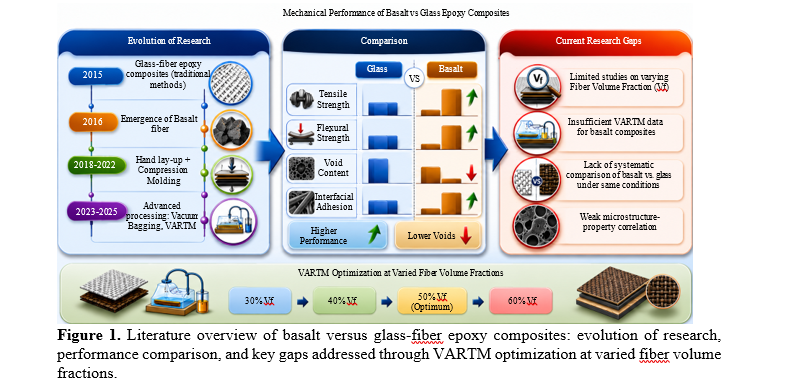
Fiber-reinforced polymer composites have been identified to possess excellent properties that render them very suitable in the aerospace, automotive, marine and renewable energy sectors. However, for the industrially scalable vacuum-assisted resin transfer molding (VARTM) process, optimization of mechanical properties of basalt epoxy composites must be achieved systematically, which means that the effect of the fiber volume fraction (VF) on the mechanical properties of the composite needs to be quantified for different fabrics with similar or different fiber types, with fiber VFR ranging from 30% to 60% and then panels were fabricated and subjected to comprehensive tensile and flexural tests according to ASTM standards, accompanied by a detailed microstructural analysis of the tested samples by FESEM and a void fraction measurement based on the density measurement. Basalt-epoxy composites were observed to have tensile and flexural strengths of 238 MPa and 295 MPa, respectively, which are 22% and 20% higher than the base line glass-epoxy properties, respectively, with an exceptionally low void fraction of 1.1%. The improvements are because of the improved interfacial bonding and reduced porosity. The results set a processing guideline for manufacturing high performance, defect minimized basalt-epoxy laminates and make VARTM basalt composites as a viable alternative sustainable material to traditional glass-fiber material in the future for lightweight structural application.
Keywords: Basalt fiber, fiber volume fraction, mechanical performance, mechanical properties, void fraction
[This article belongs to Special Issue under section in Journal of Polymer & Composites (jopc)]
References
1. Vyas CJ, Jhala RL. Mechanical characterization of glass-basalt hybrid composites with different fiber weight fraction. Mech Adv Compos Struct. 2024;11(2):295–308. doi: 10.22075/MACS.2024.31330.1541.
2. Reddy SSP, Suresh R, Hanamantraygouda MB, Shivakumar BP. Use of composite materials and hybrid composites in wind turbine blades. Mater Today Proc. 2021;46:2827–2830. doi: 10.1016/J.MATPR.2021.02.745.
3. Hamzat AK, Murad MS, Adediran IA, Asmatulu E, Asmatulu R. Fiber-reinforced composites for aerospace, energy, and marine applications: An insight into failure mechanisms under chemical, thermal, oxidative, and mechanical load conditions. Adv Compos Hybrid Mater. 2025;8(1):152–. doi: 10.1007/S42114-024-01192-Y.
4. Singh SK, Yadav A, Singh S, Jain A, Kumar A. Enhancement of mechanical and viscoelastic properties of epoxy and epoxy–nano silica composites using self-healing microcapsules. Mater Today Commun. 2025;43:111741. doi: 10.1016/J.MTCOMM.2025.111741.
5. da Silva Pinto CE, Arizaga GGC, Wypych F, Ramos LP, Satyanarayana KG. Studies of the effect of molding pressure and incorporation of sugarcane bagasse fibers on the structure and properties of poly (hydroxy butyrate). Compos Part A Appl Sci Manuf. 2009;40(5):573–582. doi: 10.1016/J.COMPOSITESA.2009.02.004.
6. Muhammad JH, Yousif AR. Effect of basalt minibars on the shear strength of BFRP-reinforced high-strength concrete beams. Case Stud Constr Mater. 2023;18:e02020. doi: 10.1016/J.CSCM.2023.E02020.
7. Li S, Yao X, Hou S. Mechanical properties of sustainable fiber-reinforced composites. Acta Mech Sin. 2026;42(2):424874. doi: 10.1007/S10409-025-24874-X.
8. Raajeshkrishna CR, Chandramohan P. Effect of reinforcements and processing method on mechanical properties of glass and basalt epoxy composites. SN Appl Sci. 2020;2(5):959. doi: 10.1007/S42452-020-2774-4.
9. Mani M. Silica nanoparticle-enhanced mechanical properties and energy absorption behavior of hybrid fiber-reinforced polymer composites for structural applications. Next Mater. 2025;9:101213. doi: 10.1016/J.NXMATE.2025.101213.
10. Deng X, Hoo MS, Cheah YW, Tran LQN. Processing and Mechanical Properties of Basalt Fibre-Reinforced Thermoplastic Composites. Polymers (Basel). 2022;14(6). doi: 10.3390/POLYM14061220.
11. Wei ZW, Wang TS, Li HJ, Dong TC, Li Z, Guo X. Study of the flexural behavior of basalt fiber–reinforced concrete beams with basalt fiber-reinforced polymer bars and steel bars. Case Stud Constr Mater. 2025;22:e04433. doi: 10.1016/J.CSCM.2025.E04433.
12. Scalici T, Pitarresi G, Badagliacco D, Fiore V, Valenza A. Mechanical properties of basalt fiber reinforced composites manufactured with different vacuum assisted impregnation techniques. Compos B Eng. 2016;104:35–43. doi: 10.1016/J.COMPOSITESB.2016.08.021.
13. Jia H, et al. Enhanced interfacial and mechanical properties of basalt fiber reinforced poly(aryl ether nitrile ketone) composites by amino-silane coupling agents. Polymer (Guildf). 2021;230:124028. doi: 10.1016/J.POLYMER.2021.124028.
14. Beemkumar N, et al. Thermal stability and flame-retardant properties of a basalt/kevlar fiber-reinforced hybrid polymer composite with bran filler particulates. Results Eng. 2025;25:104207. doi: 10.1016/J.RINENG.2025.104207.
15. Taheri F, Chowdhury SA, Ghiaskar A. Comparison of the Performance of Basalt Fiber-Reinforced Composites Incorporating a Recyclable and a Conventional Epoxy Resin. Polymers. 2025;17(10):1348. doi: 10.3390/POLYM17101348.
16. Mun SY, Ha J, Lee S, Ju Y, Lim HM, Lee D. Prediction of enhanced interfacial bonding strength for basalt fiber/epoxy composites by micromechanical and thermomechanical analyses. Compos Part A Appl Sci Manuf. 2021;142:106208. doi: 10.1016/J.COMPOSITESA.2020.106208.
17. Negru R, Coșa AV, Ianto A, Tătar B, Sîrbu RC, Șerban DA. The Influence of the Manufacturing Technology on the Mechanical Properties of Woven Jute Fiber-Reinforced Epoxy Composites. Polymers. 2025;17(12):1649. doi: 10.3390/POLYM17121649.
18. Gajjar T, Patel P, Joshi S, Shah D. Influence of fiber volume fraction variation on the mechanical properties of CFRP composites manufactured by VARTM process. Next Res. 2025;2(4):100957. doi: 10.1016/J.NEXRES.2025.100957.
19. Debnath S, Maiti S, Adivarekar RV. General testing of wool composites. Wool Fiber Reinforced Polymer Composites. 2022:179–196. doi: 10.1016/B978-0-12-824056-4.00012-1.
20. Mittal V, Saini R, Sinha S. Natural fiber-mediated epoxy composites – A review. Compos B Eng. 2016;99:425–435. doi: 10.1016/J.COMPOSITESB.2016.06.051.
21. Yang X, Zhan L, Peng Y, Liu C, Xiong R. Interface Controlled Micro- and Macro-Mechanical Properties of Vibration Processed Carbon Fiber/Epoxy Composites. Polymers. 2021;13(16):2764. doi: 10.3390/POLYM13162764.
22. Tian Y, Zhang H, Zhang Z. Influence of nanoparticles on the interfacial properties of fiber-reinforced-epoxy composites. Compos Part A Appl Sci Manuf. 2017;98:1–8. doi: 10.1016/J.COMPOSITESA.2017.03.007.
23. Kim JH, et al. Interfacial properties and permeability of three patterned glass fiber/epoxy composites by VARTM. Compos B Eng. 2018;148:61–67. doi: 10.1016/J.COMPOSITESB.2018.04.041.
24. Musa AA, Park J, Hong G, Yoon SH, Onwualu AP, Kim M. Development of high-performance basalt fiber–reinforced polymer composite using a nanocellulose-based surface modification strategy. Compos Part A Appl Sci Manuf. 2025;199. doi: 10.1016/J.COMPOSITESA.2025.109191.
25. Rahman MM, Ismail AE, Ramli MF, Rashid AHA. Predicting flexural properties of fiber reinforced composites: An experimental dataset analysis using machine learning models. Next Mater. 2026;11:101720. doi: 10.1016/J.NXMATE.2026.101720.
26. Farsani RE, Daghigh V, Derakhshani K. Tensile and flexural properties of basalt fibers/nano-alumina powder-reinforced multi-scale composites. Surfaces Interfaces. 2024;46:104009. doi: 10.1016/J.SURFIN.2024.104009.
27. Subagia A, Kim YJ. Influence of volume fraction of basalt fabrics on tensile and three-point bending behaviours of hybrid composites reinforced with carbon/basalt fabrics. AIP Conf Proc. 2023;2568. doi: 10.1063/5.0114190.
28. Wang Y, et al. Quasi-static and high-rate flexural responses of intralaminar-hybridised basalt-flax fibre-reinforced polymer composites. Adv Compos Hybrid Mater. 2025;9(1):26–. doi: 10.1007/S42114-025-01559-9.
29. Chowdhury IR, O’Dowd NP, Comer AJ. Experimental study of hygrothermal ageing effects on failure modes of non-crimp basalt fibre-reinforced epoxy composite. Compos Struct. 2021;275:114415. doi: 10.1016/J.COMPSTRUCT.2021.114415.
30. Bulut M. Mechanical characterization of Basalt/epoxy composite laminates containing graphene nanopellets. Compos B Eng. 2017;122:71–78. doi: 10.1016/J.COMPOSITESB.2017.04.013.
31. Rajkumar DR, et al. Mechanical and environmental performance of laminated composite plates reinforced with natural and synthetic fibers: A comparative study of flexural, water absorption and swelling characteristics. Discover Sustainability. 2025;6(1):905–. doi: 10.1007/S43621-025-01550-W.

Journal of Polymer & Composites
| Volume | 14 | |
| Special Issue | 04 | |
| Received | 02/07/2026 | |
| Accepted | 16/07/2026 | |
| Published | 24/07/2026 | |
| Publication Time | 22 Days |