
Nidhi Singh,
Smita Tung,
- Research Scholar, Civil Engineering Department, GLA University, Mathura, Uttar Pradesh,
- Assistant Professor, Civil Engineering Department, GLA University, Mathura, Uttar Pradesh, India
Abstract
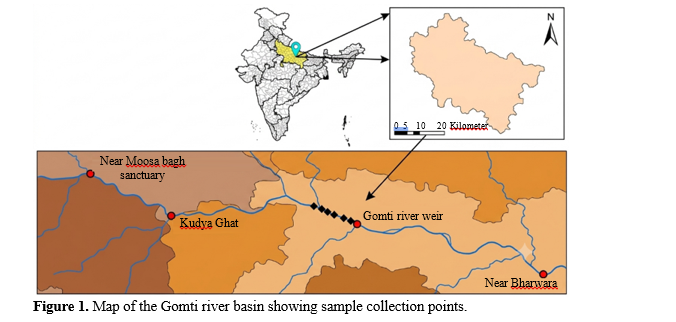
Rapid urbanization, industrial discharge, and agricultural runoff pose a significant threat to freshwater sustainability and public health. Within these ecosystems, polymer pollutants—such as microplastics, nanoplastics, synthetic fibres, and additive residues—have emerged as persistent vectors capable of adsorbing and transporting toxic heavy metals. Because these polymeric contaminants dynamically interact with conventional aquatic parameters to alter pollutant mobility and ecological risk profiles, there is an urgent need to transition from passive environmental monitoring to active, materials-driven remediation. To address this challenge, this study presents the development and machine-learning-assisted performance evaluation of a novel polymer-biochar composite adsorbent designed for the removal of heavy metals from complex aquatic matrices. The Gomti River Basin was utilized as a real-world environmental testbed. A dataset comprising 100 water samples collected from five representative locations, characterized by 18 physicochemical and heavy-metal parameters, served as the competing ionic background matrix. To predict the composite’s adsorption efficiency under varying, non-linear riverine conditions, a comparative assessment of machine learning (ML) models—Multiple Linear Regression (MLR) and Artificial Neural Network (ANN)—was conducted. A standardized 70:30 train–test split combined with nested 10-fold cross-validation was employed to ensure robust model development. Among the investigated models, the ANN demonstrated superior predictive capability for evaluating the composite’s performance against matrix interferences, achieving a testing R² of 0.99, RMSE of 0.05, and 92.5% of predictions falling within ±20% of observed values. From a physical chemistry perspective, the ML framework identified that elevated Electrical Conductivity (EC), Total Dissolved Solids (TDS), and sulfate concentrations act as the dominant variables influencing the electrical double layer, surface complexation, and biosorption capacity of the polymeric material. Ultimately, these findings demonstrate that integrating green polymer-composite design with data-driven ML modelling provides a highly effective pathway for optimizing nanoparticle-enabled water-treatment technologies, thereby advancing the goals of circular polymer science and sustainable aquatic management.
Keywords: Polymeric contaminants, Micro plastics, Nano plastics, Water Quality Index, Machine Learning, Gomti River Basin, Biopolymers, Nanoparticles, Biosorption, Green composites, River water quality.
[This article belongs to Journal of Polymer & Composites ]
References
1. Y.-J. Lu, C.-W. Wang, and C.-H. Wang, “A Hybrid Diagnostic System for Corrosion Mechanism Identification in Petrochemical Equipment: Integrating Bayesian Probabilities and Association Rule,” Process Saf. Environ. Prot., vol. 201, p. 107577, 2025, doi: 10.1016/j.psep.2025.107577.
2. M. T. Ayvaz, “A Linked Simulation-Optimization Model for Solving the Unknown Groundwater Pollution Source Identification Problems,” J. Contam. Hydrol., vol. 117, no. 1–4, pp. 46–59, 2010, doi: 10.1016/j.jconhyd.2010.06.004.
3. A. Turner and L. A. Holmes, “Adsorption of Trace Metals by Microplastic Pellets in Fresh Water,” Environ. Chem., vol. 12, no. 5, pp. 600–610, 2015, doi: 10.1071/EN14143.
4. L. A. Holmes, A. Turner, and R. C. Thompson, “Adsorption of Trace Metals to Plastic Resin Pellets in the Marine Environment,” Environ. Pollut., vol. 160, pp. 42–48, 2012, doi: 10.1016/j.envpol.2011.08.052.
5. H. Zheng, S. Hou, J. Liu, Y. Xiong, and Y. Wang, “Advanced Machine Learning and Water Quality Index (WQI) Assessment: Evaluating Groundwater Quality at the Yopurga Landfill,” Water (Switzerland), vol. 16, no. 12, 2024, doi: 10.3390/w16121666.
6. S. Jiang, J. Fan, X. Xia, X. Li, and R. Zhang, “An Effective Kalman Filter-Based Method for Groundwater Pollution Source Identification and Plume Morphology Characterization,” Water (Switzerland), vol. 10, no. 8, 2018, doi: 10.3390/w10081063.
7. A. K. Das, N. Gupta, T. Mahmood, B. C. Tripathy, R. Das, and S. Das, An Efficient Water Quality Evaluation Model Using Weighted Hesitant Fuzzy Soft Sets for Water Pollution Rating, 1st ed. CRC Press, Taylor & Francis, 2025.
8. A. K. Das, N. Gupta, T. Mahmood, B. C. Tripathy, R. Das, and S. Das, “An Innovative Fuzzy Multi-Criteria Decision Making Model for Analyzing Anthropogenic Influences on Urban River Water Quality,” Iran J. Comput. Sci., vol. 8, no. 1, pp. 103–124, 2024, doi: 10.1007/s42044-024-00211-x.
9. J. N. Hahladakis, C. A. Velis, R. Weber, E. Iacovidou, and P. Purnell, “An Overview of Chemical Additives Present in Plastics: Migration, Release, Fate and Environmental Impact During Their Use, Disposal and Recycling,” J. Hazard. Mater., vol. 344, pp. 179–199, 2018, doi: 10.1016/j.jhazmat.2017.10.014.
10. M. Ahmed, R. Mumtaz, and S. M. H. Zaidi, “Analysis of Water Quality Indices and Machine Learning Techniques for Rating Water Pollution: A Case Study of Rawal Dam, Pakistan,” Water Supply, vol. 21, no. 6, pp. 3225–3250, 2021, doi: 10.2166/ws.2021.082.
11. S. Prakash and Mishra, “Analysis of Water Quality of Gomti River At District Sultanpur (U.P.),” Int. J. Eng. Sci. Invent. Res. Dev., vol. I, no. III, p. 113, 2014.
12. R. Khan et al., “Appraisal of Water Quality and Ecological Sensitivity with Reference to Riverfront Development along the River Gomti, India,” Appl. Water Sci., vol. 12, no. 1, pp. 1–12, 2022, doi: 10.1007/s13201-021-01560-9.
13. K. P. Singh, A. Basant, A. Malik, and G. Jain, “Artificial Neural Network Modeling of the River Water Quality-A Case Study,” Ecol. Modell., vol. 220, no. 6, pp. 888–895, 2009, doi: 10.1016/j.ecolmodel.2009.01.004.
14. R. M. Singh and B. Datta, “Artificial Neural Network Modeling for Identification of Unknown Pollution Sources in Groundwater with Partially Missing Concentration Observation Data,” Water Resour. Manag., vol. 21, no. 3, pp. 557–572, 2007, doi: 10.1007/s11269-006-9029-z.
15. Y. Dong, M. Gao, Z. Song, and W. Qiu, “As(III) Adsorption onto Different-Sized Polystyrene Microplastic Particles and Its Mechanism,” Chemosphere, vol. 239, p. 124792, 2020, doi: 10.1016/j.chemosphere.2019.124792.
16. A. Kanti et al., “Assessing Anthropogenic Influences on the Water Quality of Gomati River Using an Innovative Weighted Fuzzy Soft Set Based Water Pollution Rating System,” Discov. Water, 2024, doi: 10.1007/s43832-024-00136-3.
17. S. Mohinuddin et al., “Assessing Lake Water Quality during COVID-19 Era Using Geospatial Techniques and Artificial Neural Network Model,” Environ. Sci. Pollut. Res., vol. 30, no. 24, pp. 65848–65864, 2023, doi: 10.1007/s11356-023-26878-6.
18. N. Saqib, P. K. Rai, S. Kanga, D. Kumar, B. Đurin, and S. K. Singh, “Assessment of Ground Water Quality of Lucknow City under GIS Framework Using Water Quality Index (WQI),” Water (Switzerland), vol. 15, no. 17, 2023, doi: 10.3390/w15173048.
19. A. M. Khalaf and R. Rustum, “Assessment of Projected Extreme Climate Change Impact on the Operational Performance of Surface Water Reservoirs,” Water Conserv. Manag., vol. 8, no. 1, pp. 11–19, 2024, doi: 10.26480/wcm.01.2024.11.19.
20. N. Singh and S. Tung, “Assessment of Water Quality of Gomti River at Lucknow,” Air, Soil Water Res., vol. 18, 2025, doi: 10.1177/11786221251328589.
21. A. M. Pimparkar, S. N. Patil, B. D. Patil, and A. K. Kadam, “Comparative Assessment of Wetland Water Quality from Rural and Urban Area of Aurangabad District, Maharashtra, India Using Water Quality Index,” HydroResearch, vol. 6, pp. 269–278, 2023, doi: 10.1016/j.hydres.2023.10.001.
22. M. Poursaeid, “Comprehensive Water Quality Indicators Modeling by Environmental Protection View Using Multi Optimized Weighted Ensemble Machine Learnings,” Process Saf. Environ. Prot., vol. 193, pp. 696–709, 2025, doi: 10.1016/j.psep.2024.11.042.
23. S. Bose, E. Mele, and V. V Silberschmidt, “Computational Modelling of Collagen-Based Flexible Electronics: Assessing the Effect of Hydration,” Multiscale Multidiscip. Model. Exp. Des., vol. 7, no. 3, pp. 1643–1655, 2024, doi: 10.1007/s41939-023-00230-4.
24. I. Sohn, “Deep Belief Network Based Intrusion Detection Techniques: A Survey,” Expert Syst. Appl., vol. 167, p. 114170, 2021, doi: 10.1016/j.eswa.2020.114170.
25. L. Chen et al., “Dataset of Stable Isotopes of Precipitation in the Eurasian Continent,” Earth Syst. Sci. Data, vol. 16, no. 3, pp. 1543–1557, 2024, doi: 10.5194/essd-16-1543-2024.
26. M. A. Haq, A. K. Jilani, and P. Prabu, “Deep Learning Based Modeling of Groundwater Storage Change,” Comput. Mater. Contin., vol. 70, no. 3, pp. 4599–4617, 2022, doi: 10.32604/cmc.2022.020495.
27. L. M. Sidek et al., “Developing an Ensembled Machine Learning Model for Predicting Water Quality Index in Johor River Basin,” Environ. Sci. Eur., vol. 36, no. 1, 2024, doi: 10.1186/s12302-024-00897-7.
28. B. Das, S. Jain, S. Singh, and P. Thakur, “Evaluation of Multisite Performance of SWAT Model in the Gomti River Basin, India,” Appl. Water Sci., vol. 9, no. 5, pp. 1–10, 2019, doi: 10.1007/s13201-019-1013-x.
29. L. Chen et al., “The Complexity of Moisture Sources Affects the Altitude Effect of Stable Isotopes of Precipitation in Inland Mountainous Regions,” Water Resour. Res., vol. 60, no. 6, 2024, doi: 10.1029/2023WR036084.
30. R. Li et al., “Global Stable Isotope Dataset for Surface Water,” Earth Syst. Sci. Data, vol. 17, no. 5, pp. 2135–2145, 2025, doi: 10.5194/essd-17-2135-2025.
31. M. Cao, K. P. Baxevanakis, and V. V Silberschmidt, “High-Temperature Behaviour and Interfacial Damage of CGI: 3D Numerical Modelling,” Multiscale Multidiscip. Model. Exp. Des., vol. 7, no. 3, pp. 1515–1525, 2024, doi: 10.1007/s41939-023-00188-3.
32. B. P. Nandi, G. Singh, A. Jain, and D. K. Tayal, “Evolution of Neural Network to Deep Learning in Prediction of Air, Water Pollution and Its Indian Context,” Int. J. Environ. Sci. Technol., vol. 21, no. 1, pp. 1021–1036, 2024, doi: 10.1007/s13762-023-04911-y.
33. B. M. Saalidong, S. A. Aram, S. Otu, and P. O. Lartey, “Examining the Dynamics of the Relationship between Water PH and Other Water Quality Parameters in Ground and Surface Water Systems,” PLoS One, vol. 17, no. 1 1, pp. 1–17, 2022, doi: 10.1371/journal.pone.0262117.
34. V. P. Dheeraj, C. S. Singh, N. Kishore, and A. K. Sonkar, “Groundwater Quality Assessment in Korba Coalfield Region, India: An Integrated Approach of GIS and Heavy Metal Pollution Index (HPI) Model,” Nat. Environ. Pollut. Technol., vol. 22, no. 1, pp. 369–382, 2023, doi: 10.46488/NEPT.2023.V22I01.036.
35. L. Krishnamoorthy and V. R. Lakshmanan, “Groundwater Quality Assessment Using Machine Learning Models: A Comprehensive Study on the Industrial Corridor of a Semi-Arid Region,” Environ. Sci. Pollut. Res., 2024, doi: 10.1007/s11356-024-34119-7.
36. A. Nayak, G. Matta, and D. P. Uniyal, Hydrochemical characterization of groundwater quality using chemometric analysis and water quality indices in the foothills of Himalayas, vol. 25, no. 12. Springer Netherlands, 2023. doi: 10.1007/s10668-022-02661-4.
37. K. Iqbal, S. Ahmad, and V. Dutta, “Pollution Mapping in the Urban Segment of a Tropical River: Is Water Quality Index (WQI) Enough for a Nutrient-Polluted River?,” Appl. Water Sci., vol. 9, no. 8, pp. 1–16, 2019, doi: 10.1007/s13201-019-1083-9.
38. M. Almeshaal, S. Palanisamy, T. M. Murugesan, M. Palaniappan, and C. Santulli, “Physico-chemical characterization of Grewia Monticola Sond (GMS) fibers for prospective application in biocomposites,” J. Nat. Fibers, vol. 19, no. 17, pp. 15276–15290, 2022.
39. S. Santy, P. Mujumdar, and G. Bala, “Potential Impacts of Climate and Land Use Change on the Water Quality of Ganga River around the Industrialized Kanpur Region,” Sci. Rep., vol. 10, no. 1, pp. 1–13, 2020, doi: 10.1038/s41598-020-66171-x.
40. R. Khan and A. Saxena, “Potentially Toxic Elements (PTEs) in Gomti-Ganga Alluvial Plain, Associated Human Health Risks Assessment and Potential Remediation Using Novel-Nanomaterials,” Environ. Monit. Assess., vol. 195, no. 1, 2023, doi: 10.1007/s10661-022-10562-2.
41. W. Wei, W. Xu, J. Deng, and Y. Guo, “Self-Aeration Development and Fully Cross-Sectional Air Diffusion in High-Speed Open Channel Flows,” J. Hydraul. Res., vol. 60, no. 3, pp. 445–459, 2022, doi: 10.1080/00221686.2021.2004250.
42. S. Palanisamy et al., “Tensile properties and fracture morphology of Acacia caesia bark fibers treated with different alkali concentrations,” J. Nat. Fibers, vol. 19, no. 15, pp. 11258–11269, 2022.
43. F. Wang, K. M. Shih, and X. Y. Li, “The Partition Behavior of Perfluorooctanesulfonate (PFOS) and Perfluorooctanesulfonamide (FOSA) on Microplastics,” Chemosphere, vol. 181, pp. 60–67, 2017, doi: 10.1016/j.chemosphere.2017.04.039.
44. V. Godoy, G. Blázquez, M. Calero, L. Quesada, and M. A. Martín-Lara, “The Potential of Microplastics as Carriers of Metals,” Environ. Pollut., vol. 255, p. 113363, 2019, doi: 10.1016/j.envpol.2019.113363.
45. S. Khullar and N. Singh, “Machine Learning Techniques in River Water Quality Modelling: A Research Travelogue,” Water Sci. Technol. Water Supply, vol. 21, no. 1, 2021, doi: 10.2166/ws.2020.277.
46. B. Wang et al., “Identification of Groundwater Contamination Sources Based on a Deep Belief Neural Network,” Water (Switzerland), vol. 16, no. 17, 2024, doi: 10.3390/w16172449.
47. N. Ayrilmis, G. Kanat, E. Yildiz Avsar, S. Palanisamy, and A. Ashori, “Utilizing waste manhole covers and fibreboard as reinforcing fillers for thermoplastic composites,” J. Reinf. Plast. Compos., vol. 44, no. 17–18, pp. 1108–1118, 2025.
48. C. Wei, T. Zhao, J. Cao, and P. Li, “Water Quality Prediction Model Based on Interval Type-2 Fuzzy Neural Network with Adaptive Membership Function,” Int. J. Fuzzy Syst., 2025, doi: 10.1007/s40815-025-01999-x.
49. WHO, “WHO 2008,” WHO Library Cataloguing-in-Publication Data, 2008.

Journal of Polymer & Composites
| Volume | 14 | |
| Issue | 04 | |
| Received | 26/06/2026 | |
| Accepted | 30/06/2026 | |
| Published | 01/07/2026 | |
| Publication Time | 5 Days |