R. Kiruba buri,
L.C. Manikandan,
D. Shobana,
A. Jeyamurugan,
V. Parimala,
Veeraiyah Thangasamy,
J. Jeya Caleb,
- Assistant Professor (Sr.Grade), Department of Computer Science and Engineering, School of Computing, Vel Tech Rangarajan Dr. Sagunthala R&D Institute of Science and Technology, Avadi, Chennai, Tamil Nadu, India
- Professor, Department of Computer Science and Engineering, Universal Engineering College, Thrissur, Kerala, India
- Assistant Professor, Department of Electronics and Communication Engineering, Saveetha School of Engineering, Saveetha Institute of Medical and Technical Sciences (SIMATS), Saveetha University, Chennai, Tamil Nadu, India
- Assistant Professor (Senior Grade), Department of Artificial Intelligence and Data Science, Vel Tech Multi Tech Dr. Rangarajan Dr. Sakunthala Engineering College, Chennai, Tamil Nadu, India
- Assistant Professor, Department of Electronics and Communication Engineering, Chennai Institute of Technology, Chennai, Tamil Nadu, India
- Professor, Department of Electronics and Communication, V.S.B. Engineering College, Karur 639111, Tamil Nadu, India
- Assistant Professor, Department of Electronics and Communication Engineering, Easwari Engineering College, Chennai – 600089, Tamil Nadu, India
Abstract
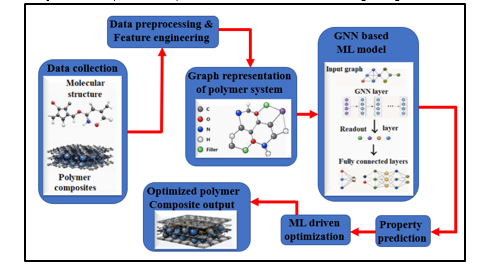
Advanced polymer materials are widely used in modern engineering and manufacturing because of their lightweight nature, flexibility, durability, and adaptability to different applications. However, designing polymer materials with enhanced thermal and electrical properties remains a challenging task. The performance of polymers is influenced by a complex combination of molecular structures, filler materials, processing parameters, and nanoscale interactions. Conventional optimization methods often require extensive experimental trials and computational resources, making it difficult to efficiently explore large material design spaces and identify optimal polymer configurations. To address these challenges, this study presents an intelligent framework for smart polymer material design using Graph Neural Network (GNN)-based machine learning. In the proposed approach, polymer molecular structures and filler interactions are represented as graph-based networks, where atoms are modeled as nodes and molecular bonds are represented as edges. This graph representation enables the framework to effectively capture structural relationships and interaction patterns that influence material properties. By learning these hidden connections, the GNN model can accurately predict the relationship between molecular architecture, composite composition, and key functional characteristics. The framework further incorporates data preprocessing, feature engineering, and adaptive model training to improve prediction efficiency, reliability, and overall performance. Machine-learning-driven optimization is employed to identify polymer compositions that provide improved thermal stability, enhanced electrical conductivity, and stronger structural performance. Extensive simulations and comparative evaluations demonstrate that the proposed GNN-based approach achieves higher prediction accuracy, better scalability, and more effective material optimization than conventional machine-learning techniques and traditional experimental modeling methods. The results indicate that the optimized polymer composites exhibit improved heat dissipation, superior electrical transport properties, and greater resistance to material degradation
Keywords: Graph neural networks, polymer materials, machine learning, thermal conductivity, electrical properties, advanced composites, material optimization, smart manufacturing
[This article belongs to Journal of Polymer & Composites ]

References
1. Simões, S. (2024). High-performance advanced composites in multifunctional material design: State of the art, challenges, and future directions. Materials, 17(23), 5997.
2. Musa, A. A., Bello, A., Adams, S. M., Onwualu, A. P., Anye, V. C., Bello, K. A., & Obianyo, I. I. (2025). Nano-enhanced polymer composite materials: A review of current advancements and challenges. Polymers, 17(7), 893.
3. Wu, X., Yin, T., Liu, W., Wan, L., & Liao, Y. (2025). The advances in polymer-based electrothermal composites: A review. Polymers, 17(15), 2047.
4. Simões, S. (2024). High-performance advanced composites in multifunctional material design: State of the art, challenges, and future directions. Materials, 17(23), 5997.
5. Sharma, S. K., Miladinović, S., Sharma, L. K., Gajević, S., Sharma, Y., Sharma, M., Čukić, S., & Stojanović, B. (2026). Graphene/CNT nanocomposites: Processing, properties, and applications. Nanomaterials, 16(2), 100.
6. Otabil, A., Kharbatli, A. R., Siddique, S. K., et al. (2025). Recent developments in the incorporation of 1D/2D nanofillers in polymer derived ceramics—a review. Advanced Composites and Hybrid Materials, 8, 267.
7. Ratchagar, V., et al. (2024). Investigation of glucose biosensors by non-enzymatic photoluminescent detection using oleic acid treated Ag2S nanoparticles. Materials Chemistry and Physics, 316, 129116.
8. Srivastava, A. K., & Pathak, V. K. (2026). Computational insights into nanofiller–matrix interaction region: A review of enhanced mechanical behaviour in nanocomposites. Multiscale and Multidisciplinary Modeling, Experiments and Design, 9, 96.
9. Zaman, S., Mahmud, M. S., Mollick, A. A., et al. (2026). Artificial intelligence in additive manufacturing: Advances in smart materials, lattice optimization, and process intelligence. International Journal of Advanced Manufacturing Technology.
10. Cao, Y., Fu, H., Lu, J., Chen, Y., Jing, T., Fan, X., & Xu, B. (2026). Artificial intelligence empowered new materials: Discovery, synthesis, prediction to validation. Nano-Micro Letters, 18(1), 109.
11. Deng, L., Dong, Z., Yang, Z., Gong, B., & Zhang, L. (2026). Graph learning in bioinformatics: A survey of graph neural network architectures, biological graph construction and bioinformatics applications. Biomolecules, 16(2), 333.
12. Reiser, P., Neubert, M., Eberhard, A., et al. (2022). Graph neural networks for materials science and chemistry. Communications Materials, 3, 93.
13. Mengesha, W. G. (2025). AI-driven design of multifunctional nanomaterials in revolutionizing high-temperature, high-power solutions for space technology: Potentials, challenges and perspectives. Discover Nano, 20(1), 220.
14. Sheng, Z., Zhu, H., Shao, B., He, Y., Liu, Z., Wang, S., & Sheng, M. (2025). Accelerated discovery of energy materials via graph neural network. Inorganics, 13(12), 395.
15. Bhujel, R., Enkmann, V., Burgstaller, H., & Maharjan, R. (2025). Artificial intelligence-driven strategies for targeted delivery and enhanced stability of RNA-based lipid nanoparticle cancer vaccines. Pharmaceutics, 17(8), 992.
16. Ma, J., Liu, J., Xu, D., Song, X., & Zhang, Z. (2025). Application and prospects of large language models in small-molecule drug discovery. Analytical Chemistry, 97(50), 27453–27477.
17. Debnath, G., Vasu, B., & Gorla, R. S. R. (2025). Current state-of-the-art in multi-scale modeling in nano-cancer drug delivery: Role of AI and machine learning. Cancer Nano, 16, 45.
18. Ali, Z., Yaqoob, S., Yu, J., & D’Amore, A. (2024). Unveiling the influential factors and heavy industrial applications of graphene hybrid polymer composites. Journal of Composites Science, 8(5), 183.
19. Tan, J., & Zhang, Y. (2024). Thermal conductive polymer composites: Recent progress and applications. Molecules, 29(15), 3572.
20. Liu, Y., Gong, W., Liu, X., Fan, Y., He, A., & Nie, H. (2024). Enhancing thermal conductivity in polymer composites through molding-assisted orientation of boron nitride. Polymers, 16(8), 1169.
21. Alosious, S., Jiang, M., & Luo, T. (2025). Computation and machine learning for materials: Past, present, and future perspectives. MRS Bulletin, 50, 1212–1224.
22. Nazari, S., & Abdelrasoul, A. (2025). Advancements and applications of artificial intelligence and machine learning in material science and membrane technology: A comprehensive review. Membranes, 15(12), 353.
23. Badini, S., Regondi, S., & Pugliese, R. (2023). Unleashing the power of artificial intelligence in materials design. Materials, 16(17), 5927.
24. Ge, W., De Silva, R., Fan, Y., Sisson, S. A., & Stenzel, M. H. (2025). Machine learning in polymer research. Advanced Materials, 37(11), e2413695.
25. Abbas, K., Hao, C., Dong, S., et al. (2026). A dual-branch graph neural network architecture for drug-target binding affinity prediction. Scientific Reports, 16, 13864.
26. Khemani, B., Patil, S., Kotecha, K., et al. (2024). A review of graph neural networks: Concepts, architectures, techniques, challenges, datasets, applications, and future directions. Journal of Big Data, 11, 18.
27. Sui, T., Liu, S., Cong, B., et al. (2025). Graph attention networks decode conductive network mechanism and accelerate design of polymer nanocomposites. npj Computational Materials, 11, 280.
28. Zhao, Y., Li, H., Zhou, H., et al. (2024). A review of graph neural network applications in mechanics-related domains. Artificial Intelligence Review, 57, 315.
29. Reiser, P., Neubert, M., Eberhard, A., Torresi, L., Zhou, C., Shao, C., Metni, H., van Hoesel, C., Schopmans, H., Sommer, T., & Friederich, P. (2022). Graph neural networks for materials science and chemistry. Communications Materials, 3(1), 93.
30. Alwan, A. H., Hamzah, M. N., & Jaber, A. A. (2026). Experimental and machine learning approaches for the design and optimization of additively manufactured polymer gears: A review. Multiscale and Multidisciplinary Modeling, Experiments and Design, 9, 60.
31. Butt, M. A., Kazanskiy, N. L., & Khonina, S. N. (2022). Revolution in flexible wearable electronics for temperature and pressure monitoring—A review. Electronics, 11(5), 716.
32. Mengesha, W. G., & Nagessar, K. (2026). A critical review on electronic materials properties and multifunctional applications. Discover Materials, 6, 38.

Journal of Polymer & Composites
| Volume | 14 | |
| Issue | 04 | |
| Received | 15/05/2026 | |
| Accepted | 08/06/2026 | |
| Published | 22/06/2026 | |
| Publication Time | 38 Days |