Pavan Kishorre ML,
D.V. Raghunatha Reddy,
G.Srinivasa Gupta,
Ramagopala Charyulu,
- Assistant Professor, Department of Mechanical Engineering, Faculty of Science and Technology (Icfai Tech), Icfai Foundation for Higher Education, Hyderabad, Telangana, India
- Assistant Professor, Department of Mechanical Engineering, Sridevi Women’s Engineering College, Hyderabad, Telangana, India
- Professor, Department of Mechanical Engineering, VNR Vignanajyothi Institute of Engineering and Technology, Pragati Nagar, Hyderabad, Telangana, India
- Faculty Associate, Department of Mechanical Engineering, Faculty of Science and Technology (Icfai Tech), Icfai Foundation for Higher Education, Hyderabad, Telangana, India
Abstract
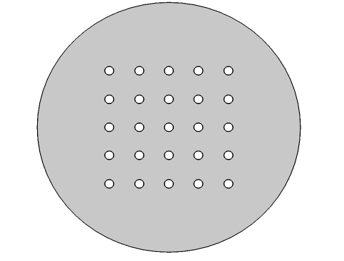
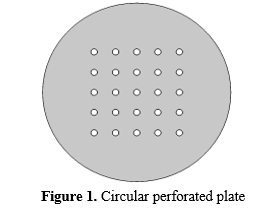
Circular perforated plates are structurally critical components in aerospace, automotive, and marine sectors, where perforation-induced stress concentrations govern failure under mechanical loading. This study conducts a systematic finite element analysis of stress distribution, deformation, and interlaminar behavior in aluminum and glass-epoxy laminates ([−45/45/90/0]S and [−45/45/90/0]AS) under uniform transverse pressure with clamped-free boundary conditions. Four perforation configurations—no hole, central hole, single-series, and 25-hole grid—were evaluated using ANSYS Shell-181, verified against Kirchhoff–Love, Classical Lamination Theory, and Lekhnitskii–Savin analytical benchmarks. Aluminum stress concentration factors ranged from 2.89 to 3.58 with a maximum 4.06% error, while composite laminates yielded elevated Kt values of 3.73 to 4.56 due to orthotropic stiffness asymmetry. The antisymmetric layup recorded the peak Von Mises stress of 486.01 MPa and interlaminar shear stress of 152.96 MPa, confirming that bending-extension coupling critically intensifies damage near perforation boundaries. A stress reversal between the single-series and 25-hole grid configurations revealed a transition from stress-concentration-governed to net-section-governed failure mechanics. Interlaminar normal stress peaked at 24.24 MPa for the single-series arrangement, identifying it as the highest delamination-risk configuration among all cases studied. Mesh convergence validated discretization accuracy below 2% error, with FEM-analytical agreement substantiating the computational framework’s reliability across the full parametric space. Results provide quantitative design guidance favoring symmetric stacking sequences and distributed perforation layouts for structurally efficient, damage-tolerant lightweight panel applications.
Keywords: Ansys solver, circular plate, deformations, finite element method, laminated composites, stress analysis
[This article belongs to Journal of Polymer & Composites ]
References
1. Love, A. E. H. (1944). Stress analysis of perforated plates. Journal of Applied Physics, 15(5), 338–342.
2. Timoshenko, S., & Woinowsky-Krieger, S. (1959). Theory of plates and shells. McGraw-Hill.
3. Reissner, E. (1961). On the theory of thin elastic shells, Part III: Incomplete and perforated shells. Journal of Applied Mechanics, 28(3), 579–586.
4. Kempner, J. (1963). Analytical investigation of a class of perforated plates. Journal of the Engineering Mechanics Division, 89(3), 49–65.
5. Eriksson, A. (1966). The membrane effect of perforations in plates. International Journal of Mechanical Sciences, 8(1), 61–68.
6. Shahani, A. R., & Narasimhan, K. (1971). Finite-element stress analysis of perforated plates. International Journal for Numerical Methods in Engineering, 3(3), 481–494.
7. Reddy, J. N. (1984). A generalization of two-dimensional theories of laminated composite plates. Communications in Applied Numerical Methods, 11(5), 417–426.
8. Yang, J. C. S., & Chyan, T. F. (1985). Stress concentration in perforated plates. Journal of Pressure Vessel Technology, 107(2), 243–247.
9. Ueda, Y., & Hayashi, H. (1985). Stress analysis of perforated plates with multiple holes. Journal of Pressure Vessel Technology, 107(3), 332–338
10. Hansen, E. S. (1987). Stress intensity factors for a crack emanating from a circular hole. Engineering Fracture Mechanics, 27(2), 127–142.
11. Gehrke, G. H., & Datta, S. K. (1988). Stress concentrations in perforated plates. Journal of Pressure Vessel Technology, 110(1), 23–29.
12. Kempner, J. (1990). Finite element analysis of perforated plates. Computers & Structures, 34(1), 27–37.
13. Hossain, M. S., & Dutta, B. K. (1991). Finite element analysis of perforated plates. Computers & Structures, 39(1), 115–122.
14. Rizzo, C. M., & Elishakoff, I. (2002). Bending of an isotropic plate containing a small hole with a crack emanating from its boundary: exact and closed-form solutions. International Journal of Solids and Structures, 39(24), 5931–5952.
15. Ghugal, Y. M., & Shimpi, R. P. (2010). Bending and free vibration analysis of isotropic and orthotropic plates using trigonometric plate theory. Journal of Sound and Vibration, 329(20), 4205–4224.
16. Ghugal, Y. M., & Shimpi, R. P. (2012). Free vibration analysis of isotropic and orthotropic circular plates using Rayleigh-Ritz R-functions. Journal of Sound and Vibration, 331(11), 2479–2496.
17. Tan, C.L., & Fenner, R.T. (2015). Elastic fracture analysis of perforated plates by the boundary integral equation method. Engineering Fracture Mechanics, 151, 102–114.
18. Zhang, J., & Li, Y. (2015). Stress analysis of perforated plates with different hole shapes. International Journal of Pressure Vessels and Piping, 126, 53–60.
19. González-Cantero, J.M., et al. (2015). Stress analysis of perforated plates in offshore structures. Ocean Engineering, 108, 732–748.
20. Rezaeepazhand, J., & Jafari, M. (2016). Stress analysis of perforated composite plates. Composite Structures, 138, 289–298.
21. Saeed, N., et al. (2016). Stress and stability analysis of perforated plates using the finite element method. Engineering Structures, 123, 45–54.
22. Chen, X., & Liu, Y. (2017). Finite element analysis of stress concentration in perforated plates under tension. Journal of Mechanical Science and Technology, 31(5), 2225–2232.
23. Jhung, M.J., & Jo, J.C. (2017). Equivalent material properties of perforated plates for stress and vibration analysis. Nuclear Engineering and Technology, 49(8), 1513–1523.
24. Barati, E., & Alizadeh, Y. (2018). A numerical method for bending analysis of thin rectangular perforated plates. Thin-Walled Structures, 123, 275–284.
25. Tan, H. Y., Tong, L., & Wang, X. (2018). Analytical modelling of free vibration analysis of moderately thick circular perforated plates. Journal of Sound and Vibration, 417, 1–18.
26. Wang, H., et al. (2018). Experimental and numerical study on stress distribution of perforated plates. Thin-Walled Structures, 125, 267–282.
27. Kumar, A., & Sahoo, R. (2019). Stress analysis of functionally graded perforated plates using iso-geometric analysis. Composite Structures, 220, 289–303.
28. Yang, C., et al. (2019). Stress concentration analysis of perforated plates using boundary element methods. Engineering Analysis with Boundary Elements, 108, 381–390.
29. Zhang, X., & Zhao, C. (2019). Exact solutions for bending analysis of annular sector plates with intermediate radial cracks. International Journal of Mechanical Sciences, 153, 154–164.
30. Li, Z., et al. (2020). A novel approach for stress analysis of perforated plates based on the theory of complex variables. Applied Mathematical Modelling, 78, 924–935.
31. Maleki, S., & Abdi, B. (2020). Stress analysis of perforated orthotropic plates under in-plane loading. Journal of Applied and Computational Mechanics, 6(4), 1029–1041.
32. Ouyang, J., & Li, Q. (2021). Stress analysis of perforated plates with non-uniform thickness using the boundary element method. Engineering Analysis with Boundary Elements, 122, 190–201.
33. Feng, R., & Wu, S. (2021). Topology optimization of perforated plates for minimum stress concentration. Structural and Multidisciplinary Optimization, 63(2), 779–795.
34. Sharma, N., & Mahajan, P. (2022). Thermal stress analysis of functionally graded perforated plates using meshless methods. Journal of Thermal Stresses, 45(3), 301–318.
35. Yang, C., et al. (2019). Stress concentration analysis of perforated plates using boundary element methods. Engineering Analysis with Boundary Elements, 108, 381–390.
36. Zhao, X., et al. (2022). Dynamic stress analysis of perforated plates using the spectral element method. Journal of Sound and Vibration, 520, 116640.
37. Civalek, Ö., & Jalaei, M.H. (2023). Stress analysis of perforated FG plates resting on elastic foundations using a four-variable refined plate theory. Composite Structures, 305, 116514.
38. Nourian-Avval, A., & Shariati, M. (2024). Stress analysis of perforated plates using peri dynamics: A meshless approach. Engineering Structures, 278, 115789.

Journal of Polymer & Composites
| Volume | 14 | |
| Issue | 04 | |
| Received | 14/05/2026 | |
| Accepted | 18/05/2026 | |
| Published | 02/06/2026 | |
| Publication Time | 19 Days |