Ruchi Sharma,
Nitu Sehrawat,
Anil Kumar,
Suman Yadav,
Annu Dabas,
Karunapati Tripathi,
- Associate Professor, Department of Electronics and Communication Engineering, Bharati Vidyapeeth’s College of Engineering, New Delhi, India
- Associate Professor, Department of Applied Science, Bharati Vidyapeeth’s College of Engineering, New Delhi, India
- Associate Professor, Department of Applied Science, Bharati Vidyapeeth’s College of Engineering, New Delhi, India
- Associate Professor, Department of Electronics and Communication Engineering, Bharati Vidyapeeth’s College of Engineering, New Delhi, India
- Assistant Professor, Department of Electronics and Communication Engineering, Bharati Vidyapeeth’s College of Engineering, New Delhi, India
- Assistant Professor, Department of Applied Science, Maharaja Agrasen Institute of Technology, Sector-22, Rohini, Delhi, India
Abstract
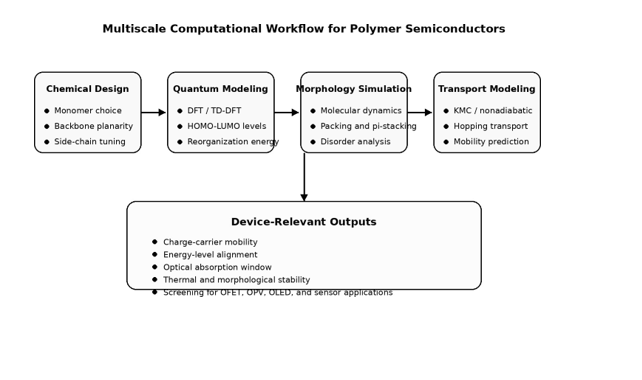
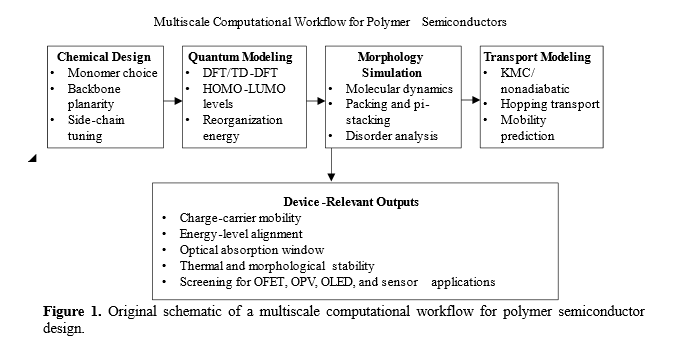
Polymer semiconductors have become important materials in modern electronic applications because they combine semiconducting behavior with mechanical flexibility, low-cost processing, and tunable molecular structure. Their growing use in organic field-effect transistors, organic photovoltaics, organic light-emitting diodes, and flexible sensing devices has increased the need for accurate computational approaches that can predict material properties and device performance before experimental fabrication. This paper reviews the major computational modeling techniques used for polymer semiconductors and explains their role in understanding structure-property relationships. Density functional theory is useful for estimating frontier orbital energies, band gaps, charge-transfer parameters, and optical transitions. Molecular dynamics simulation helps in examining chain conformation, intermolecular packing, and thin-film morphology, all of which strongly influence charge transport. Kinetic Monte Carlo methods and related transport models are important for predicting carrier mobility and transport pathways in disordered and semicrystalline systems. In addition, machine learning methods are increasingly applied for rapid screening of candidate materials and for accelerating polymer design. The study highlights that no single computational method is sufficient to explain the full electronic behavior of polymer semiconductors. Instead, meaningful prediction requires an integrated multiscale framework that connects molecular-level electronic structure with morphology and device-level charge transport. Overall, computational modeling has become an essential tool for the rational design of efficient, stable, and application-oriented polymer semiconductor materials.
Keywords: Polymer semiconductors, Computational modeling, Charge transport, Organic electronics, Density functional theory, Molecular dynamics
[This article belongs to Journal of Polymer & Composites ]
References
1. Sirringhaus H. Device Physics of Solution-Processed Organic Field-Effect Transistors. Adv Mater. 2005;17(20):2411-2425.
2. Coropceanu V, Cornil J, da Silva Filho DA, Olivier Y, Silbey R, Brédas JL. Charge Transport in Organic Semiconductors. Chem Rev. 2007;107(4):926-952.
3. Wang C, Dong H, Hu W, Liu Y, Zhu D. Semiconducting π-Conjugated Systems in Field-Effect Transistors: A Material Odyssey of Organic Electronics. Chem Rev. 2012;112(4):2208-2267.
4. Fratini S, Mayou D, Ciuchi S. The transient localization scenario for charge transport in crystalline organic materials. Adv Funct Mater. 2016;26(14):2292-2315.
5. Jackson NE, Savoie BM, Marks TJ, Ratner MA, Chen LX. The Next Breakthrough for Organic Photovoltaics? J Phys Chem Lett. 2015;6(1):77-84.
6. Bhat V, Callaway CP, Risko C. Computational Approaches for Organic Semiconductors: From Chemical and Physical Understanding to Predicting New Materials. Chem Rev. 2023;123(12):7498-7547.
7. Hutsch S, Panhans M, Ortmann F. Charge carrier mobilities of organic semiconductors: ab initio simulations with mode-specific treatment of molecular vibrations. npj Comput Mater. 2022;8:277.
8. Kunkel C, Schober C, Margraf JT, Reuter K, Oberhofer H. Finding the right bricks for molecular legos: a data mining approach to organic semiconductor design. Chem Mater. 2019;31(23):969-978.
9. Burke C, Patel M, et al. Models connecting microstructure and charge transport in polymeric semiconductors. Mater Horiz. 2025;12:1-18.
10. Nematiaram T, Ciuchi S, Xie X, Fratini S, Troisi A. Practical computation of the charge mobility in molecular semiconductors using transient localization theory. J Phys Chem C. 2019;123(11):6989-6997.
11. Giannini S, Carof A, Ellis M, et al. Quantum localization and delocalization of charge carriers in organic semiconducting crystals. Nat Commun. 2019;10:3843.
12. Saleh J, Ismail M, et al. Energy Level Prediction of Organic Semiconductors for Photodetectors with Machine Learning. ACS Omega. 2023;8:11896-11908.

Journal of Polymer & Composites
| Volume | 14 | |
| Issue | 03 | |
| Received | 28/04/2025 | |
| Accepted | 15/05/2026 | |
| Published | 25/05/2026 | |
| Publication Time | 392 Days |