Pasunuti Durga,
C. Hazarathaiah Yadav,
Darwin R S,
Mahesh Kumar Thota,
- Research Scholar, Department of Chemistry, Vel Tech Rangarajan Dr. Sakunthala R&D Institute of science &Technology, Avadi, Chennai, Tamil Nadu, India
- Professor and Head, Department of Chemistry, Vel Tech Rangarajan Dr. Sakunthala R&D Institute of science &Technology, Avadi, Chennai, Tamil Nadu, India
- Research Scholar, Department of Chemistry, Vel Tech Rangarajan Dr. Sakunthala R&D Institute of science &Technology, Avadi, Chennai, Tamil Nadu, India
- Assistant Professor, Department of Computer Science and Engineering, Koneru Lakshmaiah Education Foundation, Bowrampet, Hyderabad, Telangana, India
Abstract
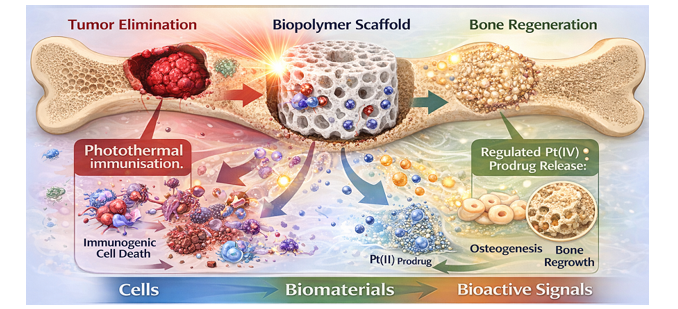
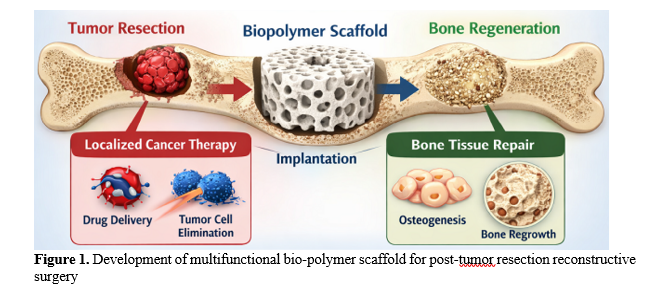
Biopolymer-based composite scaffolds have attracted significant attention as multifunctional platforms at the intersection of polymer science, regenerative medicine, and cancer nanotherapy. In this study, a dual-functional scaffold was developed for simultaneous osteosarcoma treatment and bone regeneration using poly (L-lactic acid) (PLLA) reinforced with bioactive glass (BG) and integrated with a glutathione-responsive platinum (IV) prodrug system (PDA@Pt). To improve interfacial adhesion, photothermal conversion efficiency, and tumor-specific activation, the Pt (IV) prodrug was conjugated onto polydopamine (PDA) nanoparticles. These nanofillers were uniformly embedded within the PLLA/BG matrix via selective laser sintering (SLS), enabling precise architectural control, optimized porosity, and enhanced mechanical stability suitable for load-bearing bone applications.
The engineered scaffold exhibited a highly interconnected porous structure that supported nutrient transport, vascularization, and cell infiltration, while maintaining improved compressive strength due to synergistic reinforcement from bioactive glass and polymer crystallinity. Under near-infrared (NIR) irradiation, the scaffold generated localized hyperthermia, enabling efficient tumor ablation and simultaneously triggering the reduction of Pt (IV) to cytotoxic Pt (II) species in the glutathione-rich tumor microenvironment. The drug release profile showed sustained and stimuli-responsive kinetics governed by matrix degradation and redox-sensitive cleavage mechanisms, ensuring controlled therapeutic delivery.
In vitro studies demonstrated strong cytotoxicity against osteosarcoma cells, along with induction of immunogenic cell death and activation of the cGAS–STING signaling pathway, highlighting its promise for polymer-mediated cancer immunotherapy. Concurrently, the scaffold promoted osteogenic differentiation of bone marrow mesenchymal stem cells, as evidenced by increased alkaline phosphatase activity and osteocalcin expression.
In vivo results further confirmed effective tumor suppression under NIR exposure and accelerated bone regeneration in critical-sized defects with improved tissue integration. Overall, this work highlights the potential of integrating polymer matrices, bioactive inorganic phases, and multifunctional nanocarriers to develop advanced scaffolds with synchronized therapeutic and regenerative functions for regenerative oncology and personalized biomedical applications.
Keywords: Biopolymeric composites, 3D polymer scaffolds, Photothermal-responsive materials, Polymer-based drug delivery systems, Platinum-based prodrugs, Controlled release kinetics, Tissue engineering matrices
[This article belongs to Journal of Polymer & Composites ]
References
1. Sindhi, K., Pingili, R. B., Beldar, V., Bhattacharya, S., Rahaman, J., & Mukherjee, D. (2025). The role of biomaterials-based scaffolds in advancing skin tissue construct. Journal of Tissue Viability, 34(2), 100858. https://doi.org/10.1016/j.jtv.2025.100858
2. Yan, Z., Deng, Y., Huang, L., Zeng, J., Wang, D., Tong, Z., Fan, Q., Tan, W., Yan, J., Zang, X., & Chen, S. (2025). Biopolymer-based bone scaffold for controlled Pt (IV) prodrug release and synergistic photothermal-chemotherapy and immunotherapy in osteosarcoma. Journal of Nanobiotechnology, 23(1), 286. https://doi.org/10.1186/s12951-025-03253-w
3. Sultana, N., Cole, A., & Strachan, F. (2024). Biocomposite scaffolds for tissue Engineering: materials, fabrication techniques and future directions. Materials, 17(22), 5577. https://doi.org/10.3390/ma17225577
4. Garot, C.; Bettega, G.; Picart, C. Additive Manufacturing of Material Scaffolds for Bone Regeneration: Toward Application in the Clinics. Adv. Funct. Mater. 2020, 31, 2006967.
5. Aldana, A.A.; Abraham, G.A. Current advances in electrospun gelatin-based scaffolds for tissue engineering applications. Int. J. Pharm. 2017, 523, 441–453.
6. Gregor, A.; Filová, E.; Novák, M.; Kronek, J.; Chlup, H.; Buzgo, M.; Blahnová, V.; Lukášová, V.; Bartoš, M.; Nečas, A.; et al. Designing of PLA scaffolds for bone tissue replacement fabricated by ordinary commercial 3D printer. J. Biol. Eng. 2017, 11, 31.
7. Mao, A.S.; Mooney, D.J. Regenerative medicine: Current therapies and future directions. Proc. Natl. Acad. Sci. USA 2015, 112, 14452–14459.
8. Dzobo, K.; Thomford, N.E.; Senthebane, D.A.; Shipanga, H.; Rowe, A.; Dandara, C.; Pillay, M.; Motaung, K.S.C.M. Advances in Regenerative Medicine and Tissue Engineering: Innovation and Transformation of Medicine. Stem Cells Int. 2018, 2018, 2495848.
9. Kaul, H.; Ventikos, Y. On the genealogy of tissue engineering and regenerative medicine. Tissue Eng. Part B Rev. 2015, 21, 203–217.
10. Krishani, M.; Shin, W.Y.; Suhaimi, H.; Sambudi, N.S. Development of Scaffolds from Bio-Based Natural Materials for Tissue Regeneration Applications: A Review. Gels 2023, 9, 100.
11. Marques, C.F.; Diogo, G.S.; Pina, S.; Oliveira, J.M.; Silva, T.H.; Reis, R.L. Collagen-based bioinks for complex tissue engineering applications: A comprehensive review. J. Mater. Sci. Mater. Med. 2019, 30, 32.
12. Silver, F.H.; Jaffe, M.; Shah, R.G. Structure and behavior of collagen fibers. In Handbook of Properties of Textile and Technical Fibers; Woodhead Publishing: Sawston, UK, 2018; pp. 345–365.
13. Fan, J.; Abedi-Dorcheh, K.; Sadat Vaziri, A.; Kazemi-Aghdam, F.; Rafieyan, S.; Sohrabinejad, M.; Ghorbani, M.; Rastegar Adib, F.; Ghasemi, Z.; Klavins, K.; et al. A Review of Recent Advances in Natural Polymer-Based Scaffolds for Musculoskeletal Tissue Engineering. Polymers 2022, 14, 2097.
14. Afewerki, S.; Sheikhi, A.; Kannan, S.; Ahadian, S.; Khademhosseini, A. Gelatin-polysaccharide composite scaffolds for 3D cell culture and tissue engineering: Towards natural therapeutics. Bioeng. Transl. Med. 2018, 4, 96–115.
15. Kuttappan, S.; Mathew, D.; Nair, M.B. Biomimetic composite scaffolds containing bioceramics and collagen/gelatin for bone tissue engineering—A mini-review. Int. J. Biol. Macromol. 2016, 93 Pt B, 1390–1401.
16. Norouzi, S., Shemshaki, N. S., Norouzi, E., Latifi, M., Azimi, B., Danti, S., Qiao, X., Miao, Y., Yang, S., Gorji, M., Petrovic, V., Aboudzadeh, M. A., & Bagherzadeh, R. (2024). Recent advances in biomaterials for tissue-engineered constructs: Essential factors and engineering techniques. Materials Today Chemistry, 37, 102016. https://doi.org/10.1016/j.mtchem.2024.102016
17. Hatem, S., Abdel-Gawad, R., Hussein, D.K. et al. Biological modulation and repair using plant-derived bioactives: advancements in tissue engineering and regenerative medicine. Futur J Pharm Sci 12, 14 (2026). https://doi.org/10.1186/s43094-026-00933-8
18. Norouzi, S., Shemshaki, N. S., Norouzi, E., Latifi, M., Azimi, B., Danti, S., Qiao, X., Miao, Y., Yang, S., Gorji, M., Petrovic, V., Aboudzadeh, M. A., & Bagherzadeh, R. (2024). Recent advances in biomaterials for tissue-engineered constructs: Essential factors and engineering techniques. Materials Today Chemistry, 37, 102016. https://doi.org/10.1016/j.mtchem.2024.102016
19. Huang, R., Yang, W., Wang, T., Cao, X., Sun, S., Jiang, J., Liu, H., & Peng, J. (2025). Photothermally-activated nano-delivery system for on-demand treatment of diabetic wound infections. International Journal of Pharmaceutics X, 11, 100464. https://doi.org/10.1016/
j.ijpx.2025.100464
20. Ellakwa, D.ES., Abu-Khadra, A.S. & Ellakwa, T.E. Insight into bioactive glass and bio-ceramics uses: unveiling recent advances for biomedical application. Discov Mater 5, 78 (2025). https://doi.org/10.1007/s43939-025-00254-2
21. Nshimiyimana, P., Major, I., Colbert, D. M., & Buckley, C. (2025). Progress in the Biomedical application of Biopolymers: An Overview of the status quo and outlook in managing intrauterine adhesions. Macromol—A Journal of Macromolecular Research, 5(2), 25. https://doi.org/10.3390/macromol5020025
22. Savioli Lopes, M.; Jardini, A.L.; Maciel Filho, R. Poly (lactic acid) production for tissue engineering applications. Procedia Eng. 2012, 42, 1402–1413.
23. Wang, J.; Yang, C.; Xie, Y.; Chen, X.; Jiang, T.; Tian, J.; Hu, S.; Lu, Y. Application of Bioactive Hydrogels for Functional Treatment of Intrauterine Adhesion. Front. Bioeng. Biotechnol. 2021, 9, 1–16.
24. Buckley, C.; Murphy, E.J.; Montgomery, T.R.; Major, I. Hyaluronic Acid: A Review of the Drug Delivery Capabilities of This Naturally Occurring Polysaccharide. Polymers 2022, 14, 3442.
25. Murphy, E.J.; Fehrenbach, G.W.; Abidin, I.Z.; Buckley, C.; Montgomery, T.; Pogue, R.; Murray, P.; Major, I.; Rezoagli, E. Polysaccharides—Naturally Occurring Immune Modulators. Polymers 2023, 15, 2373.
26. Lee, S.S.; Kim, H.D.; Kim, S.H.L.; Kim, I.; Kim, I.G.; Choi, J.S.; Jeong, J.; Kim, J.H.; Kwon, S.K.; Hwang, N.S. Self-healing and adhesive artificial tissue implant for voice recovery. ACS Appl. Bio Mater. 2018, 1, 1134–1146.
27. Pina, S.; Oliveira, J.M.; Reis, R.L. Natural-based nanocomposites for bone tissue engineering and regenerative medicine: A review. Adv. Mater. 2015, 27, 1143–1169.
28. Gwak, S.J.; Lee, Y.B.; Lee, E.J.; Park, K.H.; Kang, S.W.; Huh, K.M. The use of acetylation to improve the performance of hyaluronic acid-based dermal filler. Korean J. Chem. Eng. 2023, 40, 1963–1969.
29. Lee, S.S.; Du, X.; Kim, I.; Ferguson, S.J. Scaffolds for bone-tissue engineering. Matter 2022, 5, 2722–2759.
30. Roupa, Z.; Polikandrioti, M.; Sotiropoulou, P.; Faros, E.; Koulouri, A.; Wozniak, G.; Gourni, M. Causes of Infertility in Women at Reproductive Age. Heal. Sci. J. 2009, 3, 80–87.
31. Han, Q.; Du, Y. Advances in the Application of Biomimetic Endometrium Interfaces for Uterine Bioengineering in Female Infertility. Front. Bioeng. Biotechnol. 2020, 8, 1–9.
32. Feng, L.; Wang, L.; Ma, Y.; Duan, W.; Martin-Saldaña, S.; Zhu, Y.; Zhang, X.; Zhu, B.; Li, C.; Hu, S.; et al. Engineering self-healing adhesive hydrogels with antioxidant properties for intrauterine adhesion prevention. Bioact. Mater. 2023, 27, 82–97.
33. Schmerold, L.; Martin, C.; Mehta, A.; Sobti, D.; Jaiswal, A.K.; Kumar, J.; Feldberg, I.; Munro, M.G.; Lee, W.C. A cost-effectiveness analysis of intrauterine spacers used to prevent the formation of intrauterine adhesions following endometrial cavity surgery. J. Med. Econ. 2024, 27, 170–183.
34. Huang, C.Y.; Chang, W.H.; Cheng, M.; Huang, H.Y.; Horng, H.C.; Chen, Y.J.; Lee, W.L.; Wang, P.H. Crosslinked hyaluronic acid gels for the prevention of intrauterine adhesions after a hysteroscopic myomectomy in women with submucosal myomas: A prospective, randomized, controlled trial. Life 2020, 10, 67.
35. Wang, P.H.; Yang, S.T.; Chang, W.H.; Liu, C.H.; Liu, H.H.; Lee, W.L. Intrauterine adhesion. Taiwan. J. Obstet. Gynecol. 2024, 63, 312–319.
36. Kou, L.; Jiang, X.; Xiao, S.; Zhao, Y.Z.; Yao, Q.; Chen, R. Therapeutic options and drug delivery strategies for the prevention of intrauterine adhesions. J. Control. Release 2020, 318, 25–37.
37. Nie, N.; Gong, L.; Jiang, D.; Liu, Y.; Zhang, J.; Xu, J.; Yao, X.; Wu, B.; Li, Y.; Zou, X. 3D bio-printed endometrial construct restores the full-thickness morphology and fertility of injured uterine endometrium. Acta Biomater. 2023, 157, 187–199.
38. Huang, X.W.; Lin, M.M.; Zhao, H.Q.; Powell, M.; Wang, Y.Q.; Zheng, R.R.; Ellis, L.B.; Xia, W.T.; Lin, F. A prospective randomized controlled trial comparing two different treatments of intrauterine adhesions. Reprod. Biomed. Online 2020, 40, 835–841.
39. Cen, J.; Zhang, Y.; Bai, Y.; Ma, S.; Zhang, C.; Jin, L.; Duan, S.; Du, Y.; Guo, Y. Research progress of stem cell therapy for endometrial injury. Mater. Today Bio 2022, 16, 100389.
40. De Wilde, R.L.; Devassy, R.; Ten Broek, R.P.G.; Miller, C.E.; Adlan, A.; Aquino, P.; Becker, S.; Darmawan, F.; Gergolet, M.; Habana, M.A.E.; et al. The Future of Adhesion Prophylaxis Trials in Abdominal Surgery: An Expert Global Consensus†. J. Clin. Med. 2022, 11, 1476.
41. Deans, R.; Abbott, J. Review of Intrauterine Adhesions. J. Minim. Invasive Gynecol. 2010, 17, 555–569.
42. Tabeeva, G.; Silachev, D.; Vishnyakova, P.; Asaturova, A.; Fatkhudinov, T.; Smetnik, A.; Dumanovskaya, M. The Therapeutic Potential of Multipotent Mesenchymal Stromal Cell—Derived Extracellular Vesicles in Endometrial Regeneration. Int. J. Mol. Sci. 2023, 24, 9431.
43. Zhu, Q.; Yao, S.; Ye, Z.; Jiang, P.; Wang, H.; Zhang, X.; Liu, D.; Lv, H.; Cao, C.; Zhou, Z.; et al. Ferroptosis contributes to endometrial fibrosis in intrauterine adhesions. Free Radic. Biol. Med. 2023, 205, 151–162.
44. Santamaria, X.; Roson, B.; Perez-Moraga, R.; Venkatesan, N.; Pardo-Figuerez, M.; Gonzalez-Fernandez, J.; Llera-Oyola, J.; Fernández, E.; Moreno, I.; Salumets, A.; et al. Decoding the endometrial niche of Asherman’s Syndrome at single-cell resolution. Nat. Commun. 2023, 14, 5890.
45. Hooker, A.B.; de Leeuw, R.A.; Emanuel, M.H.; Mijatovic, V.; Brolmann, H.A.M.; Huirne, J.A.F. The link between intrauterine adhesions and impaired reproductive performance: A systematic review of the literature. BMC Pregnancy Childbirth 2022, 22, 837.
46. Hanstede, M.M.F.; Van Der Meij, E.; Goedemans, L.; Emanuel, M.H. Results of centralized Asherman surgery, 2003–2013. Fertil. Steril. 2015, 104, 1561–1568.e1.
47. Ang, C.J.; Skokan, T.D.; Mckinley, K.L. Mechanisms of Regeneration and Fibrosis in the Endometrium. Annu. Rev. Cell Dev. Biol. 2023, 39, 197–221.
48. Wang, J.; Zhan, H.; Wang, Y.; Zhao, L.; Huang, Y.; Wu, R. Current advances in understanding endometrial epithelial cell biology and therapeutic applications for intrauterine adhesion. Stem Cell Res. Ther. 2024, 15, 379.
49. Lee, W.L.; Liu, C.H.; Cheng, M.; Chang, W.H.; Liu, W.M.; Wang, P.H. Focus on the primary prevention of intrauterine adhesions: Current concept and vision. Int. J. Mol. Sci. 2021, 22, 5175.
50. Hooker, A.B.; Lemmers, M.; Thurkow, A.L.; Heymans, M.W.; Opmeer, B.C.; Brölmann, H.A.M.; Mol, B.W.; Huirne, J.A.F. Systematic review and meta-analysis of intrauterine adhesions after miscarriage: Prevalence, risk factors and long-term reproductive outcome. Hum. Reprod. Update 2014, 20, 262–278.
51. Wang, Y., Duan, H., Zhang, Z., Chen, L., & Li, J. (2024). Research progress on the application of natural medicines in biomaterial coatings. Materials, 17(22), 5607. https://doi.org/10.3390/
ma17225607
52. Fu, Y.; Liu, T.; Wang, H.; Wang, Z.; Hou, L.; Jiang, J.; Xu, T. Applications of nanomaterial technology in biosensing. J. Sci. Adv. Mater. Devices 2024, 9, 100694.
53. Vigneshvar, S.; Sudhakumari, C.C.; Senthilkumaran, B.; Prakash, H. Recent Advances in Biosensor Technology for Potential Applications—An Overview. Front. Bioeng. Biotechnol. 2016, 4, 11.
54. Ertas, Y.N.; Mahmoodi, M.; Shahabipour, F.; Jahed, V.; Diltemiz, S.E.; Tutar, R.; Ashammakhi, N. Role of biomaterials in the diagnosis, prevention, treatment, and study of corona virus disease 2019 (COVID-19). Emergent Mater. 2021, 4, 35–55.
55. Cai, L.; Xu, J.; Yang, Z.; Tong, R.; Dong, Z.; Wang, C.; Leong, K.W. Engineered biomaterials for cancer immunotherapy. MedComm 2020, 1, 35–46.
56. Xiao, M.; Tang, Q.; Zeng, S.; Yang, Q.; Yang, X.; Tong, X.; Zhu, G.; Lei, L.; Li, S. Emerging biomaterials for tumor immunotherapy. Biomater. Res. 2023, 27, 47.
57. Niziołek, K.; Słota, D.; Sobczak-Kupiec, A. Polysaccharide-Based Composite Systems in Bone Tissue Engineering: A Review. Materials 2024, 17, 4220.
58. Gao, C.; Peng, S.; Feng, P.; Shuai, C. Bone biomaterials and interactions with stem cells. Bone Res. 2017, 5, 253–285.
59. Sun, W.; Ye, B.; Chen, S.; Zeng, L.; Lu, H.; Wan, Y.; Gao, Q.; Chen, K.; Qu, Y.; Wu, B. Neuro–bone tissue engineering: Emerging mechanisms, potential strategies, and current challenges. Bone Res. 2023, 11, 65.
60. Ansari, M. Bone tissue regeneration: Biology, strategies and interface studies. Prog. Biomater. 2019, 8, 223–237.
61. Li, Y., & Li, R. (2025). Preparation and characterization of a GSH-responsive drug-loaded polymer nanoparticle/silk fibroin composite hydrogel. Frontiers in Bioengineering and Biotechnology, 13, 1643800. https://doi.org/10.3389/fbioe.2025.1643800
62. BryantS. J. (2016). SP0088 hydrogels for osteoarthritis treatment. Ann. Rheum. Dis.75, 22. 10.1136/annrheumdis-2016-eular.6408
63. ChelikeD. K.AlagumalaiA.AcharyaJ.KumarP.SarkarK.ThangaveluS. A. G.et al (2020). Functionalized iron oxide nanoparticles conjugate of multi-anchored schiff’s base inorganic heterocyclic pendant groups: cytotoxicity studies. Appl. Surf. Sci.501, 143963. 10.1016/j.apsusc.2019.143963
64. ChenH.ZhuangQ.WangH.ZhaiX.ZhangK.DengH.et al (2022). Ultrafine gold nanoparticles dispersed in conjugated microporous polymers with sulfhydryl functional groups to improve the reducing activity of 4-nitrophenol. Colloids Surf. Physicochem. Eng. Asp.649, 129459. 10.1016/j.colsurfa.2022.129459
65. ChenQ.YanM.HuA.LiangB.LuH.ZhouL.et al (2024). Injectable nanorobot-hydrogel superstructure for hemostasis and anticancer therapy of spinal metastasis. Nano-Micro Lett.16, 259. 10.1007/s40820-024-01469-3
66. FengJ.LiZ.TianL.MuP.HuY.XiongF.et al (2022). Efficacy and safety of curcuminoids alone in alleviating pain and dysfunction for knee osteoarthritis: a systematic review and meta-analysis of randomized controlled trials. BMC Complement. Med. Ther.22, 276. 10.1186/s12906-022-03740-9
67. FuS.RempsonC. M.PucheV.ZhaoB.ZhangF. (2022). Construction of disulfide containing redox-responsive polymeric nanomedicine. Methods199, 67–79. 10.1016/j.ymeth.2021.12.011
68. HoelderS.ClarkeP. A.WorkmanP. (2012). Discovery of small molecule cancer drugs: successes, challenges and opportunities. Mol. Oncol.6, 155–176. 10.1016/j.molonc.2012.02.004
69. KimS. H.YeonY. K.LeeJ. M.ChaoJ. R.LeeY. J.SeoY. B.et al (2018). Precisely printable and biocompatible silk fibroin bioink for digital light processing 3D printing. Nat. Commun.9, 1620. 10.1038/s41467-018-03759-y
70. KovrlijaI.MenshikhK.AbreuH.CochisA.RimondiniL.MarsanO.et al (2024). Challenging applicability of ISO 10993-5 for calcium phosphate biomaterials evaluation: towards more accurate in vitro cytotoxicity assessment. Biomater. Adv.160, 213866. 10.1016/j.bioadv.2024.213866
71. Jiao, Y., Zhang, Y., Dong, C., Zhu, J., Chen, W., Xu, T., Ye, S., & Du, Y. (2025). Recent advances in inorganic nanocomposites for the photothermal therapy of bone tumors. Nanoscale Horizons. https://doi.org/10.1039/d5nh00692a
72. Naik, G. a. R. R., Gupta, A., Datta, D., More, M., Roy, A. A., Kudarha, R., Hedayat, P., Moorkoth, S., Mutalik, S., & Dhas, N. (2025). Synergistic combinational photothermal therapy-based approaches for cancer treatment. FlatChem, 50, 100834. https://doi.org/10.1016/j.flatc.
2025.100834
73. Xu, H., Jiang, Y., Zhang, R., Wang, D., Feng, J., & Zhang, H. (2026). Multiple-pathway cGAS-STING activation with enhanced mild photothermal therapy through glycolysis regulation for boosting gastric cancer immunotherapy. Materials Today Bio, 37, 102790. https://doi.org/10.1016/j.mtbio.2026.102790
74. Yan, Y., Tan, X., Song, B., Yi, M., Chu, Q., & Wu, K. (2025). Breaking barriers: The cGAS‐STING pathway as a novel frontier in cancer immunotherapy. Cancer Communications, 45(11), 1513–1546. https://doi.org/10.1002/cac2.70067
75. Afsharian, Y. P., Rahimnejad, M., Rabiee, S. M., Feizi, F., & Seitz, H. (2025). Recent advances in promoting bone regeneration in Type 2 diabetes using drug delivery vehicles and Vehicle‐Free therapeutics. Advanced Therapeutics, 8(2). https://doi.org/10.1002/adtp.202400400
76. Yang Q, Lou S, Zhang Y, Fang Z, Xing C, Wang W, Han M, Wang Z, Tang BZ, Zhang M. NIR-II Responsive Multifunctional Scaffold Enabling “Kill-Modulation-Build” Synergistic Therapy for Infectious Bone Defects. Adv Sci (Weinh). 2025 Dec;12(47):e08948. doi: 10.1002/advs.202508948.
77. Jabeen, N., & Atif, M. (2023). Polysaccharides based biopolymers for biomedical applications: A review. Polymers for Advanced Technologies, 35(1). https://doi.org/10.1002/pat.6203

Journal of Polymer & Composites
| Volume | 14 | |
| Issue | 03 | |
| Received | 23/04/2026 | |
| Accepted | 06/05/2026 | |
| Published | 20/05/2026 | |
| Publication Time | 27 Days |