C. Hazarathaiah Yadav,
Lavanya D,
A. Mohamed Sikkander,
M. Mohamed Ismail,
- Professor & Head, Department of Chemistry, Vel Tech Rangarajan Dr. Sakunthala R&D Institute of science &Technology, Avadi, Chennai, Tamil Nadu, India
- Research Scholar, Department of Chemistry, Vel Tech Rangarajan Dr. Sakunthala R&D Institute of science &Technology, Avadi, Chennai, Tamil Nadu, India
- Professor, Department of Chemistry, GKM College of Engineering and Technology, Chennai, Tamil Nadu, India
- Research Scholar, Department of Chemistry, Kanda swami Kandar’s College (Affiliated to Periyar University, Salem), P. Velur, Namakkal Dt, Tamil Nadu, India
Abstract
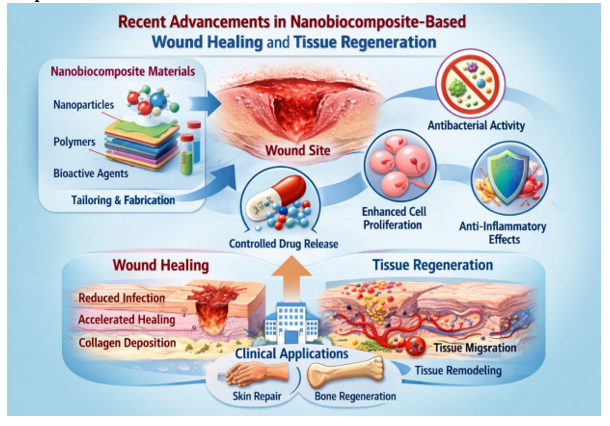
Haemostasis, inflammation, proliferation, remodeling, and other highly coordinated cellular and molecular activities are all part of the complex biological processes of wound healing and tissue regeneration. Following an injury, these stages cooperate to restore tissue integrity and function. However, this normal process is disturbed in many clinical circumstances, especially chronic wounds such diabetic ulcers, burns, and pressure sores. Prolonged inflammation, chronic microbial infection, diminished angiogenesis, and impaired extracellular matrix production are common characteristics of these wounds, which can cause delayed or incomplete healing and place a heavy strain on healthcare systems across the globe. Nanobiocomposites have become a very promising material for improved wound care applications in recent years.
Natural or artificial polymers are combined with nanoscale elements including nanoparticles, nanofibers, and nanotubes to create these hybrid systems. Multifunctional materials with increased qualities, such as potent antibacterial activity, enhanced biocompatibility, regulated medication release, and higher mechanical strength, are the outcome of this integration. Crucially, nanobiocomposites have the ability to precisely resemble the extracellular matrix’s structure and function, which encourages cell adhesion, proliferation, and differentiation all of which are critical for successful tissue regeneration. Innovative platforms like electro spun nanofibers, hydrogels filled with nanoparticles, bioactive scaffolds, and stimuli-responsive smart materials have been the focus of recent developments in this area.
Through the acceleration of angiogenesis, modulation of inflammatory responses, stimulation of collagen synthesis, and prevention of infections, these systems greatly improve wound healing. Therapeutic efficacy has also been enhanced by the addition of bioactive substances, such as growth factors, exosomes generated from stem cells, and chemicals derived from plants. Clinical translation is nevertheless hampered by issues such possible toxicity, large-scale production, regulatory limitations, and long-term safety concerns, despite these positive advancements.
Keywords: Wound healing, tissue regeneration, hydrogels, nanofibers, nanoparticles, smart materials, nanobiocomposites, regenerative medicine
[This article belongs to Journal of Polymer & Composites ]

References
- Radinekiyan, F., Eivazzadeh-Keihan, R., Naimi-Jamal, M.R. et al. Design and fabrication of a magnetic nanobiocomposite based on flaxseed mucilage hydrogel and silk fibroin for biomedical and in-vitro hyperthermia applications. Sci Rep 13, 20845 (2023). https://doi.org/10.1038/s41598-023-46445-w
- Gaharwar, A.K., Singh, I. & Khademhosseini, A. Engineered biomaterials for in situ tissue regeneration. Nat Rev Mater 5, 686–705 (2020). https://doi.org/10.1038/s41578-020-0209-x
- Jayabal, R. Nanomaterials in Regenerative Medicine: Advancing the Future of Tissue Engineering. Regen. Eng. Transl. Med. (2025). https://doi.org/10.1007/s40883-025-00416-x
- Anbazhagan, M. K., & Mahalingam, S. (2025). Advancements in nanofibers and nanocomposites: Cutting-edge innovations for tissue engineering and drug delivery—A review. Science Progress, 108(2), 368504241300842. https://doi.org/10.1177/00368504241300842
- Anjum, S., Rahman, F., Pandey, P., Arya, D. K., Alam, M., Rajinikanth, P. S., & Ao, Q. (2022). Electrospun Biomimetic Nanofibrous scaffolds: a promising prospect for bone tissue engineering and regenerative medicine. International Journal of Molecular Sciences, 23(16), 9206. https://doi.org/10.3390/ijms23169206
- Das, A., Shetty, S., N, C. K., Shetty, R., & Salins, S. S. (2024). Electrospun nanofibers: transformative innovations in biomedical applications and Future prospects in healthcare advancement. Cogent Engineering, 11(1). https://doi.org/10.1080/23311916.2024.2433147
- Ding, X., Xie, S., Zhang, W., Zhu, Y., Xu, D., Xian, S., Sun, H., Guo, X., Li, Y., Lu, J., Tong, X., Huang, R., Ji, S., & Xia, Z. (2025). Current application of tissue-engineered dermal scaffolds mimicking the extracellular matrix microenvironment in wound healing. Regenerative Therapy, 28, 371–382. https://doi.org/10.1016/j.reth.2024.12.018
- Liu, N., Zhang, X., Guo, Q., Wu, T., & Wang, Y. (2022). 3D bioprinted scaffolds for tissue repair and regeneration. Frontiers in Materials, 9. https://doi.org/10.3389/fmats.2022.925321
- Peña, O.A., Martin, P. Cellular and molecular mechanisms of skin wound healing. Nat Rev Mol Cell Biol 25, 599–616 (2024). https://doi.org/10.1038/s41580-024-00715-1
- Rodrigues, M., Kosaric, N., Bonham, C. A., & Gurtner, G. C. (2018). Wound Healing: a Cellular perspective. Physiological Reviews, 99(1), 665–706. https://doi.org/10.1152/physrev.00067.2017
- Singh, S., Young, A., & McNaught, C. (2017). The physiology of wound healing. Surgery (Oxford), 35(9), 473–477. https://doi.org/10.1016/j.mpsur.2017.06.004
- Rashdan, H. R., & El-Naggar, M. E. (2023). Traditional and modern wound dressings—characteristics of ideal wound dressings. In Elsevier eBooks (pp. 21–42). https://doi.org/10.1016/b978-0-323-95074-9.00002-6
- Ghomi, E. R., Niazi, M., & Ramakrishna, S. (2022). The evolution of wound dressings: From traditional to smart dressings. Polymers for Advanced Technologies, 34(2), 520–530. https://doi.org/10.1002/pat.5929
- Borda, L.J., Macquhae, F.E. & Kirsner, R.S. Wound Dressings: A Comprehensive Review. Curr Derm Rep 5, 287–297 (2016). https://doi.org/10.1007/s13671-016-0162-5
- Shi, C., Wang, C., Liu, H., Li, Q., Li, R., Zhang, Y., Liu, Y., Shao, Y., & Wang, J. (2020). Selection of appropriate wound dressing for various wounds. Frontiers in Bioengineering and Biotechnology, 8, 182. https://doi.org/10.3389/fbioe.2020.00182
- Gangadhar, L., & Subburaj, S. (2025). Nanotechnology advances for biomedical applications. Frontiers in Nanotechnology, 7. https://doi.org/10.3389/fnano.2025.1639506
- Nasra, S., Pramanik, S., Oza, V. et al. Advancements in wound management: integrating nanotechnology and smart materials for enhanced therapeutic interventions. Discover Nano 19, 159 (2024). https://doi.org/10.1186/s11671-024-04116-3
- Malik, S., Muhammad, K., & Waheed, Y. (2023). Emerging Applications of Nanotechnology in Healthcare and Medicine. Molecules, 28(18), 6624. https://doi.org/10.3390/molecules28186624
- Stoica, A. E., Chircov, C., & Grumezescu, A. M. (2020). Nanomaterials for Wound Dressings: An Up-to-Date Overview. Molecules, 25(11), 2699. https://doi.org/10.3390/molecules25112699
- Nandhini, J., Karthikeyan, E., & Rajeshkumar, S. (2023). Nanomaterials for wound healing: Current status and futuristic frontier. Biomedical Technology, 6, 26–45. https://doi.org/10.1016/j.bmt.2023.10.001
- Kwon, M., Kim, K.S. Nanofiber-Based Biomimetic Platforms for Chronic Wound Healing: Recent Innovations and Future Directions. Tissue Eng Regen Med 22, 755–770 (2025). https://doi.org/10.1007/s13770-025-00729-6
- Wang, M., Li, H., Luo, Y., Chen, J., Tang, Z., Wei, Y., Yang, Q., Xiao, W., You, W., Feng, M., Shen, J., & Li, L. (2025). Biomimetic nano dressing in wound healing: design strategies and application. Burns & Trauma, 13, tkaf038. https://doi.org/10.1093/burnst/tkaf038
- Partovi, A., Khedrinia, M., Arjmand, S. et al. Electrospun nanofibrous wound dressings with enhanced efficiency through carbon quantum dots and citrate incorporation. Sci Rep 14, 19256 (2024). https://doi.org/10.1038/s41598-024-70295-9
- T, A., Prabhu, A., Baliga, V., Bhat, S., Thenkondar, S. T., Nayak, Y., & Nayak, U. Y. (2023). Transforming Wound Management: Nanomaterials and Their Clinical Impact. Pharmaceutics, 15(5), 1560. https://doi.org/10.3390/pharmaceutics15051560
- Ranatunga, B., Sekar, M., Hashmi, A. R., Zahra, F., Ravi, R. N., Kumar, B. P., Hamod, M. A., Hamood, N. A., Begum, M. Y., Wong, L. S., Kumarasamy, V., & Molugulu, N. (2026). Biopolymer Hydrogel-Based Nanocomposites Functionalized with Natural Products for Wound Dressings: Translational Advances in Drug Design, Development, and Therapeutic Wound Care. Drug Design Development and Therapy, Volume 20, 1–44. https://doi.org/10.2147/dddt.s578261
- Nandhini, J., Karthikeyan, E., & Rajeshkumar, S. (2023b). Nanomaterials for wound healing: Current status and futuristic frontier. Biomedical Technology, 6, 26–45. https://doi.org/10.1016/j.bmt.2023.10.001
- Kaya, M., Akdaşçi, E., Eker, F., Bechelany, M., & Karav, S. (2025). Recent Advances of Silver Nanoparticles in Wound Healing: Evaluation of In Vivo and In Vitro Studies. International Journal of Molecular Sciences, 26(20), 9889. https://doi.org/10.3390/ijms26209889
- Turk, S. E., Chekkaramkodi, D., P, A. R., Soliman, A., Schiffer, A., Zheng, L., & Butt, H. (2026). Role of metal nanomaterials in wound healing – a review. Frontiers in Bioengineering and Biotechnology, 13. https://doi.org/10.3389/fbioe.2025.1665218
- Aliyev, A., Israyilova, A., Hasanova, U., Gakhramanova, Z., & Ahmadova, A. (2025). Nanotechnology in Wound Healing: A New Frontier in Regenerative Medicine. Micro, 5(4), 60. https://doi.org/10.3390/micro5040060
- Paul, P., Hakkimane, S.S. Nanoparticle-based approaches for wound healing: a comprehensive review of nanomaterials enhancing tissue regeneration. Discover Nano 20, 201 (2025). https://doi.org/10.1186/s11671-025-04381-w
- Adhikari, M. D., & Tiwary, B. K. (2025). Metallic Nanoparticles for Wound Healing Management: A Promising therapeutic Approach. In Smart nanomaterials technology (pp. 81–101). https://doi.org/10.1007/978-981-95-0720-7_5
- Jing, G., Hu, C., Fang, K., Li, Y., & Wang, L. (2024). How nanoparticles help in combating chronic wound biofilms infection? International Journal of Nanomedicine, Volume 19, 11883–11921. https://doi.org/10.2147/ijn.s484473
- Dam, P., Celik, M., Ustun, M., Saha, S., Saha, C., Kacar, E. A., Kugu, S., Karagulle, E. N., Tasoglu, S., Buyukserin, F., Mondal, R., Roy, P., Macedo, M. L. R., Franco, O. L., Cardoso, M. H., Altuntas, S., & Mandal, A. K. (2023). Wound healing strategies based on nanoparticles incorporated in hydrogel wounds patches. RSC Advances, 13(31), 21345–21364. https://doi.org/10.1039/d3ra03477a
- Faghani, G., & Azarniya, A. (2024). Emerging nanomaterials for novel wound dressings: From metallic nanoparticles and MXene nanosheets to metal-organic frameworks. Heliyon, 10(21), e39611. https://doi.org/10.1016/j.heliyon.2024.e39611
- Sahoo, J., Sarkhel, S., Mukherjee, N., & Jaiswal, A. (2022). Nanomaterial-Based Antimicrobial Coating for Biomedical Implants: new age solution for Biofilm-Associated infections. ACS Omega, 7(50), 45962–45980. https://doi.org/10.1021/acsomega.2c06211
- Homaeigohar, S., & Boccaccini, A. R. (2025). Extracellular Matrix (ECM) Mimicking Hybrid and Composite Nanofiber Materials: A General Perspective on Structural and Chemical Biomimicry and Their Role in Wound Healing and Skin Modelling. In https://books.rsc.org/books/collection/84/Nanoscience-Nanotechnology-Series (pp. 1–52). https://doi.org/10.1039/9781837677627-00001
- Nandhini, J., Karthikeyan, E. & Rajeshkumar, S. Eco-friendly bio-nanocomposites: pioneering sustainable biomedical advancements in engineering. Discover Nano 19, 86 (2024). https://doi.org/10.1186/s11671-024-04007-7
- Bashal, A. H., Riyadh, S. M., Alharbi, W., Alharbi, K. H., Farghaly, T. A., & Khalil, K. D. (2022). Bio-Based (Chitosan-ZnO) Nanocomposite: Synthesis, Characterization, and Its Use as Recyclable, Ecofriendly Biocatalyst for Synthesis of Thiazoles Tethered Azo Groups. Polymers, 14(3), 386. https://doi.org/10.3390/polym14030386
- Mundekkad, D., & Mallya, A. R. (2025). Biomimicry at the nanoscale – a review of nanomaterials inspired by nature. Nano Trends, 10, 100119. https://doi.org/10.1016/j.nwnano.2025.100119
- Krishnan, U. M., & Sethuraman, S. (2013). The integration of nanotechnology and biology for cell engineering: promises and challenges. Nanomaterials and Nanotechnology, 3, 19. https://doi.org/10.5772/57312
- Eivazzadeh-Keihan, R., Asgharnasl, S., Aliabadi, H. a. M., Tahmasebi, B., Radinekiyan, F., Maleki, A., Bahreinizad, H., Mahdavi, M., Alavijeh, M. S., Saber, R., Lanceros-Méndez, S., & Shalan, A. E. (2022). Magnetic graphene oxide–lignin nanobiocomposite: a novel, eco-friendly and stable nanostructure suitable for hyperthermia in cancer therapy. RSC Advances, 12(6), 3593–3601. https://doi.org/10.1039/d1ra08640e
- Sindhwani, S., & Chan, W. C. W. (2021). Nanotechnology for modern medicine: next step towards clinical translation. Journal of Internal Medicine, 290(3), 486–498. https://doi.org/10.1111/joim.13254
- Nanomaterials for biology and medicine. (2022, May 6). Frontiers Research Topic. https://www.frontiersin.org/research-topics/38000/nanomaterials-for-biology-and-medicine/magazine
- Al-Naymi, H. a. S., Al-Musawi, M. H., Mirhaj, M., Valizadeh, H., Momeni, A., Pajooh, A. M. D., Shahriari-Khalaji, M., Sharifianjazi, F., Tavamaishvili, K., Kazemi, N., Salehi, S., Arefpour, A., & Tavakoli, M. (2024). Exploring nanobioceramics in wound healing as effective and economical alternatives. Heliyon, 10(19), e38497. https://doi.org/10.1016/j.heliyon.2024.e38497
- Afshar, M., Rezaei, A., Eghbali, S., Nasirizadeh, S., Alemzadeh, E., Alemzadeh, E., Shadi, M., & Sedighi, M. (2024). Nanomaterial strategies in wound healing: A comprehensive review of nanoparticles, nanofibres and nanosheets. International Wound Journal, 21(7), e14953. https://doi.org/10.1111/iwj.14953
- Bal-Öztürk, A., Alarçin, E., Yaşayan, G., Avci-Adali, M., Khosravi, A., Zarepour, A., Iravani, S., & Zarrabi, A. (2024). Innovative approaches in skin therapy: bionanocomposites for skin tissue repair and regeneration. Materials Advances, 5(12), 4996–5024. https://doi.org/10.1039/d4ma00384e
- Liu, S., Lin, R., Pu, C., Huang, J., Zhang, J., & Hou, H. (2022). Nanocomposite biomaterials for tissue engineering and regenerative medicine applications. In IntechOpen eBooks. https://doi.org/10.5772/intechopen.102417
- Tulinski, M., Jurczyk, M. U., Arkusz, K., Nowak, M., & Jurczyk, M. (2025). Nanotechnology for Biomedical Applications: Synthesis and Properties of Ti-Based Nanocomposites. Nanomaterials, 15(18), 1417. https://doi.org/10.3390/nano15181417
- Shalaby, M.A., Anwar, M.M. & Saeed, H. Nanomaterials for application in wound Healing: current state-of-the-art and future perspectives. J Polym Res 29, 91 (2022). https://doi.org/10.1007/s10965-021-02870-x
- Saleh, T. A. (2022). Large-scale production of nanomaterials and adsorbents. In Interface science and technology (pp. 167–197). https://doi.org/10.1016/b978-0-12-849876-7.00007-5
- Mishra, A. K. (2016). Sol-Gel based nanoceramic materials: preparation, properties and applications. https://doi.org/10.1007/978-3-319-49512-5
- Varshney, S., Nigam, A., Mishra, N. (2024). Foundations of Ceramic Synthesis: Processes, Principles, and Potential Biomedical Prospects. In: Kumar, U. (eds) Defects Engineering in Electroceramics for Energy Applications. Engineering Materials. Springer, Singapore. https://doi.org/10.1007/978-981-97-9018-0_5
- Carvalho, A., Fernandes, A. R., & Baptista, P. V. (2018). Nanoparticles as delivery systems in cancer therapy. In Elsevier eBooks (pp. 257–295). https://doi.org/10.1016/b978-0-12-814029-1.00010-7
- Afolabi, O. A., & Olanrewaju, O. A. (2024). Processing and applications of composite ceramic materials for emerging technologies. In IntechOpen eBooks. https://doi.org/10.5772/intechopen.1007296
- Kopatz, V., Wen, K., Kovács, T., Keimowitz, A. S., Pichler, V., Widder, J., Vethaak, A. D., Hollóczki, O., & Kenner, L. (2023). Micro- and Nanoplastics Breach the Blood–Brain Barrier (BBB): Biomolecular Corona’s Role Revealed. Nanomaterials, 13(8), 1404. https://doi.org/10.3390/nano13081404
- Khane, Y., Albukhaty, S., Sulaiman, G. M., Fennich, F., Bensalah, B., Hafsi, Z., Aouf, M., Amar, Z. H., Aouf, D., Al-Kuraishy, H. M., Saadoun, H., Mohammed, H. A., Mohsin, M. H., & Al-Aqbi, Z. T. (2024). Fabrication, characterization and application of biocompatible nanocomposites: A review. European Polymer Journal, 214, 113187. https://doi.org/10.1016/j.eurpolymj.2024.113187
- Liu, S., Lin, R., Pu, C., Huang, J., Zhang, J., & Hou, H. (2022b). Nanocomposite biomaterials for tissue engineering and regenerative medicine applications. In IntechOpen eBooks. https://doi.org/10.5772/intechopen.102417
- Joyce, K., Fabra, G.T., Bozkurt, Y. et al. Bioactive potential of natural biomaterials: identification, retention and assessment of biological properties. Sig Transduct Target Ther 6, 122 (2021). https://doi.org/10.1038/s41392-021-00512-8
- Sharma, D.K., Pattnaik, G., Moharana, S., Behera, A. (2024). Chitosan and Their Nanocomposites for Biomedical Applications. In: Sharma, K., Tiwari, S.K., Kumar, V., Kalia, S. (eds) Novel Bio-nanocomposites for Biomedical Applications. Springer Series on Polymer and Composite Materials. Springer, Cham. https://doi.org/10.1007/978-3-031-69654-1_11
- Białkowska, A., Krzykowska, B., Zarzyka, I., Bakar, M., Sedlařík, V., Kovářová, M., & Czerniecka-Kubicka, A. (2023). Polymer/Layered Clay/Polyurethane Nanocomposites: P3HB Hybrid Nanobiocomposites—Preparation and Properties Evaluation. Nanomaterials, 13(2), 225. https://doi.org/10.3390/nano13020225
- Zhao, R., Meng, X., Pan, Z., Li, Y., Qian, H., Zhu, X., Yang, X., & Zhang, X. (2024). Advancements in nanohydroxyapatite: synthesis, biomedical applications and composite developments. Regenerative Biomaterials, 12, rbae129. https://doi.org/10.1093/rb/rbae129
- Prabu, S. L., Prakash, T. S., & Thirumurugan, R. (2014). Cleaning validation and its regulatory aspects in the pharmaceutical industry. In Elsevier eBooks (pp. 129–186). https://doi.org/10.1016/b978-0-323-31303-2.00005-4
- Khan, S.A., Khan, S.B., Khan, L.U., Farooq, A., Akhtar, K., Asiri, A.M. (2018). Fourier Transform Infrared Spectroscopy: Fundamentals and Application in Functional Groups and Nanomaterials Characterization. In: Sharma, S. (eds) Handbook of Materials Characterization. Springer, Cham. https://doi.org/10.1007/978-3-319-92955-2_9
- Sharma, K. (2023, July 8). FTIR: Principle, instrumentation, applications, advantages, Science Info. https://scienceinfo.com/ftir-principle-instrumentation-applications/
- Kiani, A. K., Pheby, D., Henehan, G., Brown, R., Sieving, P., Sykora, P., Marks, R., Falsini, B., Capodicasa, N., Miertus, S., Lorusso, L., Dondossola, D., Tartaglia, G. M., Ergoren, M. C., Dundar, M., Michelini, S., Malacarne, D., Bonetti, G., Dautaj, A., . . . Bertelli, M. (2022). Ethical considerations regarding animal experimentation. PubMed, 63(2 Suppl 3), E255–E266. https://doi.org/10.15167/2421-4248/jpmh2022.63.2s3.2768
- Hosseinzadeh, H., & Balan, V. (n.d.). Chapter 10. Upstream Bioprocess. Microbial Biotechnology: Fundamentals and Applications. https://uhlibraries.pressbooks.pub/microbialbiotech/chapter/c
hapter-10-microbial-bioprocess/ - Adepu, S., & Ramakrishna, S. (2021). Controlled Drug Delivery Systems: Current Status and Future Directions. Molecules, 26(19), 5905. https://doi.org/10.3390/molecules26195905
- Boostani, S., & Jafari, S. M. (2021). A comprehensive review on the controlled release of encapsulated food ingredients; fundamental concepts to design and applications. Trends in Food Science & Technology, 109, 303–321. https://doi.org/10.1016/j.tifs.2021.01.040
- Kumar, A., Jain, S.K., Mishra, D.K., Gautam, R. (2024). Influence of Drug Properties and Routes of Drug Administration on Design of Sustained and Controlled Release Systems. In: Yadav, A.K., Jain, K. (eds) Novel Carrier Systems for Targeted and Controlled Drug Delivery. Springer, Singapore. https://doi.org/10.1007/978-981-97-4970-6_1
- Adepu, S., & Ramakrishna, S. (2021). Controlled Drug Delivery Systems: Current Status and Future Directions. Molecules, 26(19), 5905. https://doi.org/10.3390/molecules26195905
- Swarnalatha, K. M., Iswariya, V. T., Akash, B., Bhandari, S., Shirisha, R., & Ramarao, T. (2024). A Comprehensive review of Controlled Drug release delivery Systems: current status and future directions. International Journal of Pharmaceutical and Phytopharmacological Research, 14(2), 24–30. https://doi.org/10.51847/d6pncgcouf
- Ghacham, S. E., Hejji, L., Ali, Y. a. E. H., Wahby, A., Tamegart, L., Pérez-Villarejo, L., Mennane, Z., Souhail, B., & Azzouz, A. (2025). Enhanced antibacterial and wound healing efficacy of a novel CQDs@AgNPs@CS-based nanocomposites: A multifunctional approach for advanced wound care. International Journal of Biological Macromolecules, 311(Pt 1), 143621. https://doi.org/10.1016/j.ijbiomac.2025.143621
- Ranatunga, B., Sekar, M., Hashmi, A. R., Zahra, F., Ravi, R. N., Kumar, B. P., Hamod, M. A., Hamood, N. A., Begum, M. Y., Wong, L. S., Kumarasamy, V., & Molugulu, N. (2026b). Biopolymer Hydrogel-Based Nanocomposites Functionalized with Natural Products for Wound Dressings: Translational Advances in Drug Design, Development, and Therapeutic Wound Care. Drug Design Development and Therapy, Volume 20, 1–44. https://doi.org/10.2147/dddt.s578261
- Youssef, F. S., El-Banna, H. A., Elzorba, H. Y., & Galal, A. M. (2019). Application of some nanoparticles in the field of veterinary medicine. International Journal of Veterinary Science and Medicine, 7(1), 78–93. https://doi.org/10.1080/23144599.2019.1691379
- Marasli, C., Katifelis, H., Gazouli, M., & Lagopati, N. (2024). Nano-Based Approaches in Surface Modifications of Dental Implants: A Literature Review. Molecules, 29(13), 3061. https://doi.org/10.3390/molecules29133061
- Gangadhar, L., Sana, S., Mishra, V., Venkatesan, R., Kim, S., & Al-Tabakha, M. (2025). Recent Trends in Biomedical Applications of CU2MX4-Based Nanocomposites: An Updated review. International Journal of Nanomedicine, Volume 20, 11895–11939. https://doi.org/10.2147/ijn.s548959
- Elgamal, S.G., Aly, K.H.A. & Hosny, N.S. Assessment of the dentine microhardness following the application of different intracanal medicaments. An in-vitro study. BDJ Open 12, 23 (2026). https://doi.org/10.1038/s41405-026-00408-1
- Wilkinson, H. N., & Hardman, M. J. (2020). Wound healing: cellular mechanisms and pathological outcomes. Open Biology, 10(9), 200223. https://doi.org/10.1098/rsob.200223
- Mansour, M. R., Ashour, N. A., Gaballah, A. M., Elzoghby, Y. E., Elbatawy, R. M., Shoraba, M., & Shoulah, S. (2025). Comprehensive Histopathological and Immunohistochemical Insights into Wound Healing from Cellular Dynamics to Translational Applications. Advanced Analytical Pathology. https://doi.org/10.17582/journal.aap/2025/1.64.83
- Bogadi, S., Uddin, M. E., Rahman, M. H., Karri, V. V. S. R., Begum, R., & Udeabor, S. E. (2025). Wound healing in the modern era: Emerging research, biomedical advances, and transformative clinical approaches. Journal of Drug Delivery Science and Technology, 110, 107058. https://doi.org/10.1016/j.jddst.2025.107058
- Muñoz-Torres, J. R., Garza-Veloz, I., Velasco-Elizondo, P., & Martinez-Fierro, M. L. (2025). HEALS-A and GRADES: Novel Histological and Clinical Scales for Assessing Skin Regeneration in Murine Wound Healing Models. Diagnostics, 15(3), 387. https://doi.org/10.3390/
diagnostics15030387 - Prabhu, S.R. (2025). Histology of Tissue Healing. In: Prabhu, S.R., Narayana, N., Firth, N.A., Wilson, D.F. (eds) Oral Histology and Oral Histopathology. Springer, Cham. https://doi.org/10.1007/978-3-031-77481-2_4
- Braiman-Wiksman, L., Solomonik, I., Spira, R., & Tennenbaum, T. (2007). Novel Insights into Wound Healing Sequence of Events. Toxicologic Pathology, 35(6), 767–779. https://doi.org/10.1080/01926230701584189
- Berthiaume Fox, K.A., Galvin, E.R., Kness-Knezinskis, E. et al. Decoding wound healing: cellular insights and technological advances. npj Biomed. Innov. 3, 1 (2026). https://doi.org/10.1038/
s44385-025-00046-6 - Howlader, M.S.I., Das, H. (2026). Cellular and Molecular Mechanisms in Wound Healing. In: De Francesco, F., Turksen, K. (eds) Management and Strategies for Wound Healing. Stem Cell Biology and Regenerative Medicine, vol 79. Springer, Cham. https://doi.org/10.1007/978-3-032-12442-5_5
- Xiong, J., Liu, L., & Zhang, X. (2025). Biological and Molecular mechanisms of wound healing: emerging therapeutic strategies and future directions. The American Surgeon, 91(11), 1966–1973. https://doi.org/10.1177/00031348251350983
- Farhangniya, M., & Samadikuchaksaraei, A. (2023). A review of genes involved in wound healing. Medical Journal of the Islamic Republic of Iran, 37, 140. https://doi.org/10.47176/mjiri.37.140
- Kumar, P. (2025, May 5). Using ANOVA to Compare Group Means in Health Research BA Notes. BA (Bachelor of Arts) Hub. https://banotes.org/public-health-epidemiology/anova-compare-group-means-health-research/
- (2025, July 23). Analysis of Variance (ANOVA). GeeksforGeeks. https://www.geeksforgeeks.org/data-science/analysis-of-variance-anova/
- Isuwa, J., Abdullahi, M., Ali, Y. S., Hassan, I. H., Buba, J. R., Aliyu, I., Kim, J., & Oyelade, O. N. (2023). Optimizing microarray cancer gene selection using swarm intelligence: Recent developments and an exploratory study. Egyptian Informatics Journal, 24(4), 100416. https://doi.org/10.1016/j.eij.2023.100416
- Hulting, F. L., & Jaworski, A. P. (1994). Modern Statistical Computing and Graphics. In Methods of experimental physics (pp. 481–519). https://doi.org/10.1016/s0076-695x(08)60267-7
- Shurygina, I.A., Shurygin, M.G. (2017). Nanoparticles in Wound Healing and Regeneration. In: Rai, Ph.D, M., Shegokar, Ph.D, R. (eds) Metal Nanoparticles in Pharma. Springer, Cham. https://doi.org/10.1007/978-3-319-63790-7_2
- Franco, D., Calabrese, G., Guglielmino, S. P. P., & Conoci, S. (2022). Metal-Based Nanoparticles: Antibacterial Mechanisms and Biomedical Application. Microorganisms, 10(9), 1778. https://doi.org/10.3390/microorganisms10091778
- Ozdal, M., & Gurkok, S. (2022). A Recent advance in nanoparticles as antibacterial agent. ADMET & DMPK, 10(2), 115–129. https://doi.org/10.5599/admet.1172
- Girma, A., Mebratie, G., Mekuye, B., Abera, B., Bekele, T., & Alamnie, G. (2024). Antibacterial capabilities of metallic nanoparticles and influencing factors. Nano Select, 5(12). https://doi.org/10.1002/nano.202400049
- Pathak, K., Sarma, M., Sahariah, M., Shankarishan, P., Sahariah, J. J., Deka, S., Das, A., Islam, M. A., Pramanik, P., Borthakur, P. P., Bharadwaj, A. R., & Bhaumik, R. (2026). Nanoparticles in the fight against antimicrobial challenges: A comprehensive review. Next Nanotechnology, 9, 100420. https://doi.org/10.1016/j.nxnano.2026.100420
- Vasiliev, G., Kubo, AL., Vija, H. et al. Synergistic antibacterial effect of copper and silver nanoparticles and their mechanism of action. Sci Rep 13, 9202 (2023). https://doi.org/10.1038/s41598-023-36460-2
- Hancharova, M., Halicka-Stępień, K., Dupla, A. et al. Antimicrobial activity of metal-based nanoparticles: a mini-review. Biometals 37, 773–801 (2024). https://doi.org/10.1007/s10534-023-00573-y
- Luo, L., Huang, W., Zhang, J., Yu, Y., & Sun, T. (2024). Metal-Based nanoparticles as antimicrobial agents: A review. ACS Applied Nano Materials, 7(3), 2529–2545. https://doi.org/10.1021/acsanm.3c05615
- Mondal, A., Nayak, A. K., Chakraborty, P., Banerjee, S., & Nandy, B. C. (2023). Natural Polymeric Nanobiocomposites for Anti-Cancer Drug Delivery Therapeutics: A Recent Update. Pharmaceutics, 15(8), 2064. https://doi.org/10.3390/pharmaceutics15082064
- Podgórski, R., Wojasiński, M. & Ciach, T. Nanofibrous materials affect the reaction of cytotoxicity assays. Sci Rep 12, 9047 (2022). https://doi.org/10.1038/s41598-022-13002-w
- Agarwal, G., Bhargava, S., & Dumoga, S. (2025). Nanomaterial interventions for wound healing: Current status of preclinical and clinical studies. Wound Repair and Regeneration, 33(3), e70031. https://doi.org/10.1111/wrr.70031
- Basu, S., Biswas, P., Anto, M. et al. Nanomaterial-enabled drug transport systems: a comprehensive exploration of current developments and future avenues in therapeutic delivery. 3 Biotech 14, 289 (2024). https://doi.org/10.1007/s13205-024-04135-y
- Hu, S., Zhao, R., Shen, Y., & Lyu, B. (2024). Revolutionizing drug delivery: The power of stimulus-responsive nanoscale systems. Chemical Engineering Journal, 496, 154265. https://doi.org/10.1016/j.cej.2024.154265
- Kim, M., Shin, M., Zhao, Y., Ghosh, M., & Son, Y. (2024c). Transformative impact of Nanocarrier‐Mediated drug delivery: Overcoming biological barriers and expanding therapeutic horizons. Small Science, 4(11), 2400280. https://doi.org/10.1002/smsc.202400280
- Drabczyk, A., Kudłacik-Kramarczyk, S., Jamroży, M., & Krzan, M. (2024). Biomaterials in Drug Delivery: Advancements in Cancer and Diverse Therapies—Review. International Journal of Molecular Sciences, 25(6), 3126. https://doi.org/10.3390/ijms25063126
- Nosrati, H., Khouy, R. A., Nosrati, A., Khodaei, M., Banitalebi-Dehkordi, M., Ashrafi-Dehkordi, K., Sanami, S., & Alizadeh, Z. (2021). Nanocomposite scaffolds for accelerating chronic wound healing by enhancing angiogenesis. Journal of Nanobiotechnology, 19(1), 1. https://doi.org/10.1186/s12951-020-00755-7
- Haririan, Y., Elahi, A., Shadman-Manesh, V., Rezaei, H., Mohammadi, M., & Asefnejad, A. (2025). Advanced nanostructured biomaterials for accelerated wound healing: insights into biological interactions and therapeutic innovations: a comprehensive review. Materials & Design, 258, 114698. https://doi.org/10.1016/j.matdes.2025.114698
- Julius, A., Malakondaiah, S., & Pothireddy, R. B. (2025). Polymer and nanocomposite fillers as advanced materials in biomedical applications. Nano Trends, 9, 100087. https://doi.org/10.1016/j.nwnano.2025.100087
- Alshangiti, D. M., El-Damhougy, T. K., Zaher, A., Madani, M., & Ghobashy, M. M. (2023). Revolutionizing biomedicine: advancements, applications, and prospects of nanocomposite macromolecular carbohydrate-based hydrogel biomaterials: a review. RSC Advances, 13(50), 35251–35291. https://doi.org/10.1039/d3ra07391b
- Tu, Z., Zhong, Y., Hu, H. et al. Design of therapeutic biomaterials to control inflammation. Nat Rev Mater 7, 557–574 (2022). https://doi.org/10.1038/s41578-022-00426-z
- Liao, W., Yang, D., Xu, Z., Zhao, L., Mu, C., Li, D., & Ge, L. (2023). Antibacterial Collagen‐Based nanocomposite dressings for promoting infected wound healing. Advanced Healthcare Materials, 12(15), e2203054. https://doi.org/10.1002/adhm.202203054
- Anuradha, C., & Sharma, R. K. (2024). Nanobiotechnology driven wound care solutions: A critical review of bio-synthesized nanoparticles’ applications. Results in Surfaces and Interfaces, 18, 100369. https://doi.org/10.1016/j.rsurfi.2024.100369
- Park, J., & De, R. (2025). Next-Generation Wound Healing Materials: Role of Biopolymers and Their Composites. Polymers, 17(16), 2244. https://doi.org/10.3390/polym17162244
- Sikkander, A. R. M., Tripathi, S. L., & Theivanathan, G. (2025l). Extensive sequence analysis: revealing genomic knowledge throughout various domains. In Elsevier eBooks (pp. 17–30). https://doi.org/10.1016/b978-0-443-30080-6.00007-9
- Sikkander, M., & Nasri, N. S. (2014c). Review on Inorganic Nano crystals unique benchmark of Nanotechnology. Moroccan Journal of Chemistry, 1(2). https://doi.org/10.48317/imist.prsm/morjchem-v1i2.1892
- Rodrigues, J. J., Sikkander, A. R. M., Tripathi, S. L., Kumar, K., Mishra, S. R., & Theivanathan, G. (2025d). Healthcare applications of computational genomics. In Elsevier eBooks (pp. 259–278). https://doi.org/10.1016/b978-0-443-30080-6.00012-2
- Sikkander, A. M., Rodrigues, J. J. P. C., Meena, M., & Abuelmakarem, H. S. (2025f). Federated Correction of Batch Effects & Heterogeneity in Single-cell and Multi-omics Genomics (privacy-preserving). World Journal of Applied Medical Sciences, 2(12), 24–30. https://doi.org/10.65336/wjams.2025.21204
- Mohamed Sikkander,A. . R., Meena,M. , Yadav,H. , Wahi,N. and Lakshmi,V. V. (2024). Appraisal of the Impact of Applying Organometallic Compounds in Cancer Therapy. Journal of Applied Organometallic Chemistry, 4(2), 145-166. doi: 10.48309/jaoc.2024.433120.1154
- Mohamed Sikkander,A. R., Yadav,H. , Meena,M. , Wahi,N. and Kumar,K. (2024). A Review of Diagnostic Nano Stents: Part (I). Journal of Chemical Reviews, 6(2), 138-180. doi: 10.48309/jcr.2024.432947.1287
- Manzoor, U. et al. (2024). Limitations and Concerns of Nanotechnology in Obtaining the Desirable Products. In: Rehman, S., Al-Suhaimi, E. (eds) Nanotechnology Based Microbicides and Immune Stimulators. Springer, Singapore. https://doi.org/10.1007/978-981-96-0397-8_12
- Liu, X., & Meng, H. (2021). Consideration for the scale‐up manufacture of nanotherapeutics—A critical step for technology transfer. View, 2(5). https://doi.org/10.1002/viw.20200190
- Joyce, P., Allen, C.J., Alonso, M.J. et al. A translational framework to DELIVER nanomedicines to the clinic. Nat. Nanotechnol. 19, 1597–1611 (2024). https://doi.org/10.1038/s41565-024-01754-7
- Lux, M. W., Strychalski, E. A., & Vora, G. J. (2023). Advancing reproducibility can ease the ‘hard truths’ of synthetic biology. Synthetic Biology, 8(1), ysad014. https://doi.org/10.1093/synbio/
ysad014 - Reproducibility of Scientific results (Stanford Encyclopedia of Philosophy). (2018, December 3). https://plato.stanford.edu/entries/scientific-reproducibility/
- [126]. Studies, D. O. E. a. L., Technology, B. O. C. S. A., Resources, B. O. a. a. N., Sciences, B. O. L., & System, C. O. F. B. P. a. O. T. E. C. O. T. B. R. (2017, June 28). The current biotechnology regulatory system. Preparing for Future Products of Biotechnology – NCBI Bookshelf. https://www.ncbi.nlm.nih.gov/books/NBK442204/
- Ahluwalia, K., Abernathy, M. J., Beierle, J., Cauchon, N. S., Cronin, D., Gaiki, S., Lennard, A., Mady, P., McGorry, M., Sugrue-Richards, K., & Xue, G. (2021). The future of CMC Regulatory submissions: Streamlining activities using structured content and data management. Journal of Pharmaceutical Sciences, 111(5), 1232–1244. https://doi.org/10.1016/j.xphs.2021.09.046
- Chisholm O and Critchley H (2023) Future directions in regulatory affairs. Front. Med. 9:1082384. doi: 10.3389/fmed.2022.1082384
- Nwoke, J. (2024). Regulatory compliance and risk management in pharmaceuticals and healthcare. International Journal of Health Sciences, 7(6), 60–88. https://doi.org/10.47941/
2223 - Studies, D. O. E. a. L., Technology, B. O. C. S. A., Resources, B. O. a. a. N., Sciences, B. O. L., & System, C. O. F. B. P. a. O. T. E. C. O. T. B. R. (2017a, June 28). Opportunities to enhance the capabilities of the biotechnology regulatory system. Preparing for Future Products of Biotechnology – NCBI Bookshelf. https://www.ncbi.nlm.nih.gov/books/NBK442199/
- Afshar, M., Rezaei, A., Eghbali, S., Nasirizadeh, S., Alemzadeh, E., Alemzadeh, E., Shadi, M., & Sedighi, M. (2024b). Nanomaterial strategies in wound healing: A comprehensive review of nanoparticles, nanofibres and nanosheets. International Wound Journal, 21(7), e14953. https://doi.org/10.1111/iwj.14953
- Palanisamy, S., Kalimuthu, M., Azeez, A., Palaniappan, M., Dharmalingam, S., Nagarajan, R., & Santulli, C. (2022). Wear properties and post-moisture absorption mechanical behavior of kenaf/banana-fiber-reinforced epoxy composites. Fibers, 10(4), 32. https://doi.org/10.3390/fib10040032
- Aruchamy, K., Karuppusamy, M., Krishnakumar, S., Palanisamy, S., Jayamani, M., Sureshkumar, K., Ali, S. K., & Al-Farraj, S. A. (2025). Enhancement of mechanical properties of hybrid polymer composites using palmyra palm and coconut sheath fibers: The role of tamarind shell powder. BioResources, 20(1), 698–724. https://doi.org/10.15376/biores.20.1.698-724 (BioResources)
- Ayrilmis, N., Kanat, G., Avsar, E. Y., Palanisamy, S., & Ashori, A. (2024). Utilizing waste manhole covers and fibreboard as reinforcing fillers for thermoplastic composites. Journal of Reinforced Plastics and Composites, Article 07316844241238507. https://doi.org/10.1177/07316844241238507 (Sage Journals)
- Ramasubbu, R., Kayambu, A., Palanisamy, S., & Ayrilmis, N. (2024). Mechanical properties of epoxy composites reinforced with Areca catechu fibers containing silicon carbide. BioResources, 19(2), 2353–2370. https://doi.org/10.15376/biores.19.2.2353-2370 (BioResources)
- Palanisamy, S., Murugesan, T. M., Palaniappan, M., Santulli, C., & Ayrilmis, N. (2024). Fostering sustainability: The environmental advantages of natural fiber composite materials – a mini review. Environmental Research and Technology, 7(2), 256–269. https://doi.org/10.35208/ert.1397380 (dergipark.org.tr).

Journal of Polymer & Composites
| Volume | 14 | |
| Issue | 03 | |
| Received | 07/04/2026 | |
| Accepted | 23/04/2026 | |
| Published | 14/05/2026 | |
| Publication Time | 37 Days |