
Deepika Yadav,
Aarti Sehwag,
Heena Kwatra,
Nitasha Rathore,
Amrita Ticku,
Jyotsna,
- Assistant Professor, Department of Computer Science and Engineering, Bharati Vidyapeeth’s College of Engineering, New Delhi, India
- Assistant Professor, Department of Computer Science and Engineering, Bharati Vidyapeeth’s College of Engineering, New Delhi, India
- Assistant Professor, Department of Computer Science and Engineering, Bharati Vidyapeeth’s College of Engineering, New Delhi, India
- Assistant Professor, Department of Computer Science and Engineering, Bharati Vidyapeeth’s College of Engineering, New Delhi, India
- Assistant Professor, Department of Computer Science and Engineering, Bharati Vidyapeeth’s College of Engineering, New Delhi, India
- Assistant Professor, Department of Computer Science and Engineering, Guru Tegh Bahadur Institute of Technology, New Delhi, India
Abstract
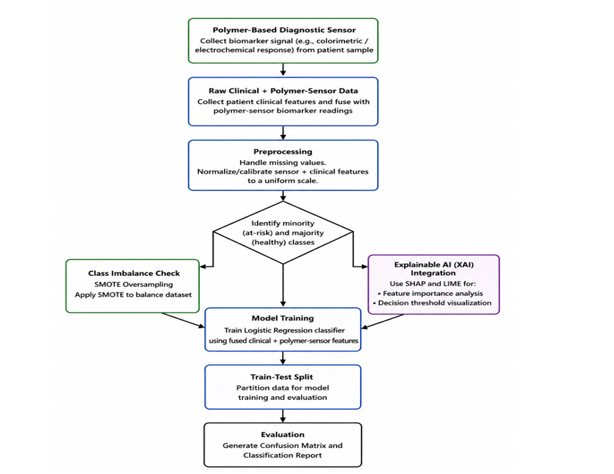
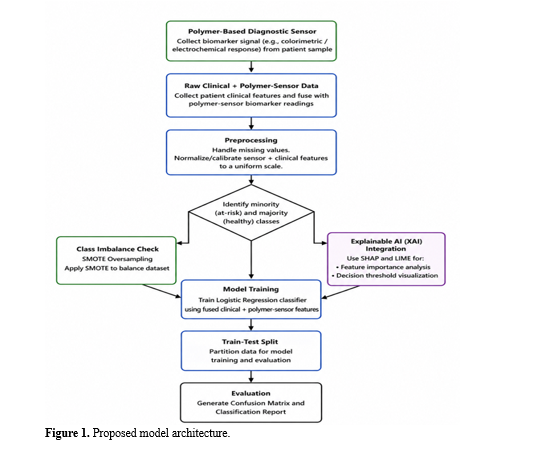
Early and reliable assessment of liver health is essential for timely treatment, yet most machine-learning approaches face limitations such as class imbalance and low clinical interpretability. This study proposes a polymer-integrated, explainable machine-learning framework that combines SMOTE-based data balancing, Logistic Regression, and XAI techniques (SHAP and LIME) for transparent liver-health classification. In addition to ML modelling, the study emphasizes the emerging role of polymer-based biosensors, microfluidic polymer chips, polymer nanomaterials, and polymer–nanoparticle diagnostic technologies for liver-function assessment. These polymer platforms generate high-sensitivity biochemical signals for biomarkers such as bilirubin, ALT, and AST, making them ideal companions to AI-based decision systems. Using the (ILPD) Indian Liver Patient Dataset, the proposed framework achieved an overall accuracy of 78%, with balanced F1-scores for both healthy (0.79) and at-risk individuals (0.76). SHAP and LIME consistently identified s1, sex, s5, and blood pressure as the most influential predictors, aligning with clinical literature. This liver disease is deadly disease that need proper treatment and care the foremost requirement is early diagnosis so that the disease can be cured on initial stages. Approximately 1.4–1.43 million deaths per year are caused due to cirrhosis and other chronic liver diseases on a global scale. The interdisciplinary integration of Machine Learning, XAI, and polymer-based diagnostic technologies highlights a promising path for advanced, sensitive, and explainable polymer-AI health-monitoring systems. By bridging polymer-based diagnostic innovations with explainable machine learning, this review aims to support the development of transparent, accurate, and clinically acceptable tools for liver health assessment and personalized healthcare.
Keywords: Polymer biosensors, polymer nanomaterials, liver disease prediction, explainable AI, machine learning, SMOTE, logistic regression, SHAP, LIME
[This article belongs to Special Issue under section in Journal of Polymer & Composites (jopc)]
References
1. Srivastava A., et al., “Conductive polymer biosensors for bilirubin detection,” Biosensors & Bioelectronics, 2023.
2. Gupta M., Verma R., “PLGA nanoparticles for liver-targeted therapy,” Journal of Applied Polymer Science, 2022.
3. Park S., Lee J., “Smart hydrogel-based bilirubin detection,” ACS Applied Polymer Materials, 2021.
4. Chen L., Yang F., “Polymer nanocarriers for liver disease drug delivery,” Polymer Chemistry, 2023.
5. Singh K., et al., “Polymer–microfluidic systems for rapid liver function analysis,” Lab on a Chip, 2024.
6. C. Huang and R. Ogawa, ‘‘The vascular involvement in soft tissue fibrosis—Lessons learned from pathological scarring,’’ Int. J. Mol. Sci., vol. 21, no. 7, p. 2542, Apr. 2020, doi: 10.3390/ijms21072542.
7. J. Trebicka, P. Bork, A. Krag, and M. Arumugam, ‘‘Utilizing the gut microbiome in decompensated cirrhosis and acute-on-chronic liver failure,’’ Nature Rev. Gastroenterology Hepatology, vol. 18, no. 3, pp. 167–180, Nov. 2020, doi: 10.1038/s41575-020-00376-3.
8. N. V. Bergasa, Approach to Patient with Liver Disease. London, U.K.: Springer, 2022, pp. 5–26, doi: 10.1007/978-1-4471-4715-2_2.
9. D. Q. Huang, N. A. Terrault, F. Tacke, L. L. Gluud, M. Arrese, E. Bugianesi, and R. Loomba, ‘‘Global epidemiology of cirrhosis— Aetiology, trends and predictions,’’ Nature Rev. Gastroenterology Hepatology, vol. 20, no. 6, pp. 388–398, Jun. 2023.
10. J. F. Creeden, D. M. Gordon, D. E. Stec, and T. D. Hinds, ‘‘Bilirubin as a metabolic hormone: The physiological relevance of low levels,’’ Amer. J. Physiol.-Endocrinol. Metabolism, vol. 320, no. 2, pp. E191–E207, Feb. 2021, doi: 10.1152/ajpendo.00405.2020.
11. P. Ginès, A. Krag, J. G. Abraldes, E. Solà, N. Fabrellas, and P. S. Kamath, ‘‘Liver cirrhosis,’’ Lancet, vol. 398, no. 10308, pp. 1359–1376, 2021.
12. L. Fabris and M. Strazzabosco, ‘‘Rare and undiagnosed liver diseases: Challenges and opportunities,’’ Transl. Gastroenterol. Hepatol., vol. 6, p. 18, Apr. 2021, doi: 10.21037/tgh-2020-05.
13. M. Yin, J. Woollard, X. Wang, V. E. Torres, P. C. Harris, C. J. Ward, K. J. Glaser, A. Manduca, and R. L. Ehman, ‘‘Quantitative assessment of hepatic fibrosis in an animal model with magnetic resonance elastography,’’ Magn. Reson. Med., vol. 58, no. 2, pp. 346–353, Aug. 2007, doi: 10.1002/mrm.21286.
14. N. Tanwar and K. F. Rahman, ‘‘Machine learning in liver disease diagnosis: Current progress and future opportunities,’’ IOP Conf. Ser., Mater. Sci. Eng., vol. 1022, no. 1, Jan. 2021, Art. no. 012029. [Online]. Available: https://iopscience.iop.org/article/10.1088/1757-899X/1022/1/012029
15. D. W. Crabb, G. Y. Im, G. Szabo, J. L. Mellinger, and M. R. Lucey, ‘‘Diagnosis and treatment of alcohol-associated liver diseases: 2019 practice guidance from the American Association for the Study of Liver Diseases,’’ Hepatology, vol. 71, no. 1, pp. 306–333, Jan. 2020, doi: 10.1002/hep.30866.
16. Md Shazid Islam and Sayak Nag and Arindam Dutta and Miraj Ahmed and Fahim Faisal Niloy and Amit K. Roy-Chowdhury: Active Learning Guided Federated Online Adaptation: Applications in Medical Image Segmentation 2023
17. Cyr DD, Lucas JE, Thompson JW, Patel K, Clark PJ, Thompson A et al (2011) Characterization of serum proteins associated with IL28B geno-type among patients with chronic hepatitis C. PLoS ONE 6(7):e21854. https://doi.org/10.1371/journal.pone.0021854
18. Macdonald JA, Zhu Z, Konkel B, Mazurowski MA, Wiggins WF, Bashir MR Duke liver dataset: a publicly available liver mri dataset radiology: artificial intelligence 5(5)
19. Prakash NR, Namakhwa V, Pande D, Sandeep Sk, Shaik H, Hasane (2023) A DenseNet CNN-based liver lesion prediction and classification for future medical diagnosis. Scientific African. 20.
20. Ragab M, Alyami J (2023) Stacked Gated recurrent unit classifier with CT images for liver cancer classification. computer systems Sci Eng 44: 2309–2322. https://doi.org/10.32604/csse. 2023.026877.
21. Aslam M, Younas M, Sarwar M, Shah MA, Khan A, Uddin MI, Ahmad S, Firdausi M, Zaindin M (2021) Liver-Tumor Detection Using CNN ResUNet. Computers, Materials & Continua. 67. 1899–1914. https://doi.org/10.32604/cmc.2021.015151.
22. Elbashir M, Mahmoud A, Mostafa A, Hamouda E, Alruily M, Alotaibi S, Shabana H, Ezz M, Shabana H (2023) A transfer learning approach based on ultrasound images for liver cancer detection. Comput Mater Continua.75. https://doi.org/10.32604/cmc. 2023.037728.
23. Manjunath R, Ghanshala A, Kwadiki K (2023) Deep learning algorithm performance evaluation in detection and classification of liver disease using CT images. Multimedia Tools Appl 83:1–18. https://doi.org/10.1007/s11042-023-15627-z.
24. Randhawa S, Alsadoon A, Prasad PWC, Al-Dala’in T, Dawoud A, Alrubaie A (2021) Deep learning for liver tumourclassification: enhanced loss function. Multimedia Tools Appl 80: 1-22. https:// doi.org/10.1007/s11042-020-09900-8.
25. Liu Y, Yang F, Yang Y (2023) A partial convolution generative adversarial network for lesion synthesis and enhanced liver tumor segmentation. J Appl Clin Med Phys 24:e13927. https://doi.org/ 10.1002/acm2.13927
26. Xiao X, Zhao J, Qiang Y, Chong J, Yang X, Guy-Fernand N, Kazihise, Chen B, Li S (2019) Radiomics-guided GAN for Segmentation of Liver Tumor without Contrast Agents.
27. B. V. Ramana, M. S. P. Babu, and N. B. Venkateswarlu, A critical study of selected classification algorithms for liver disease diagnosis, Int. J. Database Manage. Syst., vol. 3, no. 2, pp. 101–114, May 2011.
28. D. Dua and C. Graff, UCI Machine Learning Repository. Irvine, CA: University of California, School of Information and Computer Science, 2019.
29. F. Pedregosa, G. Varoquaux, A. Gramfort, V. Michel, B. Thirion, O. Grisel, M. Blondel, P. Prettenhofer, R. Weiss, V. Dubourg, J. Vanderplas, A. Passos, D. Cournapeau, M. Brucher, M. Perrot, and É. Duchesnay, Scikit-learn: Machine learning in Python, J. Mach. Learn. Res., vol. 12, pp. 2825–2830, 2011.
30. Y. Xu and R. Goodacre, On splitting training and validation set: A comparative study of cross-validation, bootstrap and systematic sampling for estimating the generalization performance of supervised learning, J. Anal. Test., vol. 2, no. 3, pp. 249–262, 2018.
31. R. Kohavi, A study of cross-validation and bootstrap for accuracy estimation and model selection, in Proc. 14th Int. Joint Conf. Artif. Intell. (IJCAI), vol. 2, 1995, pp. 1137–1143.
32. N. V. Chawla, K. W. Bowyer, L. O. Hall, and W. P. Kegelmeyer, SMOTE: Synthetic Minority Over-sampling Technique, J. Artif. Intell. Res., vol. 16, pp. 321–357, 2002, doi: 10.1613/jair.953.
33. A. Fernández, S. García, M. Galar, R. C. Prati, B. Krawczyk, and F. Herrera, Learning from Imbalanced Data Sets. Cham: Springer, 2018.
34. D. W. Hosmer, S. Lemeshow, and R. X. Sturdivant, Applied Logistic Regression, 3rd ed. Hoboken, NJ: John Wiley & Sons, 2013.
35. S. M. Lundberg and S.-I. Lee, A unified approach to interpreting model predictions, in Advances in Neural Information Processing Systems (NeurIPS), vol. 30, 2017, pp. 4765–4774.
36. M. T. Ribeiro, S. Singh, and C. Guestrin, “Why should I trust you?”: Explaining the predictions of any classifier, in Proc. 22nd ACM SIGKDD Int. Conf. Knowl. Discovery Data Mining, 2016, pp. 1135–1144, doi: 10.1145/2939672.2939778.

Journal of Polymer & Composites
| Volume | 14 | |
| Special Issue | 03 | |
| Received | 09/02/2026 | |
| Accepted | 10/03/2026 | |
| Published | 12/05/2026 | |
| Publication Time | 92 Days |