Khiraling Patil,
Sachhidanand Reur,
Ashok Kumar Vanageri,
- Research Scholar, Department of Industrial and Production Engineering, PDA College of Engineering, Kalaburgi, Karnataka, India & Visvesvaraya Technological University, Belagavi, Karnataka, India
- Professor, Department of Industrial and Production Engineering, PDA College of Engineering, Kalaburgi, Karnataka, India & Visvesvaraya Technological University, Belagavi, Karnataka, India
- Professor, Department of Mechanical Engineering Basavakalyan Engineering College, Basavakalyan Karnataka, India & Visvesvaraya Technological University, Belagavi, Karnataka, India
Abstract
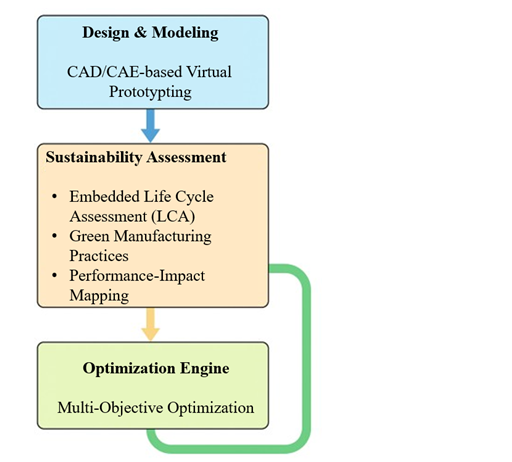
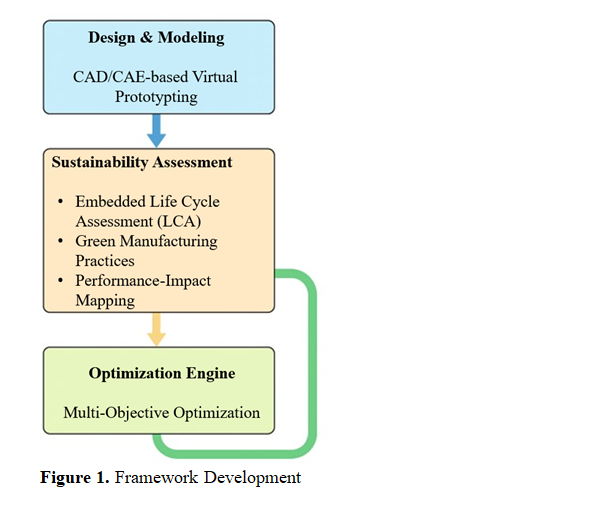
The increasing emphasis on sustainable manufacturing has intensified the need for environmentally responsible design and development methodologies for polymer and polymer-composite materials, where material selection, processing routes, and waste generation play a critical role in overall environmental impact. This paper presents a Sustainable and Green Prototyping (SGP) framework that integrates Virtual Prototyping (VP), Life Cycle Assessment (LCA), and multi-objective optimization to systematically reduce carbon footprint, energy consumption, and material waste throughout the polymer composite product development process. The proposed framework is structured into three interconnected levels: (i) CAD/CAE-based virtual modeling and simulation of polymer and composite components, enabling early-stage evaluation of material behavior and manufacturability, (ii) embedded LCA, which quantifies environmental impacts associated with raw materials, composite manufacturing processes, and end-of-life scenarios, and (iii) Pareto-based decision-making, allowing simultaneous optimization of sustainability, performance, and production-related constraints. The applicability of the framework is demonstrated through automotive, electronics, and consumer product case studies, focusing on thermoplastic and thermo set polymer composites, fiber-reinforced polymers, and lightweight molded composite components commonly employed in industrial applications. The results indicate that the SGP framework achieves reductions of 30–38% in carbon emissions, 24–33% in energy consumption, and 35–43% in material waste when compared to conventional VP-based prototyping approaches. In addition, the optimization engine reveals inherent trade-offs among sustainability indicators and processing choices, enabling the selection of eco-efficient polymer composite materials and manufacturing strategies without compromising cost, quality, structural integrity, or production lead time. Overall, the proposed SGP framework provides a practical, industry-ready approach for integrating sustainability into polymer composite design and processing, supporting the transition toward circular economy principles, Industry 4.0-enabled manufacturing, and low-carbon composite production systems.
Keywords: Sustainable and Green Prototyping; Polymer and Composite Materials; Virtual Prototyping; Life Cycle Assessment; Multi-objective Optimization; Low-carbon Manufacturing; Circular Manufacturing; Industry 4.0
[This article belongs to Special Issue under section in Journal of Polymer & Composites (jopc)]
References
- 1. Y. Wang, X. Xu, R. Wang, M. Bilal, W. Liu and G. Cui, “A Resource-Efficient Placement of Edge Servers for Green Agriculture Consumer Electronics,” in IEEE Transactions on Consumer Electronics, doi: 10.1109/TCE.2025.3602923.
2. J. S. MacDonald and C. Regnier, “Metrics for Evaluating Grid Service Provision from Communities of Grid-interactive and Efficient Buildings and other DER,” 2023 IEEE Power & Energy Society General Meeting (PESGM), Orlando, FL, USA, 2023, pp. 1-5, doi:10.1109/PESGM52003.2023.10252606.
3. D. Nemtzow, C. Regnier, K. LaCommare, N. M. Frick, and J. MacDonald, “If one geb is good, a community of gebs is better,” in Proceedings of the 2022 ACEEE Summer Study on Energy Efficiency in Buildings trivia conference. Asilomar CA : ACEEE, 2022. [Online]. Available: https://escholarship.org/uc/item/5xh4m9jn
4. Satchwell, M. A. Piette, A. Khandekar, J. Granderson, N. M. Frick, R. Hledik, A. Faruqui, L. Lam, S. Ross, J. Cohen et al., “A national roadmap for grid-interactive efficient buildings,” Lawrence Berkeley National Lab.(LBNL), Berkeley, CA (United States), Tech. Rep., 2021.
5. Olgyay, S. Coan, B. Webster, and W. Livingood, “Connected communities: A multi-building energy management approach,” National Renewable Energy Lab.(NREL), Golden, CO (United States), Tech. Rep., 2020.
6. J. Liu, R. Yin, L. Yu, M. A. Piette, M. Pritoni, A. Casillas, J. Xie, T. Hong, M. Neukomm, and P. Schwartz, “Defining and applying an electricity demand flexibility benchmarking metrics framework for grid-interactive efficient commercial buildings,” Advances in Applied Energy, vol. 8, p. 100107, Dec. 2022. [Online]. Available: https://linkinghub.elsevier.com/retrieve/pii/S2666792422000257
7. M. Shah, D. Cutler, J. Maguire, Z. Peterson, X. Li, J. Pohl, and J. Reyna, “Metrics and analytical frameworks for valuing energy efficiency and distributed energy resources in the built environment,” in Proceedings of the 2020 ACEEE Summer Study on Energy Efficiency in Buildings trivia conference. Asilomar CA: ACEEE, 2020. [Online]. Available: https://www.nrel.gov/docs/fy21osti/77888.pdf
8. European Commission, “Communication from the commission to the European Parliament, the Council, the European economic and social committee and the committee of the regions. Closing the loop – an EU action plan for the circular economy,” Com, vol. 614, p. 21, 2015, doi: 10.1017/CBO9781107415324.004.
9. M. Barbaritano, L. Bravi, and E. Savelli, “Sustainability and Quality Management in the Italian Luxury Furniture Sector: A Circular Economy Perspective,” Sustainability, vol. 11, no. 11, p. 3089, May 2019, doi: 10.3390/su11113089.
10. S. Witjes and R. Lozano, “Towards a more Circular Economy: Proposing a framework linking sustainable public procurement and sustainable business models,” Resources, Conservation and Recycling, 2016, doi: 10.1016/j.resconrec.2016.04.015.
11. P. Ghisellini, C. Cialani, and S. Ulgiati, “A review on circular economy: The expected transition to a balanced interplay of environmental and economic systems,” Journal of Cleaner Production, vol. 114, pp. 11–32, 2016, doi: 10.1016/j.jclepro.2015.09.007.
12. M. Geissdoerfer, P. Savaget, N. M. P. Bocken, and E. J. Hultink, “The Circular Economy — A new sustainability paradigm?,” Journal of Cleaner Production, vol. 143, pp. 757–768, 2017, doi: 10.1016/j.jclepro.2016.12.048.
13. P. Nowicki, P. Kafel, U. Balon, and M. Wojnarowska, “Circular economy’s standardized management systems. Choosing the best practice. Evidence from Poland,” International Journal for Quality Research, 2020, doi: 10.24874/IJQR14.04-08.
14. N. M. P. Bocken, I. de Pauw, C. Bakker, and B. van der Grinten, “Product design and business model strategies for a circular economy,” Journal of Industrial and Production Engineering, 2016, doi: 10.1080/21681015.2016.1172124.
15. Y. Geng and B. Doberstein, “Developing the circular economy in China: Challenges and opportunities for achieving ‘leapfrog development,’ ” International Journal of Sustainable Development & World Ecology, 2008, doi: 10.3843/SusDev.15.3:6.
16. Z. Yuan, J. Bi, and Y. Moriguichi, “The circular economy: A new development strategy in China,” Journal of Industrial Ecology. 2006, doi: 10.1162/108819806775545321.
17. M. Lieder and A. Rashid, “Towards circular economy implementation: A comprehensive review in context of manufacturing industry,” Journal of Cleaner Production, vol. 115, pp. 36–51, 2016, doi: 10.1016/j.jclepro.2015.12

Journal of Polymer & Composites
| Volume | 14 | |
| Special Issue | 03 | |
| Received | 02/02/2026 | |
| Accepted | 06/03/2026 | |
| Published | 09/05/2026 | |
| Publication Time | 96 Days |