Sandip K. Kadu,
Palash Soni,
Shripad R. Nimbalkar,
- Research Scholar, Department of Mechanical Engineering, Oriental University, Indore, Madhya Pradesh, India
- Assistant Professor, Department of Mechanical Engineering, Oriental University, Indore, Madhya Pradesh, India
- Assistant Professor, Mechanical engineering, Pravara Rural Engineering College, Loni, Maharashtra, India
Abstract
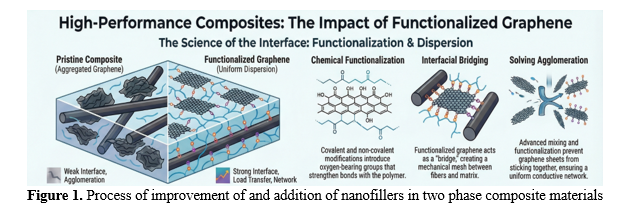
Current research work studies the influence of amines(–NH₂) and carboxyl(–COOH) functionalized graphene nanoplatelets on the mechanical and thermomechanical behavior of unidirectional hybrid composite. Composites having different graphene concentration from 0 to 0.7 wt% were fabricated, characterized and analyzed for multiple testing – tensile testing, dynamic mechanical analysis (DMA) and Fourier transform infrared spectroscopy (FTIR). Tensile testing indicates better elastic modulus and tensile strength due to efficient load transfer between nanoparticles fiber and matrix with most improved properties at 0.5% graphene. Finite element analysis has been performed to simulate orthotropic laminate properties and maximum-stress first-ply failure theory generates the experimental stress–strain response and failure load, with deviations within 5%. DMA indicates increase in storage modulus and elevation in glass transition temperature(Tg), which improves interfacial bonding and better polymer chain mobility due to graphene reinforcement. Functionalization improves dispersion and interfacial bonding. Amine functionalized graphene nanoparticles (GNP) results in minor better modulus. The maximum flexural stress of the composite specimen was equal to the corresponding stress of the peak force before the failure of the specimen and flexural strength of hybrid layered composite evaluated for o.5% wt. fraction of GnP. In totality, the combined experimentation and FEA approach demonstrates that functionalized GNP improves mechanical and thermomechanical properties of carbon fiber reinforced polymer.
Keywords: Multi-phase composite, Mechanical characterisation, Functionalisation, GnP, Glass transition temperature, Loss modulus
[This article belongs to Journal of Polymer & Composites ]
References
1. Mallick, P. K. Fiber-Reinforced Composites: Materials, Manufacturing, and Design, Third Edition. (CRC Press, Boca Raton, 2007). doi:10.1201/9781420005981.
2. Clyne, T. W. & Hull, D. An Introduction to Composite Materials. (Cambridge University Press, 2019). doi:10.1017/9781139050586.
3. Drzal, L. T. & Madhukar, M. Fibre-matrix adhesion and its relationship to composite mechanical properties. J. Mater. Sci. 28, 569–610 (1993).
4. Qiang, X., Wang, T., Xue, H., Ding, J. & Deng, C. Study on Low-Velocity Impact and Residual Compressive Mechanical Properties of Carbon Fiber–Epoxy Resin Composites. Materials 17, 3766 (2024).
5. Gojny, F. H., Wichmann, M. H. G., Köpke, U., Fiedler, B. & Schulte, K. Carbon nanotube-reinforced epoxy-composites: enhanced stiffness and fracture toughness at low nanotube content. Compos. Sci. Technol. 64, 2363–2371 (2004).
6. Alampalli, S., O’Connor, J. & Yannotti, A. P. Design, Fabrication, Construction, and Testing of an Frp Superstructure. (2000).
7. Li, C. X. et al. Interlaminar reinforcement of carbon fiber reinforced polyimide composites using vertically aligned carbon nanotubes. Compos. Part B Eng. 292, 112098 (2025).
8. Novoselov, K. S. et al. Electric Field Effect in Atomically Thin Carbon Films. Science 306, 666–669 (2004).
9. Alexander A. Balandin. Superior Thermal Conductivity of Single-Layer Graphene. ACS Publ. https://pubs.acs.org/doi/abs/10.1021/nl0731872 (2008).
10. Geim, A. K. & Novoselov, K. S. The rise of graphene. Nat. Mater. 6, 183–191 (2007).
11. Rafiee, M. A. et al. Enhanced mechanical properties of nanocomposites at low graphene content. ACS Nano 3, 3884–3890 (2009).
12. Kim, H. Graphene/Polymer Nanocomposites. ACS Publ. 43, (2010).
13. Potts, J. R., Dreyer, D. R., Bielawski, C. W. & Ruoff, R. S. Graphene-based polymer nanocomposites. Polymer 52, 5–25 (2011).
14. Kuilla, T. et al. Recent advances in graphene based polymer composites. Prog. Polym. Sci. 35, 1350–1375 (2010).
15. Li, A., Zhang, C. & Zhang, Y.-F. Thermal Conductivity of Graphene-Polymer Composites: Mechanisms, Properties, and Applications. Polymers 9, (2017).
16. Zare, Y., Munir, M. T., Rhee, K. Y. & Park, S.-J. Multi-scale prediction of effective conductivity for carbon nanofiber polymer composites. J. Mater. Res. Technol. 33, 8895–8902 (2024).
17. Fang, J., Zhang, Y. & Zhao, P. High-efficiency thermal transport in graphene-based composites via a copper interlayer. Cell Rep. Phys. Sci. 6, 102917 (2025).
18. Her, S.-C. & Zhang, K.-C. Mode I Fracture Toughness of Graphene Reinforced Nanocomposite Film on Al Substrate. Nanomaterials 11, (2021).
19. Huang, X. A Review of dielectric polymer composites with high thermal conductivity | Request PDF. IEEE Electr. Insul. Mag. 27, 8–16 (2011).
20. Yan, D.-X. et al. Efficient electromagnetic interference shielding of lightweight graphene/polystyrene composite. J. Mater. Chem. 22, 18772–18774 (2012).
21. Singh, V. et al. Graphene based materials: Past, present and future. Prog. Mater. Sci. 56, 1178–1271 (2011).
22. Ramanathan, T. et al. Functionalized graphene sheets for polymer nanocomposites. Nat. Nanotechnol. 3, 327–331 (2008).
23. Díez-Pascual, A. M., Naffakh, M., Marco, C. & Ellis, G. Mechanical and electrical properties of carbon nanotube/poly(phenylene sulphide) composites incorporating polyetherimide and inorganic fullerene-like nanoparticles. Compos. Part Appl. Sci. Manuf. 43, 603–612 (2012).
24. Dreyer, D. R., Park, S., Bielawski, C. W. & Ruoff, R. S. The chemistry of graphene oxide. Chem. Soc. Rev. 39, 228–240 (2009).
25. Park, S. & Ruoff, R. S. Chemical methods for the production of graphenes. Nat. Nanotechnol. 4, 217–224 (2009).
26. Stankovich, S. et al. Graphene-based composite materials. Nature 442, 282–286 (2006).
27. Ramanathan, T. et al. Functionalized graphene sheets for polymer nanocomposites. Nat. Nanotechnol. 3, 327–331 (2008).
28. Stankovich, S. et al. Synthesis of graphene-based nanosheets via chemical reduction of exfoliated graphite oxide. Carbon 45, 1558–1565 (2007).
29. Ferrari, A. C. et al. Science and technology roadmap for graphene, related two-dimensional crystals, and hybrid systems. Nanoscale 7, 4598–4810 (2015).
30. Dai, D. & Fan, M. Wood fibres as reinforcements in natural fibre composites: structure, properties, processing and applications. in Natural Fibre Composites 3–65 (Woodhead Publishing, 2014). doi:10.1533/9780857099228.1.3.
31. Chung, D. D. L. Electromagnetic interference shielding effectiveness of carbon materials. Carbon 39, 279–285 (2001).
32. mahboubizadeh, S., Sadeq, A., Arzaqi, Z., Ashkani, O. & Samadoghli, M. Advancements in fiber-reinforced polymer (FRP) composites: an extensive review. Discov. Mater. 4, 22 (2024).
33. Elena Bekyarova. Chemical Modification of Epitaxial Graphene: Spontaneous Grafting of Aryl Groups. ACS Publ. https://pubs.acs.org/doi/abs/10.1021/ja8057327 (2009).
34. Koronis, G., Silva, A. & Fontul, M. Green composites: A review of adequate materials for automotive applications. Compos. Part B Eng. 44, 120–127 (2013).
35. Menard, K. P. Dynamic Mechanical Analysis: A Practical Introduction, Second Edition. (CRC Press, Boca Raton, 2008). doi:10.1201/9781420053135.
36. Kim, D. (Dae-W., Hennigan, D. J. & Beavers, K. D. Effect of fabrication processes on mechanical properties of glass fiber reinforced polymer composites for 49 meter (160 foot) recreational yachts. Int. J. Nav. Archit. Ocean Eng. 2, 45–56 (2010).
37. Daniel, I. M., Ishai, O., Daniel, I. M. & Ishai, O. Engineering Mechanics of Composite Materials. (Oxford University Press, Oxford, New York, 2005).
38. Engineering Mechanics of Composite Materials. (Oxford University Press, New York, 2006).
39. Thiagarajan, S. & Munusamy, R. Experimental and numerical study of composite sandwich panels for lightweight structural design. Int. J. Crashworthiness https://www.tandfonline.com/doi/abs/10.1080/13588265.2020.1838178 (2022).
40. Affdl, J. C. H. & Kardos, J. L. The Halpin‐Tsai equations: A review. https://doi.org/10.1002/pen.760160512 doi:10.1002/pen.760160512.
41. Hashin, Z. Failure Criteria for Unidirectional Fiber Composites. https://doi.org/10.1115/1.3153664 doi:10.1115/1.3153664.
42. Atif, R., Shyha, I. & Inam, F. Mechanical, Thermal, and Electrical Properties of Graphene-Epoxy Nanocomposites—A Review. Polymers 8, (2016).
43. Silvestre, J., Silvestre, N. & de Brito, J. Polymer nanocomposites for structural applications: Recent trends and new perspectives. Mech. Adv. Mater. Struct. 23, 1263–1277 (2016).
44. Akmal Zia, A. et al. Impact Resistance of 3D-Printed Continuous Hybrid Fiber-Reinforced Composites. Polymers 15, 4209 (2023).
45. Khan, M. & Karthikeyan, R. Tensile and flexural behavior of synthetic and hybrid natural fiber composites for lightweight applications – Ramachandran – 2025 – Polymer Composites – Wiley Online Library. 46, (2025).
46. Mirzapour, M., Cousin, P., Robert, M. & Benmokrane, B. Dispersion Characteristics, the Mechanical, Thermal Stability, and Durability Properties of Epoxy Nanocomposites Reinforced with Carbon Nanotubes, Graphene, or Graphene Oxide. Polymers 16, (2024).
47. Hsissou, R. et al. Polymer composite materials: A comprehensive review. Compos. Struct. 262, 113640 (2021).

Journal of Polymer & Composites
| Volume | 14 | |
| Issue | 03 | |
| Received | 15/04/2026 | |
| Accepted | 22/04/2026 | |
| Published | 07/05/2026 | |
| Publication Time | 22 Days |