
Kusum Tharani,
Anika Ahuja,
Mehak Vasudeva,
Yug,
Shashi Gandhar,
- Professor, Department of Electrical & Electronics Engineering, Bharati Vidyapeeth’s College of Engineering, New Delhi, India
- Undergraduate Scholar, Department of Electrical & Electronics Engineering, Bharati Vidyapeeth’s College of Engineering, New Delhi, India
- Undergraduate Scholar, Department of Electrical & Electronics Engineering, Bharati Vidyapeeth’s College of Engineering, New Delhi, India
- Undergraduate Scholar, Department of Electrical & Electronics Engineering, Bharati Vidyapeeth’s College of Engineering, New Delhi, India
- Associate Professor, Department of Electrical & Electronics Engineering, Bharati Vidyapeeth’s College of Engineering, New Delhi, India
Abstract
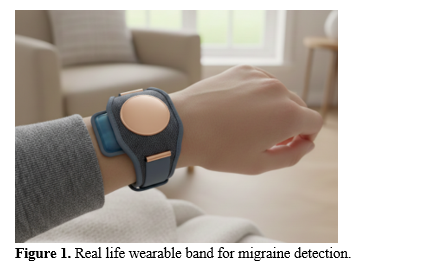
Migraine is a neurological disorder, and its effect on the global workforce is resultantly significant. However, the fact of the matter is the absence of notable technological breakthroughs and the fact that the technology presently available is reactive, meaning it tackles the symptoms of the attack after the attack has occurred. The requirement for this paper is, therefore, the provision of an innovative approach, and this paper will describe the intelligent and wearable approach utilizing the predictions of the attack based on the stochastic nature of the biological signals. The proposed system monitors the essential pre-ictal physiological signal variations, which consist of the heart rate signal extracted from the photoplethysmography signal, Galvanic Skin Response, and the temperature of the skin. The essential physiological signal variations are processed through sophisticated machine learning techniques such as eXtreme Gradient Boosting (XGBoost) and Long Short-Term Memory (LSTM) Networks, which have the precision to identify the minute trends among the patients prior to the onset of the migraine attacks. When the detection algorithm receives information about the potential onset of a migraine, it provides alert messages to the patients in the form of vibration messages and a polymer-based web interface. Development in the hardware arena also places importance on utilizing polymers/composites to their fullest extent. This technology can be employed in the development of wearable forms that should also exhibit biocompatibility, elasticity, lightness, and strength. Its applications also include future possibilities related to energy use. Based on the final prototype, the verification test of the prototype made it possible to establish the presence of the physiological pattern before the attack and attain an average prediction accuracy of the LSTM model of 88.9 percent. Generally, the results of the experiment underscore the huge potential for the use of AI technology in conjunction with the utilization of polymers in wearable technology for the prediction and prevention of neurology and Migraines.
Keywords: eXtreme Gradient Boosting (XGBoost), Long Short-Term Memory (LSTM), pre-ictal, Galvanic Skin Response
[This article belongs to Special Issue under section in Journal of Polymer & Composites (jopc)]
References
1. Siirtola P, Koskimäki H, Mönttinen H, Röning J. Using sleep time data from wearable sensors for early detection of migraine attacks. Sensors (Basel). 2018;18(5):1374.
2. Kapustynska, Viroslava & Paulikas, Šarūnas. (2024). Analysis Of Electrodermal Activity Signal Fluctuations Prior To Migraine Onset. 342-344. 10.36074/grail-of-science.02.08.2024.048.
3. Kapustynska, Viroslava, Vytautas Abromavičius, Artūras Serackis, Šarūnas Paulikas, Kristina Ryliškienė, and Saulius Andruškevičius. 2024. “Machine Learning and Wearable Technology: Monitoring Changes in Biomedical Signal Patterns during Pre-Migraine Nights” Healthcare 12, no. 17: 1701. https://doi.org/10.3390/healthcare12171701
4. Giffin NJ, Ruggiero L, Lipton RB, Silberstein SD, Tvedskov JF, Olesen J, Altman J, Goadsby PJ, Macrae A. Premonitory symptoms in migraine: an electronic diary study. Neurology. 2003 Mar 25;60(6):935–40. doi: 10.1212/01.wnl.0000052998.58526.a9. PMID: 12654956..
5. May A. Understanding migraine as a cycling brain syndrome: reviewing the evidence from functional imaging. Neurol Sci. 2017;38(Suppl 1):125–130.
6. Oyeleye M, Chen T, Titarenko S, Antoniou G. A Predictive Analysis of Heart Rates Using Machine Learning Techniques. Int J Environ Res Public Health. 2022 Feb 19;19(4):2417. doi: 10.3390/ijerph19042417. PMID: 35206603; PMCID: PMC8872524
7. Saadatnejad, Saeed & Oveisi, Mohammadhosein & Hashemi, Matin. (2018). LSTM-Based ECG Classification for Continuous Monitoring on Personal Wearable Devices. 10.48550/arXiv.1812.04818
8. Bansal R, Tharani K, Rai T, Budhiraja V. Polymer-integrated smart biomedical waste management system using AI and sensor-based segregation. J Polym Compos. 2025;13(4):172-184.
9. Sabry F, Eltaras T, Labda W, Alzoubi K, Malluhi Q. Machine Learning for Healthcare Wearable Devices: The Big Picture. J Healthc Eng. 2022 Apr 18;2022:4653923. doi: 10.1155/2022/4653923. PMID: 35480146; PMCID: PMC9038375
10. Peng, Shuhua & Yu, Yuyan & Wu, Shuying & Wang, Chun. (2021). Conductive Polymer Nanocomposites for Stretchable Electronics: Material Selection, Design, and Applications. ACS Applied Materials & Interfaces. 13. 10.1021/acsami.1c15014.
11. Toto, Elisa, Susanna Laurenzi, and Maria Gabriella Santonicola. 2022. “Recent Trends in Graphene/Polymer Nanocomposites for Sensing Devices: Synthesis and Applications in Environmental and Human Health Monitoring” Polymers 14, no. 5: 1030. https://doi.org/10.3390/polym14051030
12. Rimjhim Bansal, Kusum Tharani, Trisha Rai, Vanshika Budhiraja. Polymer-Integrated Smart Biomedical Waste Management System Using AI and Sensor-Based Segregation. Journal of Polymer and Composites. 2025; 13(04):172–184.
13. Patel S, Park H, Bonato P, Chan L, Rodgers M. A review of wearable sensors and systems with application in rehabilitation. J Neuroeng Rehabil. 2012 Apr 20;9:21. doi: 10.1186/1743-0003-9-21. PMID: 22520559; PMCID: PMC3354997..
14. Prithivirajkumar, Pon Harshavardhanan & Suman, Preetam & Ghosh, Soumya. (2024). IoT as Wearable Device in Smart Healthcare Systems: A New Paradigm. 10.4018/979-8-3693-2901-6.ch005
15. Karuppiah, Ganesan, Kailasanathan Chidambara Kuttalam, Murugesan Palaniappan, Carlo Santulli, and Sivasubramanian Palanisamy. 2020. “Multiobjective Optimization of Fabrication Parameters of Jute Fiber/Polyester Composites with Egg Shell Powder and Nanoclay Filler” Molecules 25, no. 23: 5579. https://doi.org/10.3390/molecules25235579
16. Santulli, Carlo & Palanisamy, Sivasubramanian & Mayandi, K.. (2022). Pineapple fibers, their composites and applications. 10.1016/B978-0-12-824528-6.00007-2.
17. Goutham, Emani Ram Sai, Shaik Sajeed Hussain, Chandrasekar Muthukumar, Senthilkumar Krishnasamy, T. Senthil Muthu Kumar, Carlo Santulli, Sivasubramanian Palanisamy, Jyotishkumar Parameswaranpillai, and Naveen Jesuarockiam. 2023. “Drilling Parameters and Post-Drilling Residual Tensile Properties of Natural-Fiber-Reinforced Composites: A Review” Journal of Composites Science 7, no. 4: 136. https://doi.org/10.3390/jcs7040136
18. Ayrilmis N, Kanat G, Yildiz Avsar E, Palanisamy S, Ashori A. Utilizing waste manhole covers and fibreboard as reinforcing fillers for thermoplastic composites. Journal of Reinforced Plastics and Composites. 2024;44(17-18):1108-1118. doi:10.1177/07316844241238507
19. Aruchamy, K., Karuppusamy, M., Krishnakumar , S., Palanisamy, S., Jayamani, M., Sureshkumar , K., Ali, S. K., and Al-Farraj, S. A. (2025). “Enhancement of mechanical properties of hybrid polymer composites using palmyra palm and coconut sheath fibers: The role of tamarind shell powder,” BioResources 20(1), 698–724.

Journal of Polymer & Composites
| Volume | 14 | |
| Special Issue | 02 | |
| Received | 23/01/2026 | |
| Accepted | 16/02/2026 | |
| Published | 20/04/2026 | |
| Publication Time | 87 Days |