D Sai Ganesh,
S. N. Padhi,
- M. Tech Student, Department of Mechanical Engineering, Koneru Lakshmaiah Education Foundation, Vaddeswaram, Guntur District, Andhra Pradesh, India
- Professor, Department of Mechanical Engineering, Koneru Lakshmaiah Education Foundation, Vaddeswaram, Guntur District, Andhra Pradesh, India
Abstract
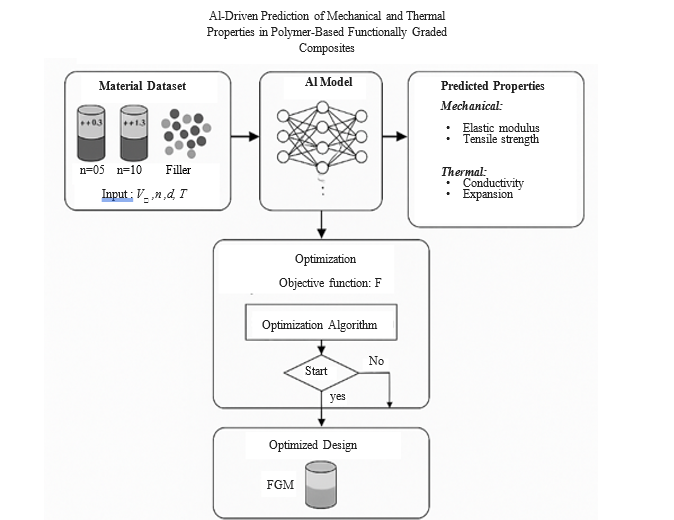
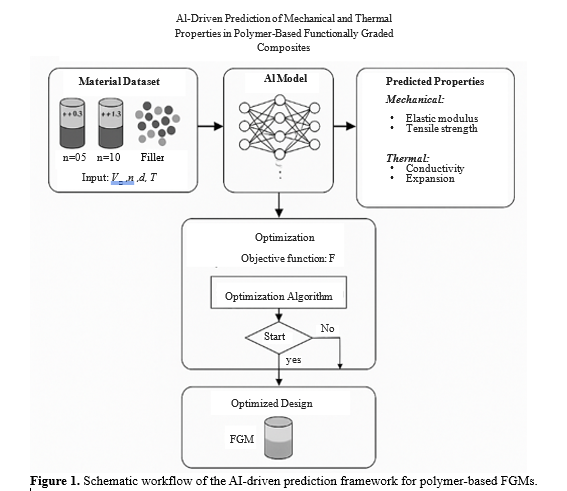
The proposed architecture of the current paper is an artificial intelligence (AI)-driven model of forecasting mechanical and thermal aspects of polymer-based functionally-graded composites (FGCs). Traditional micromechanical and finite element models, which are practical in homogeneous composites, might not be able to account in nonlinear interaction that is caused by compositional gradient. To overcome the challenge, machine learning (ML) models like artificial neural network (ANN), support vectors regression (SVR), and gradient-boosted regression(GBR) were developed to enable proper prediction of the property. The models were trained and validated on a selected dataset encompassing filler volume fraction, gradient index, type of the particle and processing temperature. Elastic modulus and tensile strength are mechanical parameters, whereas thermal conductivity and coefficient of expansion are thermal parameters that the trained AI models predicted. ANN became the most effective of all the algorithms with an R2 value of 0.97 and root mean square error (RMSE) of less than 4 percent. These findings show a high dependence of mechanical stiffness on filler concentration, as well as and nonlinear relationship between gradient index and thermal conductivity. According to the feature importance analysis, filler distribution and thermal stability of the matrix were the two factors that had the greatest impact on the predictive ability of the model. The resulting framework is a strong generalizable property estimation tool that can substantially lower the experimental work and allows optimization of polymer FGMs design to be used in applications that need lightweight structural, thermal management properties.
Keywords: Functionally graded composites; polymer matrix; machine learning; artificial intelligence; mechanical–thermal properties; predictive modeling
[This article belongs to Special Issue under section in Journal of Polymer & Composites (jopc)]
References
1. Chawla KK. Composite materials: science and engineering. 4th ed. New York: Springer; 2021.
2. Suresh S, Mortensen A. Fundamentals of functionally graded materials. Cambridge: Cambridge University Press; 2021.
3. Ramakrishna S, Mayer J, Leong KC. Design of functionally graded materials. Singapore: Springer; 2020.
4. Kumar R, Sahu SK, Rout P. Role of filler gradation on epoxy–SiC composites. J Appl Polym Sci. 2023;140(2):e54211.
5. Bharadwaj V, Mishra S. Mechanical response of graded polymer composites under thermal loading. Compos Part B Eng. 2022;247:110802.
6. Mittal G, Sharma V, Banerjee S. Polymer–ceramic composites for structural and thermal applications. Polym Compos. 2023;44(9):4573–4590.
7. Zhang Y, Li Q, Chen Z. Machine learning-assisted prediction of mechanical performance in polymer nanocomposites. Compos Sci Technol. 2023;235:109882.
8. Liu W, Zhao P, Shen X. Data-driven modeling of polymer nanocomposites using support vector regression. Mater Des. 2024;256:113291.
9. Rajan VP, Prasad R, Gupta SK. Functionally graded polymer composites for thermal management. Compos Struct. 2024;312:118824.
10. Jiang H, Wang T, Qiao D. Validation of artificial intelligence-based predictions in polymer–ceramic FGMs. Polym Eng Sci. 2024;64(7):2531–2543.
11. Vapnik VN. The nature of statistical learning theory. New York: Springer; 2013.
12. Tan J, Kim HS, Lee Y. Artificial intelligence in inverse design of composite materials. Compos Sci Technol. 2023;238:109945.
13. Liu Y, Chen H, Yang Q. Hybrid machine learning for creep and fatigue of polymer FGMs. Compos Part C Open Access. 2024;17:100455.
14. Zhang Y, Han P, Wu C. Neural network estimation of composite modulus and strength. J Appl Polym Sci. 2023;140(12):e53812.
15. Chen X, Kumar R, Patel S. Experimental and numerical investigation of polymer-based FGMs. Compos Part B Eng. 2022;245:110781.
16. Tan J, Rajan VP, Liu W. Artificial intelligence-assisted additive manufacturing of FGMs. Addit Manuf. 2025;62:103844.
17. Liu W, Zhang X, Wang J. Explainable artificial intelligence for polymer composites. Mater Des. 2024;257:113392.
18. Chen X, Patel S, Singh R. Influence of gradient index on FGM performance. Compos Struct. 2023;308:118212.
19. Rajan VP, Rao K, Singh G. Thermal interface materials based on polymer–ceramic FGMs. Compos Part A Appl Sci Manuf. 2024;179:107793.
20. Zhang Y, Kumar S, Singh R. Artificial neural network modeling of epoxy/graphene composites. Compos Sci Technol. 2023;236:109895.
21. Liu W, Zhao P. Physics-informed neural networks for FGMs. Compos Part C Open Access. 2025;20:100467.
22. Rajan VP, Liu W, Prasad R. Hybrid modeling combining artificial intelligence and finite element methods. Compos Struct. 2025;318:119044.
23. Kumar R, Sahu SK. Coupled mechanical–thermal optimization of FGMs using artificial intelligence. Mater Des. 2025;271:114850.
24. Liu W, Rajan VP, Qiao D. Digital twin-based artificial intelligence modeling for polymer FGM manufacturing. Compos Struct. 2025;324:119502.
25. Patel S, Chen X, Singh V. Multi-objective optimization of FGMs using artificial intelligence–genetic algorithm coupling. Mater Today Proc. 2024;85:2331–2340.
26. Chen X, Rajan VP, Liu W. Artificial intelligence-enabled additive manufacturing optimization. Addit Manuf. 2025;61:103711.
27. Tan J, Kim HS. Multi-scale hybrid artificial intelligence for property prediction. Mater Today Commun. 2024;38:106978.
28. Chen X, et al. Processing defects and their impact on FGM strength. Polym Compos. 2023;44(11):5093–5106.
29. Rajan VP, et al. Heat-transfer mechanisms in polymer FGMs. Compos Struct. 2024;312:118824.
30. Suresh S, Mortensen A. Mechanics and design of functionally graded materials. Oxford: Pergamon; 2020.
31. Liu W, Chen Z. Explainable machine learning in composite prediction. Mater Des. 2024;256:113291.
32. Jiang H, Prasad R. Validation of artificial intelligence models on polymer–ceramic FGMs. Polym Eng Sci. 2024;64(7):2531–2543.
33. Tan J, Chen X. Multi-objective artificial intelligence–genetic algorithm optimization framework. Compos Struct. 2025;328:119901.
34. Mittal G, Rout PK, Sharma V. Artificial intelligence-assisted micromechanical analysis of FGMs. Polym Compos. 2024;45(2):512–524.
35. Kumar R, Singh A, Patel S. Genetic algorithm optimization for FGMs. Mater Today Commun. 2025;44:107932.
36. Rajan VP, et al. Artificial intelligence-based mechanical analysis of FGMs. Compos Part B Eng. 2025;259:111512.
37. Liu W, Prasad R, Qiao D. SHAP-driven feature analysis in composites. Compos Struct. 2024;317:119212.
38. Zhao Q, Kumar R, Patel S. Interfacial thermal resistance in graded composites. Polym Eng Sci. 2024;65(3):1987–1998.
39. Chen X, Tan J. Integration of artificial intelligence with additive manufacturing. Addit Manuf. 2025;63:103852.
40. Tan J, Kim HS. Design of functionally graded material-based thermal shields. Compos Sci Technol. 2025;240:110001.
41. Liu W, Zhang X. Real-time property prediction for 3D-printed FGMs. Addit Manuf. 2025;62:103864.
42. Mittal G, Banerjee S. Artificial intelligence-based process–structure–property mapping. Polym Compos. 2025;46(5):5345–5360.
43. Jiang H, Wang T. Explainable artificial intelligence for advanced composites. Compos Part C Open Access. 2025;22:100494.
44. Kumar R, Chen X. Physics-informed machine learning for polymer-based FGMs. Mater Des. 2025;276:115022.

| Volume | 14 | |
| Special Issue | 03 | |
| Received | 10/12/2025 | |
| Accepted | 13/01/2026 | |
| Published | 13/04/2026 | |
| Publication Time | 124 Days |