Sanjay P. Raut,
Uday Singh Patil,
Dhiraj Agrawal,
- Professor, Department of Civil Engineering, Yeshwantrao Chavan College of Engineering, Nagpur, Maharashtra, India
- Assistant Professor, Department of Civil Engineering, Yeshwantrao Chavan College of Engineering, Nagpur, Maharashtra, India
- Assistant Professor, Department of Civil Engineering, Yeshwantrao Chavan College of Engineering, Nagpur, Maharashtra, India
Abstract
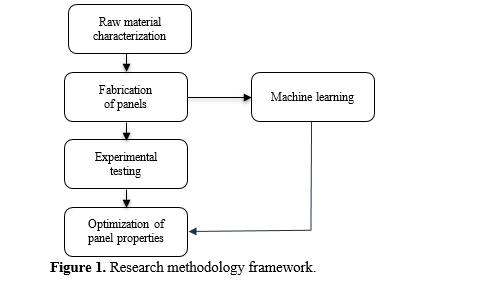
The increased rate of the accumulation of industrial residues in the developing countries is a major cause of concern for the environment. The current study brings forth the use of industrial residues in the form of the production of eco-friendly building materials as a sustainable approach to their valorization. The valorization of recycled paper mill reject, a cellulose-based biopolymeric industrial residue, is being addressed in this study as a reinforcement in the form of a lightweight polymer-cement composite false ceiling.. Various approaches, including elemental analysis, thermal analysis, phase identification, and microstructural studies, are carried out to determine the properties of RPMR. TGA-DTA confirm that RPMR is thermally stable up to 300 °C, while SEM images showed a porous fibrous network which is conducive to thermal insulation. Complementing experimental investigations, a machine learning framework is implemented on predicted and optimized key thermal parameters-thermal conductivity and reduction in indoor temperature-on the basis of material composition and processing conditions. ML models were found to yield a prediction accuracy with R² > 0.89, reducing the need for extensive physical trials by a great extent. Optimization output revealed an optimal mix design composition of 92% RPMR and pressing force of 150 kN, which resulted in an improvement in thermal conductivity by 15% relative to the reference mix. Integration of machine learning applications and sustainable materials innovation applies not only to waste management but also drives faster innovation in energy-efficient housing. The hybrid composite panels produced through the use of RPMR are the most energy-efficient, save up to 22% of cooling energy, and cost-effective, hence helping with rural entrepreneurship as well as practices related to the circular economy.
Keywords: Recycled paper mill reject (RPMR), biopolymer–cement hybrid panels, machine learning, Green polymer composites, biopolymeric
[This article belongs to Special Issue under section in Journal of Polymer & Composites (jopc)]
References
- Kamal Al-Malaha, and Basim Abu-Jdayilb, Clay-based heat insulator composites: Thermal and water retention properties, J. Applied Clay Science, 37 (1–2), 90-96, (2007)
- Jun Han, Lin Lu and Hongxing Yang, Investigation on the thermal performance of different lightweight roofing structures and its effect on space cooling load, J. Applied Thermal Engineering, 29 (11–12), 2491-2499, (2009)
- Salah-Eddine Ouldboukhitine, Rafik Belarbi, Issa Jaffal and Abdelkrim Trabelsi, Assessment of green roof thermal behavior: A coupled heat and mass transfer model, J. Building and Environment, 46 (12), 2624–2631, (2011)
- Jorge L. Alvarado, Wilson Terrell Jr. and Michael D. Johnson, Passive cooling systems for cement-based roofs, J. Building and Environment, 44 (9), 1869–1875, (2009)
- Mohammad S. Al-Homoud, Performance characteristics and practical applications of common building thermal insulation materials, J. Building and Environment, 40 (3), 353–366, (2005)
- Rakesh Kumar and S.C. Kaushik, Performance evaluation of green roof and shading for thermal protection of buildings, J. Building and Environment, 40 (11), 1505–1511, (2005)
- Sami A. Al-Sanea, Thermal performance of building roof elements, J. Building and Environment, 37 (7), 665–675, (2002)
- W. Tsang and C.Y. Jim, Theoretical evaluation of thermal and energy performance of tropical green roofs, J. Energy, 36 (5), 3590–359, (2011)
- Azra Korjenic, Vít Petránek, Jiri Zach and Jitka Hroudova, Development and performance evaluation of natural thermal-insulation materials composed of renewable resources, J. Energy and Buildings, 43 (9), 2518–2523, (2011)
- Renato M. Lazzarin, Francesco Castellotti and Filippo Busato, Experimental measurements and numerical modelling of a green roof, J. Energy and Buildings, 37 (12), 1260–1267, (2005)
- Jinghua Yu, Liwei Tian, Changzhi Yang, Xinhua Xu and Jinbo Wang, Optimum insulation thickness of residential roof with respect to solar-air degree-hours in hot summer and cold winter zone of china, J. Energy and Buildings, 43 (9), 2304–2313, (2011)
- Liuzzi, S., Rubino, C., Martellotta, F., & Stefanizzi, P., Experimental analysis of building components with paper and textile waste, Energy Efficiency, 17 (2024), Article 42. https://doi.org/10.1007/s12053-024-10223-y
- Lee, M.-L., Sarkar, A., Guo, Z., Zhou, C., Armstrong, J. N., & Ren, S., Additive manufacturing of eco-friendly building insulation materials by recycling pulp and paper, Nanoscale Advances, 5 (2023), 1975–1985. https://doi.org/10.1039/D3NA00036B
- Karuppiah G, Kuttalam KC, Palaniappan M, Santulli C, Palanisamy S. Multiobjective optimization of fabrication parameters of jute fiber/polyester composites with egg shell powder and nanoclay filler. Molecules. 2020;25(23):5579. doi:10.3390/molecules25235579.
- Santulli C, Palanisamy S, Kalimuthu M. Pineapple fibers, their composites and applications. In: Rangappa SM, Parameswaranpillai J, Siengchin S, Ozbakkaloglu T, Wang H, editors. Plant Fibers, Their Composites, and Applications. Woodhead Publishing; 2022. p. 323–346. doi:10.1016/B978-0-12-824528-6.00007-2.
- Goutham ERS, Hussain SS, Muthukumar C, Krishnasamy S, Kumar TSM, Santulli C, et al. Drilling parameters and post-drilling residual tensile properties of natural-fiber-reinforced composites: A review. J Compos Sci. 2023;7(4):136. doi:10.3390/jcs7040136.
- Ayrilmis N, Kanat G, Yildiz Avsar E, Palanisamy S, Ashori A. Utilizing waste manhole covers and fibreboard as reinforcing fillers for thermoplastic composites. J Reinf Plast Compos. 2024;44(17–18):1108-1118. doi:10.1177/07316844241238507.
- Aruchamy K, Karuppusamy M, Krishnakumar S, Palanisamy S, Jayamani M, Sureshkumar K, et al. Enhancement of mechanical properties of hybrid polymer composites using palmyra palm and coconut sheath fibers: The role of tamarind shell powder. BioResources. 2025;20(1):698–724.
- Palanisamy S, Mayandi K, Dharmalingam S, Rajini N, Santulli C, Mohammad F, et al. Tensile properties and fracture morphology of Acacia caesia bark fibers treated with different alkali concentrations. J Nat Fibers. 2022;19(15):11258–11269. doi:10.1080/15440478.2021.2022562.
- Bureau of Indian Standards, IS 8112, (1989), 43 grade ordinary portland cement -specification, New Delhi, India.
- Bureau of Indian Standard, SP: 41, (1987), Handbook on functional requirements of buildings (other than industrial buildings) (parts 1–4), New Delhi, India.

Journal of Polymer & Composites
| Volume | 14 | |
| Special Issue | 02 | |
| Received | 04/12/2025 | |
| Accepted | 25/02/2026 | |
| Published | 28/03/2026 | |
| Publication Time | 114 Days |