
B. Kiran Kumar,
K. Siva Satya Mohan,
K. Venkatesan,
K. Tilak,
- Associate Professor, Department of Mechanical Engineering, Koneru Lakshmaiah Education Foundation, Vaddeswaram, Andhra Pradesh, India
- Assistant Professor, Department of Mechanical Engineering, Aditya University, Surampalem, Andhra Pradesh, India
- Professor, Department of Automobile Engineering, Bharath Institute of Higher Education and Research, Chennai, Tamil Nadu, India
- Student, Department of Mechanical Engineering, Koneru Lakshmaiah Education Foundation, Vaddeswaram, Andhra Pradesh, India
Abstract
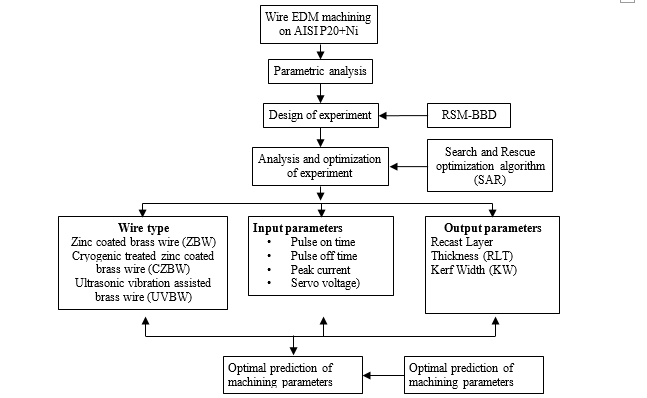
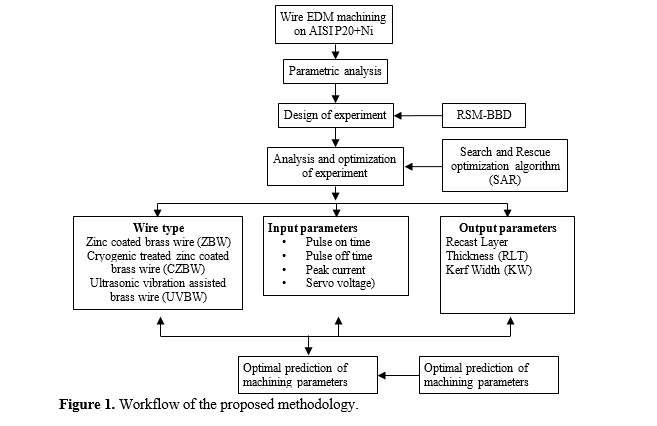
AISI P20+Ni steel is extensively used for forging dies, plastic moulds, and automotive die components due to its excellent polishability, hardness, and homogeneity. This research utilizes Wire Electrical Discharge Machining (WEDM) to process pre-hardened AISI P20+Ni steel, focusing on minimizing both recast layer thickness (RLT) and kerf width (KW). The performance of wires made from composite materials, including zinc-coated brass wire (ZBW), cryogenically treated ZBW (CZBW), and ultrasonic vibration-assisted brass wire (UVBW), is evaluated in this study. Pulse on time (TON), pulse off time (TOFF), peak current (IP), and servo voltage (VS) are the main machining parameters considered during experiments. Their effects on RLT and KW are studied experimentally, and the process was additionally enhanced through the application of Response Surface Methodology and the Search and rescue algorithm (SAR). Results show that UVBW yields the best performance, Utilizing optimized parameters of TON at 110 µs, TOFF at 60 µs, IP of 12 A, and VS set to 6 V, achieving a desirability of 0.722 in RSM. Additionally, a hybrid deep belief neural network integrated with SAR (DBN-SAR) is found to be the most accurate method for predicting WEDM outcomes, outperforming standalone DBN and RSM with RMSE values ranging from 0.024 to 0.03, indicating lower error.
Keywords: AISI P20+Ni, optimization, hybrid modeling, Composite EDM Wires
[This article belongs to Special Issue under section in Journal of Polymer & Composites (jopc)]
References
- Russo D, Urbicain G, Sánchez Egea A J, Simoncelli A and Martinez Krahmer D. Milling force model for asymmetric end-mills during high-feed milling on AISI-P20. Materials and Manufacturing Processes. 2021; 36(15), 1761–7p.
- Kumar, Rajeev and Shankar Singh. Current research trends in wire electrical discharge machining: an overview. International Journal on Emerging Technologies. 2012; 3(1), 33–7p.
- Kuo, Chunliang, Huanjiun Kao and Hao Wang. Novel design and characterisation of surface modification in wire electrical discharge machining using assisting electrodes. Journal of Materials Processing Technology. 2017; 244, 136–13p.
- Yuan, Jin, Kesheng Wang, Tao Yu and Minglun Fang. Reliable multi-objective optimization of high-speed WEDM process based on Gaussian process regression. International Journal of Machine Tools and Manufacture. 2008; 48(1), 47–13p.
- Abdulkareem, Suleiman, Ahsan Ali Khan and Zakaria Mohd Zain. Experimental investigation of machining parameters on surface roughness in dry and wet wire-electrical discharge machining. In Advanced Materials Research. Trans Tech Publications Ltd. 2011; 264, 831–5p.
- Singh T, Misra J P and Singh B. Experimental Investigation of Influence of Process Parameters on MRR during WEDM of Al6063 alloy. Materials Today: Proceedings. 2017; 4(2), pp.2242–5p.
- Ritesh Joshi, Gopal Zinzala, Nishit Nirmal, and Kishan Fuse. Multi-Response Optimization of EDM for Ti-6Al-4V Using Taguchi-Grey Relational Analysis;. In Solid State Phenomena. Trans Tech Publications Ltd. 2017; 266, 43–7p.
- Mahapatra, K K, Tripathy S, Thatoi D N, and Mohapatra S. Multi-objective Optimization of AISI P-20 Tool Steel During Electrical Discharge Machining. In Current Advances in Mechanical Engineering. Springer Singapore. 2021; 919–8p.
- Ruma Sen, Bikash Choudhuri, John Deb Barma, and Prasun Chakraborti. Study the impact of process parameters and electrode material on wire electric discharge machining performances. Materials Today: Proceedings, 2018; 5(2), 7552–8p.
- Navjot Singh, Parlad Kumar, and Khushdeep Goyal. Effect of two different cryogenic treated wires in wire electrical discharge machining of AISI D3 die steel. Journal of mechanical engineering, 2013; 43(2), 54–p6.
- Manisha Priyadarshini, Chandan Kumar Biswas, and Ajit Behera. Machining of sub-cooled low carbon tool steel by wire-EDM. Materials and Manufacturing Processes. 2019; 34(12), 1316-9p.
- Nihat Tosun, and Can Cogun. An investigation on wire wear in WEDM; Journal of materials processing technology. 2003;134(3), 273–5p.
- Rupesh Chalisgaonkar, and Jatinder Kumar. Multi-response optimization and modeling of trim cut WEDM operation of commercially pure titanium (CPTi) considering multiple user’s preferences. Engineering Science and Technology, an International Journal. 2015; 18(2), 125–9p.
- Ugrasen G, Singh M B, and Ravindra H V. Optimization of process parameters for SS304 in wire electrical discharge machining using Taguchi’s technique. Materials today: proceedings. 2018; 5(1), 2877–6p.
- Bharathi P, Tummalapenta Gouri Lalitha Priyanka, G. Srinivasa Rao, and B. Nageswara Rao. Optimum WEDM process parameters of SS304 using Taguchi method. International Journal of Industrial and Manufacturing Systems Engineering. 2016; 1(3), 69–3p.
- Bikash Choudhuri, Ruma Sen, Subrata Kumar Ghosh, and S. C. Saha. Study of surface integrity and recast surface machined by Wire electrical discharge machining. Materials Today: Proceedings. 2018; 5(2), 7515–9p.
- Gowthaman P S, Gowthaman J, and Nagasundaram N J M T P. A study of machining characteristics of AISI 4340 alloy steel by wire electrical discharge machining process. Materials Today: Proceedings. 2020; 27, 565–5p.
- Nixon Kuruvila, and Ravindra H V. Parametric influence and optimization of wire EDM of hot die steel. Machining Science and Technology. 2011; 15(1), 47–28p.
- Bhupinder Singh and J P Misra. Surface finish analysis of wire electric discharge machined specimens by RSM and ANN modelling. Measurement. 2019;137, 225–12p.
- Bijaya Bijeta Nayak, and Siba Sankar Mahapatra. Optimization of WEDM process parameters using deep cryo-treated Inconel 718 as work material. Engineering Science and Technology, an International Journal. 2016; 19(1), 161–9p.
- Singh T, Kumar P, and Misra J P. Modelling of MRR during Wire-EDM of ballistic grade alloy using artificial neural network technique. Journal of Physics: Conference Series. IOP Publishing. 2019; 1240(1), pp.012114.
- Ping-Hsien Chou, Yean-Ren Hwang, and Bling-Hwa Yan. The study of machine learning for wire rupture prediction in WEDM. The International Journal of Advanced Manufacturing Technology. 2022; 119(1), 1301–10p.
- Mustafa Ulas, Osman Aydur, Turan Gurgenc, and Cihan Ozel. Surface roughness prediction of machined aluminum alloy with wire electrical discharge machining by different machine learning algorithms. Journal of Materials Research and Technology. 2020; 9(6), 12512–12p.

Journal of Polymer & Composites
| Volume | 14 | |
| Special Issue | 01 | |
| Received | 24/09/2025 | |
| Accepted | 03/11/2025 | |
| Published | 07/02/2026 | |
| Publication Time | 136 Days |