
Manju Tripathi,
Vaishali B. Adsul,
Mrudula Wadekar,
Elija Khatiwora,
Rasika C. Torane,
- Assistant Professor, Department of Chemistry, Yashwantrao Mohite College of Arts, Science & Commerce, Bharati Vidyapeeth (Deemed to Be University), Pune, Maharashtra, India
- Assistant Professor, Department of Chemistry, Yashwantrao Mohite College of Arts, Science & Commerce, Bharati Vidyapeeth (Deemed to Be University), Pune, Maharashtra, India
- Assistant Professor, Department of Chemistry, Yashwantrao Mohite College of Arts, Science & Commerce, Bharati Vidyapeeth (Deemed to Be University), Pune, Maharashtra, India
- Assistant Professor, Department of Chemistry, Yashwantrao Mohite College of Arts, Science & Commerce, Bharati Vidyapeeth (Deemed to Be University), Pune, Maharashtra, India
- Associate Professor, Department of Chemistry, Sir Parshuram College, Pune, Maharashtra, India
Abstract
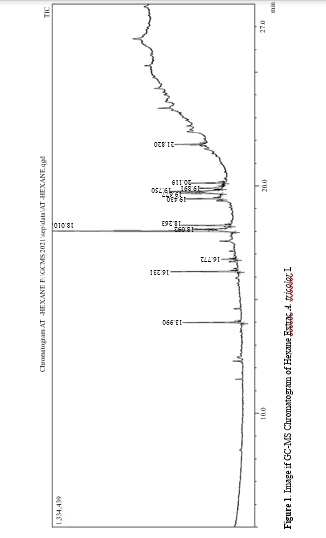
Amaranthus tricolor Linn and Amaranthus viridis Linn, belonging to the Amaranthaceae family, are popularly consumed leafy vegetables in India and many other countries globally. The bioactive components of Hexane extract from these two plants have been analysed using gas chromatography-mass spectrometry (GC–MS) technique. According to analysis, both species contain a total of nineteen important chemicals. Of these, ten were found in A. tricolour L. and nine in A. viridis L. Their structures were determined through percentage similarity indices from NIST library. The GC-MS analysis reveals that most prevalent secondary metabolite compounds include Tetradecane, Heptadecane, 2-Methyltetracosane, Hexadecanoic acid, 3,7,11,15-Tetramethyl-2-hexadecen-1-ol, Phthalic acid butyl undecyl ester, Pentadecanoic acid, Nonadecane, Z,E-3,13-Octadecadien-1-ol, cis,cis,cis–7,10,13–Hexadecatrienal, Butyl octyl phthalate, Henicosane, Eicosane and Oleic acid, 3-(octadecyl) propyl ester. Structures are verified through an examination of the classical fragmentation patterns, the base peak and molecular ion peak of the compounds. While some of the chemical compounds are specific to each species, others are common to both plants. The natural occurrence and pharmacological properties of identified secondary metabolites were studied from literature. Results validate the existence of bioactive substances known for their pharmacological effects and therapeutic qualities.
Keywords: Amaranthacea, Amaranthus tricolor Linn, Amaranthus viridis Linn, Bioactive phytochemicals, GC-MS
[This article belongs to Special Issue under section in Journal of Polymer & Composites (jopc)]
References
- Agte VV, Tarwadi KV, Mengale S, Chiplonkar SA. Potential of indigenous green vegetables as natural sources of fortification of eight micronutrients. J. Food Comp. Anal. 2000;13:885-91.
- Lee HW, Bi X, Henry CJ. Comparative evaluation of minerals content of common green leafy vegetables consumed by the Asian populations in Singapore. Journal of Food Composition and Analysis. 2024 Jan 1;125:105787.
- Saunders RM, Becker R. Amaranthus: a potential food and feed resource.
- Jimoh MO, Afolayan AJ, Lewu FB. Suitability of Amaranthus species for alleviating human dietary deficiencies. South African Journal of Botany. 2018 Mar 1;115:65-73.
- Angel Huerta-Ocampo J, Paulina Barba de la Rosa A. Amaranth: a pseudo-cereal with nutraceutical properties. Current Nutrition & Food Science. 2011 Feb 1;7(1):1-9.
- Topwal M. A review on amaranth: nutraceutical and virtual plant for providing food security and nutrients. Acta scientific agriculture. 2019;3(1):9-15.
- Venskutonis PR, Kraujalis P. Nutritional components of amaranth seeds and vegetables: a review on composition, properties, and uses. Comprehensive reviews in food science and food safety. 2013;12(4):381-412.
- Peter K, Gandhi P. Rediscovering the therapeutic potential of Amaranthus species: A review. Egyptian journal of basic and applied sciences. 2017;4(3):196-205.
- Shukla S, Bhargava A, Chatterjee A, Pandey AC, Mishra BK. Diversity in phenotypic and nutritional traits in vegetable amaranth (Amaranthus tricolor), a nutritionally underutilised crop. Journal of the Science of Food and Agriculture. 2010;15;90(1):139-44.
- Bharathi DR, Sahana KG, Mahesh C, Karthik S, Rupesh Kumar M, Ramesh B. Phytochemical composition and therapeutic effects of Amaranthus viridis Linn: A review. International Journal of Indigenous Herbs and Drugs. 2022; 8:110-3.
- Chopra, R.N., Nayar, S.L., Chopra, I.C., Asolkar, L. and Kakkar, K. Glossary of Indian medicinal plants, New Delhi. Council of Scientific & Industrial Research. 1956; 15-18.
- Ayurvedic Pharmacopoeia of India. Government of India, Ministry of Health and family welfare, Department of ISM & H. Part 1, 3:159; 2001. http://www.ayurveda.hu/api/API-Vol-3.pdf
- CK AK, Sree MD, Joshna A, Lakshmi SM, Kumar DS. A review on South Indian edible leafy vegetables. Journal of Global Trends in Pharmaceutical Sciences. 2013;4(4):1248-56.
- Buragohain J. Ethnomedicinal plants used by the ethnic communities of Tinsukia district of Assam, India. Recent research in Science and Technology. 2011;14,3(9).
- Uusiku NP, Oelofse A, Duodu KG, Bester MJ, Faber M. Nutritional value of leafy vegetables of sub-Saharan Africa and their potential contribution to human health: A review. Journal of food composition and analysis. 2010;23(6):499-509.
- Panda T. Traditional knowledge on wild edible plants as livelihood food in Odisha, India. Journal of Biology and Earth Sciences. 2014;4(2).
- Fan S, Chang J, Zong Y, Hu G, Jia J. GC-MS analysis of the composition of the essential oil from Dendranthema indicum Var. Aromaticum using three extraction methods and two columns. Molecules. 2018;23(3):576.
- Adsul V, Khatiwora E, Kulkarni M, Tambe A, Pawar P, Deshpande N. GC-MS study of fatty acids, esters, alcohols from the leaves of Ipomoea carnea. Int. J. Pharm. Tech. Res. 2009;1:1224-6.
- Chamblee TS, Clark Jr BC, Brewster GB, Radford T, Iacobucci GA. Quantitative analysis of the volatile constituents of lemon peel oil. Effects of silica gel chromatography on the composition of its hydrocarbon and oxygenated fractions. Journal of agricultural and food chemistry. 1991 Jan;39(1):162-9.
- Chavan MJ, Wakte PS, Shinde DB. Saturated long-chain hydrocarbons from Annona squamosa L. bark. Natural Product Research. 2009 Mar 20;23(5):455-9.
- Sagayaraj C, Kumar KB, Vimal S, Danya U. Assessment of Phytochemical Profile, Antioxidant, and Anticancer Activity Against Colon Cancer-HT-29: A Potent Therapeutic Medicinal Plant (Tarenna alpestris) in Megamalai Hills, Western Ghats, India. Applied Biochemistry and Biotechnology. 2025 May;197(5):3382-406.
- Lee BB, Jeong HJ, Yoon CY, Nam SH. Evaluation of quality, composition and anti-inflammatory effects of yuzu seed oil obtained by different drying pretreatments. Food Science and Biotechnology. 2025 Jul 1:1-1.
- Islam MT, Ali ES, Uddin SJ, Shaw S, Islam MA, Ahmed MI, Shill MC, Karmakar UK, Yarla NS, Khan IN, Billah MM. Phytol: A review of biomedical activities. Food and chemical toxicology. 2018;121:82-94.
- Hadi F, Sardar H, Alam W, Aschner M, Alzahrani FM, Halawani IF, Xiao J, Khan H. Vigna mungo (Linn.) Hepper: ethnobotanical, pharmacological, phytochemical, and nutritious profile. Phytochemistry Reviews. 2024;1-24.
- Technical document for (E, Z)-3,13-Octadecadien-1-ol and (Z, Z)-3,13-Octacecadien-1-ol, Western Poplar Clearwing Moth Pheromone, US-EPA office of pesticide program. https://www3.epa.gov/pesticides/chem_search/reg_actions/registration/decision_G-125_15-Nov-06.pdf
- Kumari A, Sidhu MC. A comparative account of chemical compounds in Terminalia anogeissiana Gere & Boatwr. and Terminalia pendula (Edgew.) Gere & Boatwr. Vegetos. 2025 Jun 10:1-2.
- RobbinsnJH, Tenenbaum AN. Composition including effervescent agents, biostimulant, nutrient, and pesticide. United States patent application US 17/667,880. 2022 Sep 1.
- Yaglioglu AS, Demirtas I. Comparative essential oil composition of flowers, leaves, and stems of Centaurea polypodiifolia var. polypodiifolia. Chemistry of Natural Compounds. 2015 Sep;51(5):982-4.
- Huang L, Zhu X, Zhou S, Cheng Z, Shi K, Zhang C, Shao H. Phthalic acid esters: Natural sources and biological activities. Toxins. 2021 Jul 16;13(7):495.
- Vanitha V, Vijayakumar S, Nilavukkarasi M, Punitha VN, Vidhya E, Praseetha PK. Heneicosane—A novel microbicidal bioactive alkane identified from Plumbago zeylanica L. Industrial Crops and Products. 2020 Oct 15;154:112748.
- Maheshwari S, Rajagopal K, Sriraman V, Lokesh K, Meenambiga SS, Balakrishnan M, Ramalingam A. 1-Eicosane, A Hydrocarbon from Curvularia lunata an endophytic fungi isolated from bark tissue of Ficus religiosa. Research Journal of Pharmacy and Technology. 2018;11(12):5297-303.
- Abubacker MN, Devi PK. In vitro antifungal potentials of bioactive compound oleic acid, 3-(octadecyloxy) propyl ester isolated from Lepidagathis cristata Willd (Acanthaceae) inflorescence. Asian Pacific journal of tropical medicine. 2014 Sep 1;7:S190-3.

Journal of Polymer & Composites
| Volume | 13 | |
| Special Issue | 06 | |
| Received | 09/06/2025 | |
| Accepted | 05/07/2025 | |
| Published | 10/08/2025 | |
| Publication Time | 62 Days |