V. Ravi Raj,
Neethi Madhavan C.S,
Bikash Chandra Saha,
Manu Vijay,
D. Sudha,
S. Sivakumar,
R. M. Karthikeyan,
Shailendra Kumar Bohidar,
Zakir Hussain,
- Associate Professor, Department of Mechanical Engineering, Sri Sairam Engineering College, Chennai, Tamil Nadu, India
- Assistant Professor, Department of Aeronautical Engineering, Rajadhani Institute of Engineering and Technology, Kerala, India
- Associate Professor, Department of Electrical and Electronics Engineering, Cambridge Institute of Technology, Ranchi, Jharkhand, India
- Associate Professor, Department of Civil Engineering, ATME College of Engineering, Mysore, Karnataka, India
- Associate Professor, Department of Physics, R.M.K. Engineering College, Tamil Nadu, India
- Professor, Department of Chemistry, Varuvan Vadivelan Institute of Technology, Dharmapuri, Tamil Nadu, India
- Associate Professor, Department of Civil Engineering, SNS College of Technology, Coimbatore, Tamil Nadu, India
- Associate Professor, Department of Mechanical Engineering, School of Engineering & I.T, MATS University, Raipur, Chhattisgarh, India
- Assistant Professor, Department of Chemical Technology, Loyola Academy, Secunderabad, Telangana, India
Abstract
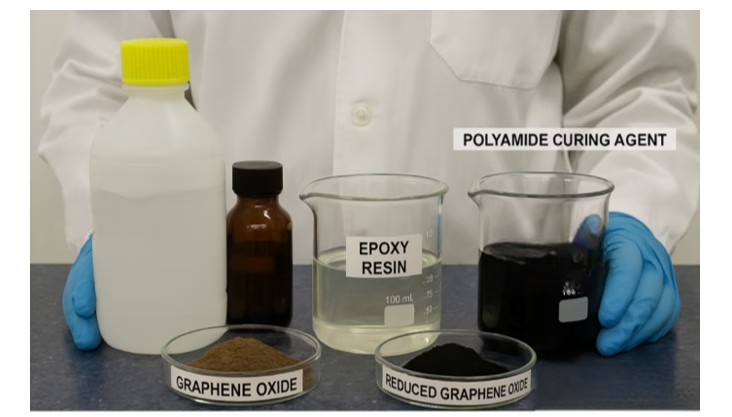
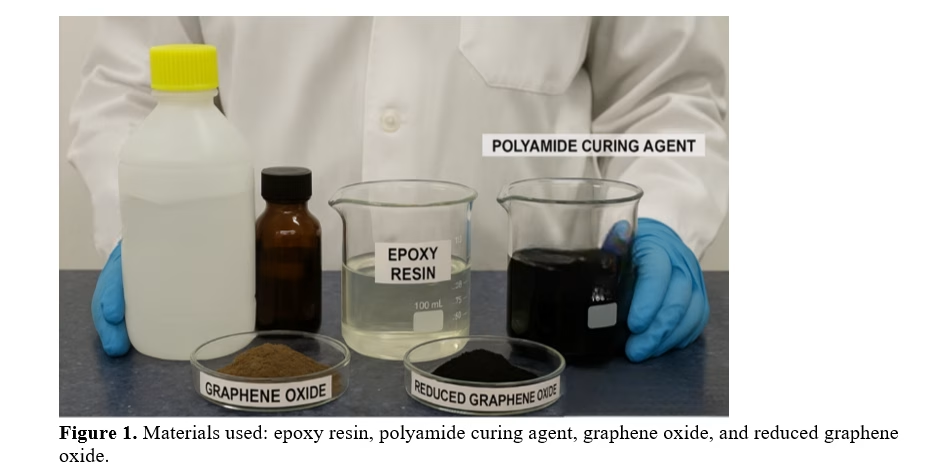
This study presents a matrix-centric polymer-composite repair binder: an epoxy–polyamide network reinforced with graphene derivatives (GO/rGO, 0.1–1.0 wt%). The polymer drives function via segmental mobility that closes microcracks, while 2D-filler topology densifies the interphase, improves load transfer, and enforces tortuous moisture pathways. Adhesion was high: pull-off (ASTM D4541) reached 13.5 MPa at 2.0 mm displacement; slant-shear (ASTM C882) reached 12.1 MPa at 2.8 mm, with greater deformation capacity (zero stress ~5.6 mm) and higher work-to-failure (~45.17 MPa·mm) than pull-off (~36.00 MPa·mm), evidencing polymer ductility and filler-mediated bridging under mixed-mode loading. Water permeability (EN 12390-8, 0.5 MPa, 72 h) plateaued at ~7.3 mm, with average ingress rates dropping from ~0.236 to ~0.053 to ~0.015 mm h⁻¹ across 0–24, 24–48, and 48–72 h, consistent with pore blocking and microcrack self-sealing within the composite interphase. Pre-cracked specimens (~0.2 ± 0.05 mm) recovered ~35% strength by day 1, ~78% by day 5, and ~92% by day 7 at 25 °C/60% RH, confirming polymer-enabled healing assisted by filler percolation across crack wakes. SEM revealed uniform filler dispersion, polymer fibrils bridging microcracks, and a dense, low-void interphase; EDS and mapping indicated O (~40 wt%), Si (~25 wt%), Ca (~15 wt%), and C (~20 wt%) with Si-rich streaks along crack corridors. Overall, this polymer-composite binder couples high adhesion, low permeability, and autonomous healing to extend durability under wet or cyclic service.
Keywords: Polymer-composite, graphene, adhesion, micro-cracks, self-healing.
[This article belongs to Journal of Polymer & Composites ]
References
- Tong T, Fan Z, Liu Q, Wang S, Tan S, Yu Q. Investigation of the effects of graphene and graphene oxide nanoplatelets on the micro-and macro-properties of cementitious materials. Constr Build Mater. 2016;106:102–14. doi: 10.1016/j.conbuildmat. 2015.12.092.
- Chuah S, Li W, Chen SJ, Sanjayan JG, Duan WH. Investigation on dispersion of graphene oxide in cement composite using different surfactant treatments. Constr Build Mater. 2018;161:519–27. doi: 10.1016/j.conbuildmat.2017.11.154.
- Palaniappan M, Palanisamy S, Mani T, et al. Physico-chemical characterization of Grewia monticola Sond. fibers for polymer composites. J Nat Fibers. 2022;19(17):15276-15290. doi:10.1080/15440478.2022.2123076.
- Chandramohan D, Sathish T, Dinesh Kumar S, Sudhakar M. Mechanical and thermal properties of jute/aloevera hybrid natural fiber reinforced composites. AIP Conf Proc. 2020; 2283(1).
- Palaniappan M, Palanisamy S, Mani T. Novel Ficus retusa L. aerial root fiber: a sustainable alternative for synthetic fibres in polymer composites reinforcement. Biomass Convers Biorefin. 2024;Ahead-of-print. doi:10.1007/s13399-024-05495-4.
- Vennila T, Surakasi R, Raghuram KS, Ravi G, Madhavarao S, Udagani C, Sudhakar M. Investigation on tensile behaviour of Al/Si3N4/sugarcane ash particles reinforced FSP composites. Int J Photoenergy. 2021; 59:1266–70.
- Palaniappan M, Palanisamy S, Khan R, et al. Synthesis and suitability characterization of microcrystalline cellulose from Citrus × sinensis peel waste for polymer composite applications. J Polym Res. 2024;31(4):105. doi:10.1007/s10965-024-03946-0.
- Prabhu FF, Kumar KP, Shanmugam A, Kumar M, Senthil TS, Dhanraj JA. Study on wear behaviour of Al6061 MMC with nano-MoC. Mater Today Proc. 2022;69(Part 3):1154–8.
- Jasmin MN, Sathish S, Senthil TS, Naidu BA, Das AD, Arun KK, et al. Investigation on natural fiber reinforced polymer matrix composite. Mater Today Proc. 2023;74(Part 1):60–3.
- Srinivas J, Karthikeyan KR, Senthil TS, Yesuraj K, Aultrin KSJ. Characterization of mechanical and viscoelastic properties of ceramic nanoparticle-reinforced polymer composites. J Polym Compos. 2024;13(1):71–82.
- Palanisamy S, Kalimuthu M, Palaniappan M, et al. Characterization of Acacia caesia bark fibers (ACBFs). J Nat Fibers. 2022;19(15):10241-10252. doi:10.1080/15440478.2021.1993493.
- Mary Jasmin N, Beena T, Senthil S, Sakthi S, Ramesh Kumar M, Rahul Alex S, et al. Machinability behaviors of synthesized beryllium composite. Mater Today Proc. 2023;74(Part 1):40–3.
- Priya CB, Ravi Kumar V, Umamaheswari D, Venkatesh R, Karthigairajan M, Kaliappan S, et al. Bio-degradable waste banana and neem fiber reinforced epoxy hybrid composites: Characteristics study. J Mech Sci Technol. 2024;38(4):1891–6.
- Saravanan AK, Rajendra Prasad A, Muruganandam D, Saravanan G, Vivekanandan S, Sudhakar M. Study on natural fiber composites of jute, pineapple, and banana compositions percentage of weight basis for thermal resistance and thermal conductivity. Mater Today Proc. 2020; 37:147–51.
- Logendran D, Gurusami K, AnandChakaravarthi MC, Puthilibai G, Suresh M, Sudhakar M. Experimental research on glass fibres/caustic soda treated banana fibers hybrid composite. Mater Today Proc. 2020; 33:4408–11.
- Muruganandam D, Jayapriya J, Suresh M, Chitradevi S, Puthilibai G, Sudhakar M. Simple study on behavior of composites with augmentation of silicon carbide on Al6061 aluminium alloy based on mechanical properties. Mater Today Proc. 2020; 33:4573–7.
- Palanisamy S, Kalimuthu M, Azeez A, et al. Wear properties and post-moisture absorption mechanical behavior of kenaf/banana-fiber-reinforced epoxy composites. Fibers. 2022;10(4):32. doi:10.3390/fib10040032.
- Liu C, Huang X, Wu YY, Deng X, Zheng Z, Xu Z, et al. Advance on the dispersion treatment of graphene oxide and the graphene oxide modified cement-based materials. Nanotechnol Rev. 2021;10(1):34–49.
- Suo Y, Guo R, Xia H, Yang Y, Zhou B, Zhao Z. A review of graphene oxide/cement composites: performance, functionality, mechanisms, and prospects. J Build Eng. 2022;53:104502.
- Li X, Lu Z, Chuah S, Li W, Liu Y, Duan WH, et al. Effects of graphene oxide aggregates on hydration degree, sorptivity, and tensile splitting strength of cement paste. Compos Appl Sci Manuf. 2017;100:1–8. doi: 10.1016/j.compositesa.2017. 05.002.
- El-Gamal SM, Abo-El-Enein SA, El-Hosiny FI, Amin MS, Ramadan M. Thermal resistance, microstructure and mechanical properties of type I Portland cement pastes containing low-cost nanoparticles. J Therm Anal Calorim. 2018;131(2):949–68. doi: https://doi.org/10.1007/s10973-17-6629-1.
- Heikal M, Ismail MN, Ibrahim NS. Physico-mechanical, microstructure characteristics and fire resistance of cement pastes containing Al2O3 nano-particles. Constr Build Mater. 2015;91:232–42. doi: 10.1016/j.conbuildmat.2015.05.036.
- Horszczaruk E, Sikora P, Cendrowski K, Mijowska E. The effect of elevated temperature on the properties of cement mortars containing nanosilica and heavyweight aggregates. Constr Build Mater. 2017;137:420–31. doi: 10.1016/j.conbuildmat. 2017.02.003.
- Irshidat MR, Al-Saleh MH. Thermal performance and fire resistance of nanoclay modified cementitious materials. Constr Build Mater. 2018;159:213–9. doi: 10.1016/j. conbuildmat.2017.10.127.
- Chen Y, Li X, Dong B, Du H, Yan R, Wang L. High-temperature properties of cement paste with graphene oxide agglomerates. Constr Build Mater. 2022;320:126286. doi: 10.1016/j.conbuildmat.2021.126286.
- Hager I. Behaviour of cement concrete at high temperature. Bull Pol Acad Sci Tech Sci. 2013;61(1):145–54. doi: 10.2478/ bpasts-2013-0013.
- Fernandes B, Gil AM, Bolina FL, Tutikian BF. Microstructure of concrete subjected to elevated temperatures: physico-chemical changes and analysis techniques. IBRACON Struct Mater J. 2017;10:838–63. doi: 10.1590/S1983-41952017000400004.
- Sikora P, Abd Elrahman M, Chung SY, Cendrowski K, Mijowska E, Stephan D. Mechanical and microstructural properties of cement pastes containing carbon nanotubes and carbon nanotube–silica core–shell structures, exposed to elevated temperature. Cement Concr Compos. 2019;95:193–204. doi: 10.1016/j.cemconcomp.2018.11.006.

Journal of Polymer & Composites
| Volume | 13 | |
| Issue | 06 | |
| Received | 22/08/2025 | |
| Accepted | 03/09/2025 | |
| Published | 13/09/2025 | |
| Publication Time | 22 Days |