Ch. Tirumala Rao,
Baviri. Praveen Kumar,
Md. Touseef Ahamad,
T. Suseela,
Smt K. Sree Devi,
P. Narendra Mohan,
- Assistant Professor, Department of Mechanical Engineering, Acharya Nagarjuna University College of Engineering & Technology, Acharya Nagarjuna University, Guntur, Andhra Pradesh, India
- PG Scholar, Department of Mechanical Engineering, Acharya Nagarjuna University College of Engineering & Technology, Acharya Nagarjuna University, Guntur, Andhra Pradesh, India
- Assistant Professor, Department of Mechanical Engineering, Acharya Nagarjuna University College of Engineering & Technology, Acharya Nagarjuna University, Guntur, Andhra Pradesh, India
- Assistant Professor, Department of Mechanical Engineering, Acharya Nagarjuna University College of Engineering & Technology, Acharya Nagarjuna University, Guntur, Andhra Pradesh, India
- Assistant Professor, Department of Mechanical Engineering, Acharya Nagarjuna University College of Engineering & Technology, Acharya Nagarjuna University, Guntur, Andhra Pradesh, India
- Assistant Professor, Department of Mechanical Engineering, Acharya Nagarjuna University College of Engineering & Technology, Acharya Nagarjuna University, Guntur, Andhra Pradesh, India
Abstract
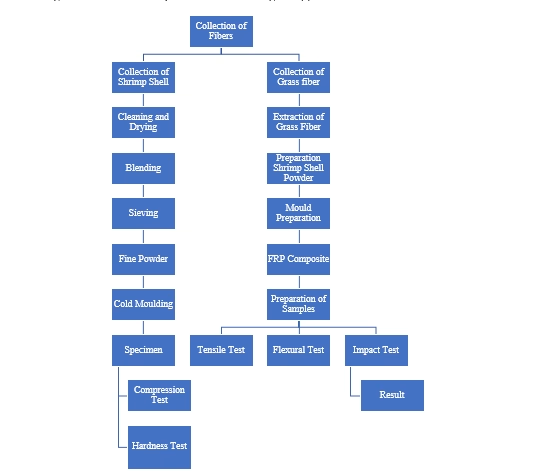
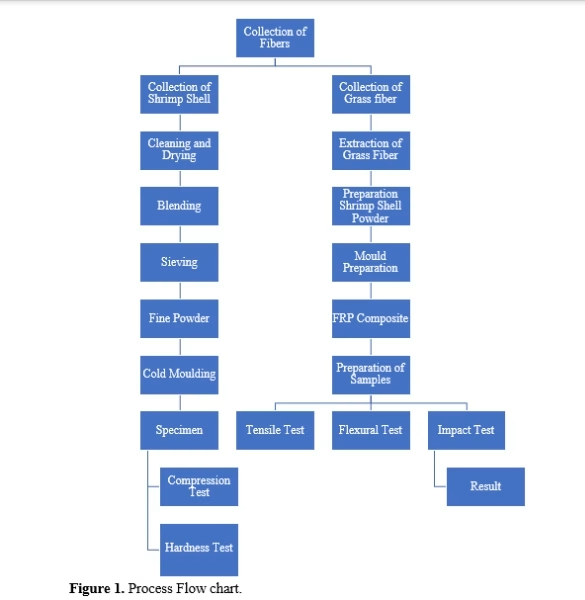
Shrimp, a significant area of the seafood industry in terms of production, is exceeded by only prawn and salmon in terms of volume; its global annual production exceeds 4.4 million tons. India is a sea of shrimp production: the country recorded a record high production of 9 lakh tonnes (900,000 metric tonnes) of cultured shrimp in 2021. Andhra Pradesh was the major contributor to cultured shrimp culture, amounting to around 70% of the Indian output. The intensive system, notwithstanding the high-growth potential, is associated with environmental degradation, water pollution, and loss of diversity. This review addresses the status of shrimp production, the key environmental impacts of shrimp farming and efforts in the name of innovations for achieving sustainable growth. This paper discusses the mechanical properties and biodegradability of bio-degradable shrimp shell powder with grass fiber reinforced composites (BGFRPs). Bio-degradable shrimp shell powder is compressed through cold moulding process, and cylindrical samples are prepared for testing in compression and hardness properties of the cylindrical sample before its usage in the manufacturing of fiber reinforced composites. The composites were prepared using a hand layup method, with shrimp shell powder as filler material and epoxy resin supplemented with grass fibers to enhance mechanical strength. The tensile test, flexural test, impact test was performed in order to evaluate the performance of the BGFRPs compared to traditional composites. It depicts the methodologies adopted and principal findings with regards to Shrimp shell powder’s mechanical properties and biodegradability, while also expounding on further possibilities for implications for sustainable material solutions for industry. It is inexpensive, very durable, and a greener alternative for a multitude of uses.
Keywords: Biodegradable, grass fiber, composite, shrimp shell powder, environmental impact, sustainable growth, cold moulding machine, fiber reinforced composites
[This article belongs to Special Issue under section in Journal of Polymer & Composites (jopc)]
References
- Vanasarla Hema, K. Srinivasa Rao, K. (2016): Fabrication and Testing of Composite Powder Materials from Shrimp Powder Epoxy. International Journal & Magazine of Engineering, Technology, Management and Research, ISSN 2348-4845.
- Muralidharan’s (2017), “Experimental Investigations of Mechanical Properties of Natural Hybrid Fiber, Reinforced Polymer Composite Materials”.
- Brahim S B and Cheikh R B (2006), “Influence of Fiber Orientation and Volume Fraction on the Tensile Properties of Unidirectional Alfa-Polyester Composite”, Composites Science and Technology
- Pothan, Laly A., Zachariah Oommen, and Sabu Thomas. “Dynamic mechanical analysis of banana fiber reinforced polyester composites.” Composites Science and Technology63.2 (2003): 283-293.
- Idicula, Maries, et al. “Dynamic mechanical analysis of randomly oriented intimately mixed short banana/sisal hybrid fiber reinforced polyester composites.” Composites Science and Technology 65.7-8 (2005): 1077-1087
- Reddy, M. Indra, M. Anil Kumar, and Ch Rama Bhadri Raju. “Tensile and flexural properties of jute, pineapple leaf and grass fiber reinforced polymer matrix hybrid composites.” Materials Today: Proceedings 5.1 (2018): 458- 462.
- Chen, G. Qipeng, M. Yongli, ―Bamboo fiber-reinforce polypropylene composites: a study of the mechanical properties, J Appl Polymers Sciences, vol. 69, pp. 1891-1899, 1998
- Brahma Kumar M. Pavithran C and Pillai RM (2005), “Coconut Fiber Reinforced Polyethylene Composites: Effect of Natural Waxy Surface Layer of the Fiber on Fiber/Matrix Interfacial Bonding and Strength of Composites”, Composites Science and Technology, Vol. 65, pp. 563569.
- Rao KMM and Rao KM (2007), “Extraction and Tensile Properties of Natural Fibers: Vika, Date and Bamboo”, Composite Structures, Vol. 77, pp. 288-295.
- Murali MRK and Mohana RK. Extraction of the tensile properties of natural fibers, Vakka, Date and Bambo. Journal of Composite Structures. 2007; 77-288-295. http://dx.doi.org/10.1016/j.compstruct.2005.07.023
- Franco, PJH, Valadez-González, A., 2005. Fiber-matrix adhesion in natural fiber composites. In: Mohanty, A.K., Misra, M., Drzal, L.T. (Eds.), Natural Fibers, Biopolymers and Bio composites. Taylor & Francis, Florida, pp. 177-230.
- Alam, S. N., Pickering, K. L. and Fernyhough, A. (2004): The Characterization of Natural Fibers& Their Interfacial & Composite Properties, Proceedings of SPPM, 25-27 February 2004, Dhaka, pp. 248-2
- Syed Khaja Naimuddin, Md Touseef Ahamad, Dr. Vidhu Kampurath and Dr. Yousuf Ali, Mechanical Properties of Friction Stir Welding Joints of Similar & Disimilar Aluminium Alloys Aa6061 & 6082. International Journal of Mechanical Engineering and Technology, 7(4), 2016, pp. 256–266.
- AR Devi, MT Ahamad, PN Mohan, BPC Sekhar, SK Naimuddin Metallurgical Characterization of Friction Stir Welding Joints of AA6061-AA6061, AA6061-AA6082 & AA6082-AA6082 Under T6 Condition, IJSART – Volume 2 Issue 8 –AUGUST 2016, 71-76
- Gibson, R.F. (2016). Principles of Composite Material Mechanics (4th ed.). CRC Press. https://doi.org/10.1201/b19626
- Callister, W. D., & Rethwisch, D. G. (2018). Materials Science and Engineering: An Introduction. John Wiley & Sons.
- Satyanarayana, K. G., Arizaga, G. G. C., & Wypych, F. (2009). Biodegradable composites based on lignocellulosic fibers—An overview. Progress in Polymer Science, 34(9), 982-1021.
- Ifuku, S., & Kadla, J. F. (2008). Preparation of chitin nanofibers with a uniform width as α-chitin from crab shells. Biomacromolecules, 9(8), 2396-2401.
- V Joshi, L.T Drzal, A.K Mohanty, S Arora, Are natural fiber composites environmentally superior to grass fiber reinforced composites?, Composites Part A: Applied Science and Manufacturing, Volume 35, Issue 3, 2004, Pages 371-376, ISSN 1359-835X,https://doi.org/10.1016/j.compositesa.2003.09.016.
- P.S. Abdul Khalil, A.H. Bhat, A.F. Ireana Yusra, Green composites from sustainable cellulose nanofibrils: A review, Carbohydrate Polymers, Volume 87, Issue 2,2012,Pages-963-979,ISSN0144-8617, https://doi.org/10.1016/j.carbpol.2011.08.078.

Journal of Polymer & Composites
| Volume | 13 | |
| Special Issue | 05 | |
| Received | 21/11/2024 | |
| Accepted | 15/03/2025 | |
| Published | 28/07/2025 | |
| Publication Time | 249 Days |