
Sumit Srivastava,
Shanmugha pillai Balaji,
Mayur Dilip Jakhete,
S. Vinoth Kumar,
L. Ganesh Babu,
Sandeep Chinta,
Goutam Kumar Mahato,
Ram subbiah,
- Professor, Department of Electronics & Communication Engineering, MJP Rohilkhand University, Bareilly, Uttar Pradesh, India
- Assistant professor, Department of Aeronautical Engineering, Nehru Institute of Engineering and Technology, Tamil Nadu, India
- Assistant Professor, Department of Computer Science and Engineering, Pimpri Chinchwad University Pune, Maharashtra, India
- Professor, Department of Computer science and engineering, School of Computing, Vel Tech Rangarajan Dr. Sagunthala R&D Institute of Science and Technology, Avadi, Tamil Nadu, India
- Assistant Professor, Department of Robotics and Automation, Rajalakshmi Engineering College, Chennai, Tamil Nadu, India
- Associate Professor, , Department of Mechanical Engineering, Institute of Aeronautical Engineering, Dundigal, Hyderabad, Telangana, India
- Assistant Professor, Department of Mathematics, Centurion University of Technology and Management, Odisha, India
- Professor, Department of Mechanical engineering, Gokaraju Rangaraju Institute of Engineering and Technology, Hyderabad, Telangana, India
Abstract
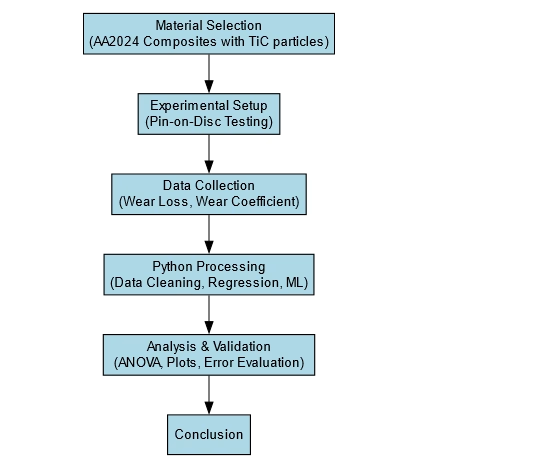
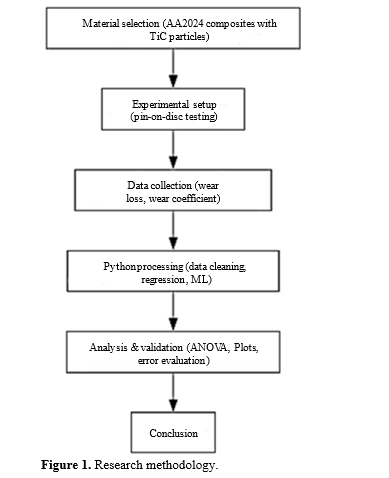
Determining wear coefficient accurately serves as a critical factor to maximize engineering materials’ tribological characteristics. The experiment examines the wear characteristics of TiC-reinforced AA2024 aluminum alloy subjected to different tribological operating conditions. A pin-on-disc tribometer performed wear tests under different conditions of load and TiC weight fraction and sliding speed and duration. ANOVA statistical results show that load intensity and TiC reinforcement density stand out as principal variables that affect wear coefficient measurements showing that increased TiC amounts lead to improved wear resistance. The prediction accuracy became improved through the implementation of Decision Tree and Random Forest together with Artificial Neural Networks (ANNs) in machine learning (ML) models. ANNs delivered better results than other tested models with a 0.00000007 MSE and a 0.995 R² score thus proving its optimal predictive ability. The coupling of computational modeling using Python with experimental tribology testing established an efficient and affordable method for determining wear coefficient values. The established framework enables wear prediction together with material optimization functions that can be applicable for composite systems and industrial applications.
Keywords: Wear coefficient, AA2024–TiC composites, tribological performance, pin-on-disc testing, machine learning prediction, artificial neural networks (ANN)
[This article belongs to Special Issue under section in Journal of Polymer & Composites (jopc)]
References
- Li, B., Li, P., Zhou, R., Feng, X. Q., & Zhou, K. (2022). Contact mechanics in tribological and contact damage-related problems: A review. Tribology International, 171, 107534.
- Liu, J., Xue, Y., Dong, X., Fan, Y., Hao, H., & Wang, X. (2023). Review of the surface treatment process for the adhesive matrix of composite materials. International Journal of Adhesion and Adhesives, 126, 103446.
- Sethu, S., Kalimuthu, M., & Mohan, M. (2024). Tribological investigations on fibre-reinforced composites: a comprehensive review considering variable velocity and load scenarios. Interactions, 245(1), 137.
- Yin, F., Wang, Y., Ji, H., Ma, Z., & Nie, S. (2021). Impact of sliding speed on the tribological behaviors of cermet and steel balls sliding against SiC lubricated with seawater. Tribology Letters, 69, 1-16.
- Solasa, K. C., Venkataraman, N. V., Choudhury, P. R., Schueller, J. K., & Bhattacharyya, A. (2024). On the Use of Alternative Measurement Methods in the Estimation of Wear Rates in Rotary-Pin-on-Disk Tribometry. Tribology Letters, 72(2), 45.
- Marian, M., & Tremmel, S. (2021). Current trends and applications of machine learning in tribology—A review. Lubricants, 9(9), 86.
- Li, B., Li, P., Zhou, R., Feng, X. Q., & Zhou, K. (2022). Contact mechanics in tribological and contact damage-related problems: A review. Tribology International, 171, 107534.
- Deshpande, P., Pandiyan, V., Meylan, B., & Wasmer, K. (2021). Acoustic emission and machine learning based classification of wear generated using a pin-on-disc tribometer equipped with a digital holographic microscope. Wear, 476, 203622.
- Orgeldinger, C., Rosnitschek, T., & Tremmel, S. (2024). Unveiling an additively manufactured open hardware pin-on-disc tribometer considering its high reproducibility. Wear, 552, 205437.
- Azzam, A. (2021). Nano-modified cementitious composites reinforced with basalt fiber pellets and their potential for repair/overlay applications.
- Soni, A., Das, P. K., Yusuf, M., & Ridha, S. (2022). Tribological behavior of particulates reinforced sustainable composites: Effect of composition, load, and sliding speed. Sustainable Chemistry and Pharmacy, 29, 100748.
- Pasha, M. B., Rao, R. N., Ismail, S., Gupta, M., & Prasad, P. S. (2024). Tribo-informatics approach to predict wear and friction coefficient of Mg/Si3N4 composites using machine learning techniques. Tribology International, 196, 109696.
- Mattei, L., & Di Puccio, F. (2023). How accurate is the Archard law to predict wear of UHMWPE in hard-on-soft hip implants? A numerical and experimental investigation. Tribology International, 187, 108768.
- Samal, P., Vundavilli, P. R., Meher, A., & Mahapatra, M. M. (2022). Multi-response modeling for sliding wear behavior of AA5052/TiC composites by stir casting: a comparative analysis using response surface methodology and fuzzy logic system. Proceedings of the Institution of Mechanical Engineers, Part E: Journal of Process Mechanical Engineering, 236(2), 254-266.
- Yan, S., Sui, L., Wang, S., & Sun, Y. (2023). On-line tool wear monitoring under variable milling conditions based on a condition-adaptive hidden semi-Markov model (CAHSMM). Mechanical Systems and Signal Processing, 200, 110644.
- Kurani, A., Doshi, P., Vakharia, A., & Shah, M. (2023). A comprehensive comparative study of artificial neural network (ANN) and support vector machines (SVM) on stock forecasting. Annals of Data Science, 10(1), 183-208.
- Ahmed, S. F., Alam, M. S. B., Hassan, M., Rozbu, M. R., Ishtiak, T., Rafa, N., … & Gandomi, A. H. (2023). Deep learning modelling techniques: current progress, applications, advantages, and challenges. Artificial Intelligence Review, 56(11), 13521-13617.
- Pasha, M. B., Rao, R. N., Ismail, S., Gupta, M., & Prasad, P. S. (2024). Tribo-informatics approach to predict wear and friction coefficient of Mg/Si3N4 composites using machine learning techniques. Tribology International, 196, 109696.
- Bararpour, S. M., Aval, H. J., & Jamaati, R. (2023). Combined experimental-numerical analysis of A356 aluminum alloy friction surfacing on AA2024 aluminum alloy substrate. Journal of Materials Research and Technology, 25, 4860-4875.
- Kanaginahal, G. M., Kiran, M. C., Shahapurkar, K., Mahale, R. S., & Kakkamari, P. (2024). Automobile Applications of Mechanically Alloyed Magnesium and Titanium Material. In Mechanically Alloyed Novel Materials: Processing, Applications, and Properties (pp. 379-406). Singapore: Springer Nature Singapore.
- Conejo Magaña, G. D., García García, V., Cahue Díaz, D., Herrera-Sandoval, N., & Hernández Cristóbal, O. (2025). Effect of Dynamic Corrosion and Degradation on Fatigue Life of an AA2024-T3 Aircraft Profile: Experimental, Statistical, and Numerical Analyses. Crystals, 15(1), 66.
- Veeresh Kumar, G. B., Pramod, R., Hari Kiran Reddy, R., Ramu, P., Kunaal Kumar, B., Madhukar, P., … & Khiste, S. K. (2021). Investigation of the tribological characteristics of aluminum 6061-reinforced titanium carbide metal matrix composites. Nanomaterials, 11(11), 3039.
- Deore, H. A., Mishra, J., Rao, A. G., Bhanushali, B. D., & Hiwarkar, V. D. (2022). Utilizing additive friction stir processing to fabricate B4C reinforced Ti–6Al–4V matrix surface composite: microstructure refinement and enhancement in mechanical properties. Metals and Materials International, 28(1), 322-335.
- Vanani, B. B., & Abdollahzadeh, A. (2024). Fabrication of reinforced Al–Mg composite by TiC particles via FSW: microstructure and tribology study. Journal of Materials Research and Technology, 30, 6787-6801.
- Lavanya, A., Gaurav, L., Sindhuja, S., Seam, H., Joydeep, M., Uppalapati, V., … & SD, V. S. (2023). Assessing the performance of Python data visualization libraries: a review. Int. J. Comput. Eng. Res. Trends, 10(1), 28-39.
- Solasa, K. C., Venkataraman, N. V., Choudhury, P. R., Schueller, J. K., & Bhattacharyya, A. (2024). On the Use of Alternative Measurement Methods in the Estimation of Wear Rates in Rotary-Pin-on-Disk Tribometry. Tribology Letters, 72(2), 45.
- Ketu, S. (2022). Spatial air quality index and air pollutant concentration prediction using linear regression based recursive feature elimination with random forest regression (RFERF): a case study in India. Natural Hazards, 114(2), 2109-2138.
- Kouadri, S., Elbeltagi, A., Islam, A. R. M. T., & Kateb, S. (2021). Performance of machine learning methods in predicting water quality index based on irregular data set: application on Illizi region (Algerian southeast). Applied Water Science, 11(12), 190.
- Raiaan, M. A. K., Sakib, S., Fahad, N. M., Al Mamun, A., Rahman, M. A., Shatabda, S., & Mukta, M. S. H. (2024). A systematic review of hyperparameter optimization techniques in Convolutional Neural Networks. Decision analytics journal, 100470.
- Solairaju, J. A., Rathinasamy, S., & Thanikodi, S. (2024). Modeling for predicting and optimizing of the flexural and hardness properties of jute/kenaf/glass fiber nano-composite through RSM. Results in Engineering, 24, 102977.
- Salem, H., Kabeel, A. E., El-Said, E. M., & Elzeki, O. M. (2022). Predictive modelling for solar power-driven hybrid desalination system using artificial neural network regression with Adam optimization. Desalination, 522, 115411.
- Kasiviswanathan, S., Gnanasekaran, S., Thangamuthu, M., & Rakkiyannan, J. (2024). Machine-learning-and Internet-of-Things-driven techniques for monitoring tool wear in machining process: a comprehensive review. Journal of Sensor and Actuator Networks, 13(5), 53.
- Rozing, G., Duspara, M., Dudic, B., & Savkovic, B. (2023). Research on the effect of load and rotation speed on resistance to combined wear of stainless steels using ANOVA Analysis. Materials, 16(12), 4284.
- Singhal, V., Shelly, D., Saxena, A., Gupta, R., Verma, V. K., & Jain, A. (2025). Study of the Influence of Nanoparticle Reinforcement on the Mechanical and Tribological Performance of Aluminum Matrix Composites—A Review. Lubricants, 13(2), 93.
- Jayanthi, A., Priya, R. K., Surakasi, R., Vanam, J. P., Puthilibai, G., Santhanakrishnan, M., & Rajkumar, S. (2022). Mechanical and tribological properties of TiC nano particles reinforced polymer matrix composites. Materials Today: Proceedings, 59, 1472-1477.
- Alnahit, A. O., Mishra, A. K., & Khan, A. A. (2022). Stream water quality prediction using boosted regression tree and random forest models. Stochastic Environmental Research and Risk Assessment, 36(9), 2661-2680.
- Singha, S., Pasupuleti, S., Singha, S. S., Singh, R., & Kumar, S. (2021). Prediction of groundwater quality using efficient machine learning technique. Chemosphere, 276, 130265.
- Jradi, R., Marvillet, C., & Jeday, M. R. (2024). Multi-objective optimization and performance assessment of response surface methodology (RSM), artificial neural network (ANN) and adaptive neuro-fuzzy interfence system (ANFIS) for estimation of fouling in phosphoric acid/steam heat exchanger. Applied Thermal Engineering, 248, 123255.
- Mu’azu, N. D., & Olatunji, S. O. (2023). K-nearest neighbor based computational intelligence and RSM predictive models for extraction of Cadmium from contaminated soil. Ain Shams Engineering Journal, 14(4), 101944.
- Pasha, M. B., Rao, R. N., Ismail, S., Gupta, M., & Prasad, P. S. (2024). Tribo-informatics approach to predict wear and friction coefficient of Mg/Si3N4 composites using machine learning techniques. Tribology International, 196, 109696.

Journal of Polymer & Composites
| Volume | 13 | |
| Special Issue | 06 | |
| Received | 30/04/2025 | |
| Accepted | 14/08/2025 | |
| Published | 30/08/2025 | |
| Publication Time | 122 Days |