S.Baskar,
Santosh Kumar Sahu,
Mayur Dilip Jakhete,
R Ben Ruben,
G Hima Bindu,
Makrand Jadhav,
Avinash Kumar,
L.Ganesh Babu,
- professor, Department of Electrical and Electronics Engineering, Dr. M. G. R. Educational and research institute, Chennai, Tamil Nadu, India
- Assistant Professor, Department of Mechanical Engineering, Veer Surendra Sai University of Technology, Burla, Odisha, India
- Assistant Professor, Computer Science and Engineering, Pimpri Chinchwad University Pune, Maharashtra, India
- Associate Professor, , Department of Mechanical Engineering, Sri Krishna College of Engineering and Technology, Coimbatore, Tamil Nadu, India
- Assistant Professor, Department of Mechanical Engineering, Institute of Aeronautical Engineering, Dundigal, Hyderabad, Telangana, India
- Professor and Head, Department of Computer Science and Engineering, NBN Sinhgad Technical Institutes Campus, Pune, Maharashtra, India
- Assistant professor, Department of Mechanical Engineering, Cambridge Institute of Technology, Ranchi, Jharkhand, India
- Assistant Professor, Department of Robotics and Automation, Rajalakshmi Engineering College, Chennai, Tamil Nadu, India
Abstract
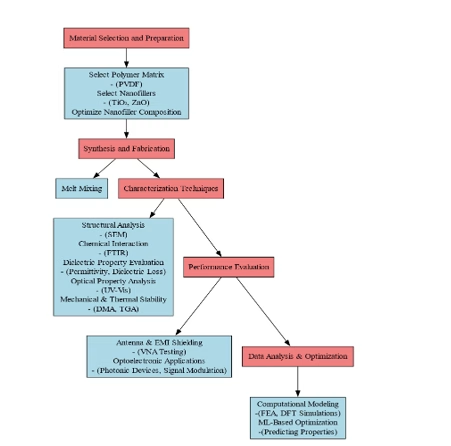
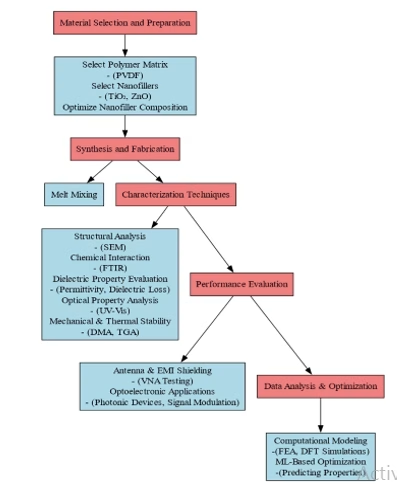
The incorporation of nanofillers into polymer matrices offers a promising approach to enhancing the multifunctional properties of composite materials. This study examines the effect of nanofiller concentration on the dielectric performance, mechanical strength, thermal stability, optical absorbance, and electromagnetic interference (EMI) shielding effectiveness of polyvinylidene fluoride (PVDF)-based nanocomposites. Titanium dioxide (TiO₂) and zinc oxide (ZnO) nanofillers were incorporated at varying concentrations to assess their influence on material properties. EMI shielding analysis revealed improved attenuation with increasing nanofiller content, demonstrating the composites’ potential for electronic applications. UV-Vis spectroscopy indicated enhanced light absorption in PVDF/ZnO nanocomposites compared to PVDF/TiO₂. Dynamic mechanical analysis (DMA) showed that TiO₂-filled PVDF provided superior reinforcement at moderate concentrations, while excessive filler loading reduced mechanical strength. Thermogravimetric analysis (TGA) confirmed that PVDF/ZnO composites exhibited greater thermal stability and degradation resistance at elevated temperatures. AI-based modeling predicted an optimal nanofiller concentration for maximizing dielectric performance, beyond which permittivity declined due to nanoparticle agglomeration. Scanning electron microscopy (SEM) confirmed the dispersion characteristics of nanofillers, correlating with the observed material properties. This study underscores the importance of optimizing nanofiller concentration to enhance material performance while minimizing adverse effects. These findings contribute to the development of high-performance polymer nanocomposites for applications in electronics, energy storage, and structural materials.
Keywords: Nanocomposites, PVDF, Nanofillers, Dielectric Permittivity, Thermal Stability, AI Optimization
[This article belongs to Special Issue under section in Journal of Polymer & Composites (jopc)]
References
- Ahmadi, A. (2024). Digital health transformation: leveraging ai for monitoring and disease management. International Journal of BioLife Sciences (IJBLS), 3(1), 10-24.
- Balakrishna, S., & Solanki, V. K. (2024). A comprehensive review on ai-driven healthcare transformation. Ingeniería Solidaria, 20(2), 1-30.
- Tariq, M. U. (2024). Advanced wearable medical devices and their role in transformative remote health monitoring. In Transformative approaches to patient literacy and healthcare innovation (pp. 308-326). IGI Global.
- Junaid, S. B., Imam, A. A., Abdulkarim, M., Surakat, Y. A., Balogun, A. O., Kumar, G., … & Hashim, A. S. (2022). Recent advances in artificial intelligence and wearable sensors in healthcare delivery. Applied Sciences, 12(20), 10271.
- Sahu, M., Gupta, R., Ambasta, R. K., & Kumar, P. (2022). Artificial intelligence and machine learning in precision medicine: A paradigm shift in big data analysis. Progress in molecular biology and translational science, 190(1), 57-100.
- Kuo, C. L. (2023). Revolutionizing healthcare paradigms: The integral role of artificial intelligence in advancing diagnostic and treatment modalities. International Microsurgery Journal (IMJ).
- Qureshi, R., Irfan, M., Ali, H., Khan, A., Nittala, A. S., Ali, S., … & Alam, T. (2023). Artificial intelligence and biosensors in healthcare and its clinical relevance: A review. IEEE access, 11, 61600-61620.
- Naskar, S., Sharma, S., Kuotsu, K., Halder, S., Pal, G., Saha, S., … & Bhattacharjee, S. (2024). The biomedical applications of artificial intelligence: an overview of decades of research. Journal of Drug Targeting, 1-32.
- Rane, N., Choudhary, S., & Rane, J. (2023). Towards Autonomous Healthcare: Integrating Artificial Intelligence (AI) for Personalized Medicine and Disease Prediction. Available at SSRN 4637894.
- Kacker, R., Singh, S. K., & Arora, A. (2024). and Internet of Things Biomedical Technologies. Evolution of Machine Learning and Internet of Things Applications in Biomedical Engineering, 169.
- Rastogi, P. (2024). Convergence of Smart Health, Data Mining, and Dynamical Systems: A Paradigm Shift in Healthcare. American-Eurasian Journal of Scientific Research, 11(02).
- Rajeswari, S. V. K. R., & Ponnusamy, V. (2022). Internet of Things and artificial intelligence in biomedical systems. In Artificial Intelligence for Innovative Healthcare Informatics (pp. 153-177). Cham: Springer International Publishing.
- AKHTAR, Z. (2024). Biomedical engineering (bme) and medical health science: an investigation perspective exploration. Quantum Journal of Medical and Health Sciences, 3(3), 1-24.
- Aminizadeh, S., Heidari, A., Dehghan, M., Toumaj, S., Rezaei, M., Navimipour, N. J., … & Unal, M. (2024). Opportunities and challenges of artificial intelligence and distributed systems to improve the quality of healthcare service. Artificial Intelligence in Medicine, 149, 102779.
- Akhtar, Z. B., & Rawol, A. T. (2024). A biomedical engineering (BME) perspective investigation analysis: Artificial intelligence (AI) and extended reality (XR).
- Chen, X., Xie, H., Tao, X., Wang, F. L., Leng, M., & Lei, B. (2024). Artificial intelligence and multimodal data fusion for smart healthcare: topic modeling and bibliometrics. Artificial Intelligence Review, 57(4), 91.
- Weerarathna, I. N., Kumar, P., Luharia, A., & Mishra, G. (2024). Engineering with Biomedical Sciences Changing the Horizon of Healthcare-A Review. Bioengineered, 15(1), 2401269.
- Srinivasan, V. A., Annalakshmi, M., & Priya, C. (2024). Innovations in Healthcare and Biotechnology Driven by Industry 5.0. In Utilizing Renewable Energy, Technology, and Education for Industry 5.0 (pp. 258-274). IGI Global.
- Roy, S., Meena, T., & Lim, S. J. (2022). Demystifying supervised learning in healthcare 4.0: A new reality of transforming diagnostic medici
- Singh, B., Kaunert, C., Vig, K., & Gautam, B. K. (2024). Wearable Sensors Assimilated With Internet of Things (IoT) for Advancing Medical Imaging and Digital Healthcare: Real-Time Scenario. In Inclusivity and Accessibility in Digital Health (pp. 275-297). IGI Global.
- Khang, A. (Ed.). (2024). Driving Smart Medical Diagnosis Through AI-Powered Technologies and Applications. IGI Global.
- Yadav, S. (2024). Transformative frontiers: a comprehensive review of emerging technologies in modern healthcare. Cureus, 16(3).
- Kumar, N. V., Chakradhar, D., & Abhilash, P. M. (2024). Advancing bioimplant manufacturing through artificial intelligence. In Bioimplants Manufacturing (pp. 284-312). CRC Press.
- Zeb, S., Nizamullah, F. N. U., Abbasi, N., & Qayyum, M. U. (2024). Transforming Healthcare: Artificial Intelligence’s Place in Contemporary Medicine. BULLET: Jurnal Multidisiplin Ilmu, 3(4), 592385.
- Bhambri, P., & Khang, A. (2024). Machine learning advancements in E-health: transforming digital healthcare. In Medical robotics and ai-assisted diagnostics for a high-tech healthcare industry (pp. 174-194). IGI Global.
- Bhagat, S. V., & Kanyal, D. (2024). Navigating the future: the transformative impact of artificial intelligence on hospital management-a comprehensive review. Cureus, 16(2).
- Adibi, S., Rajabifard, A., Shojaei, D., & Wickramasinghe, N. (2024). Enhancing healthcare through sensor-enabled digital twins in smart environments: A comprehensive analysis. Sensors, 24(9), 2793.
- Bhambri, P., & Khang, A. (2024). Managing and monitoring patient’s healthcare using AI and IoT technologies. In Driving Smart Medical Diagnosis Through AI-Powered Technologies and Applications (pp. 1-23). IGI Global.
- Anurogo, D., & Hidayat, N. A. (2023). The Art Of Televasculobiomedicine 5.0. Nas Media Pustaka.
- Prakashan, D., Kaushik, A., & Gandhi, S. (2024). Smart sensors and wound dressings: Artificial intelligence-supported chronic skin monitoring–A review. Chemical Engineering Journal, 154371.
- Nashruddin, S. N. A. B. M., Salleh, F. H. M., Yunus, R. M., & Zaman, H. B. (2024). Artificial intelligence− powered electrochemical sensor: Recent advances, challenges, and prospects. Heliyon.
- Khera, R., Oikonomou, E. K., Nadkarni, G. N., Morley, J. R., Wiens, J., Butte, A. J., & Topol, E. J. (2024). Transforming cardiovascular care with artificial intelligence: from discovery to practice: JACC state-of-the-art review. Journal of the American College of Cardiology, 84(1), 97-114.
- Chugh, V., Basu, A., Kaushik, A., Bhansali, S., & Basu, A. K. (2024). Employing nano-enabled artificial intelligence (AI)-based smart technologies for prediction, screening, and detection of cancer. Nanoscale, 16(11), 5458-5486.
- González-Rodríguez, V. E., Izquierdo-Bueno, I., Cantoral, J. M., Carbú, M., & Garrido, C. (2024). Artificial intelligence: a promising tool for application in phytopathology. Horticulturae, 10(3), 197.
- Akhtar, Z. B. (2024). Exploring biomedical engineering (BME): Advances within accelerated computing and regenerative medicine for a computational and medical science perspective exploration analysis. J. Emerg. Med. OA, 2, 1-23.
- Fuentes, S., Viejo, C. G., Tongson, E., & Dunshea, F. R. (2022). The livestock farming digital transformation: implementation of new and emerging technologies using artificial intelligence. Animal health research reviews, 23(1), 59-71.
- Fan, Z., Yan, Z., & Wen, S. (2023). Deep learning and artificial intelligence in sustainability: a review of SDGs, renewable energy, and environmental health. Sustainability, 15(18), 13493.
- Baseer, K. K., Sivakumar, K., Veeraiah, D., Chhabra, G., Lakineni, P. K., Pasha, M. J., … & Harikrishnan, G. (2024). Healthcare diagnostics with an adaptive deep learning model integrated with the Internet of medical Things (IoMT) for predicting heart disease. Biomedical Signal Processing and Control, 92, 105988.
- Ahmad, F., & Muhmood, T. (2024). Clinical translation of nanomedicine with integrated digital medicine and machine learning interventions. Colloids and Surfaces B: Biointerfaces, 114041.
- Yadav, D. K., & Gulati, A. (Eds.). (2023). Artificial Intelligence and Machine Learning in Healthcare. Springer.

Journal of Polymer & Composites
| Volume | 13 | |
| Special Issue | 05 | |
| Received | 30/04/2025 | |
| Accepted | 25/06/2025 | |
| Published | 04/08/2025 | |
| Publication Time | 96 Days |