
Ankush Kumar Jain,
Jitendra Kumar,
Akash Panwar,
- Associate Professor, Department of Civil Engineering, Poornima University, Jaipur, Rajasthan, India
- Assistant Professor, Department of Civil Engineering, Poornima University, Jaipur, Rajasthan, India
- Assistant Professor, Department of Civil Engineering, Poornima University, Jaipur, Rajasthan, India
Abstract
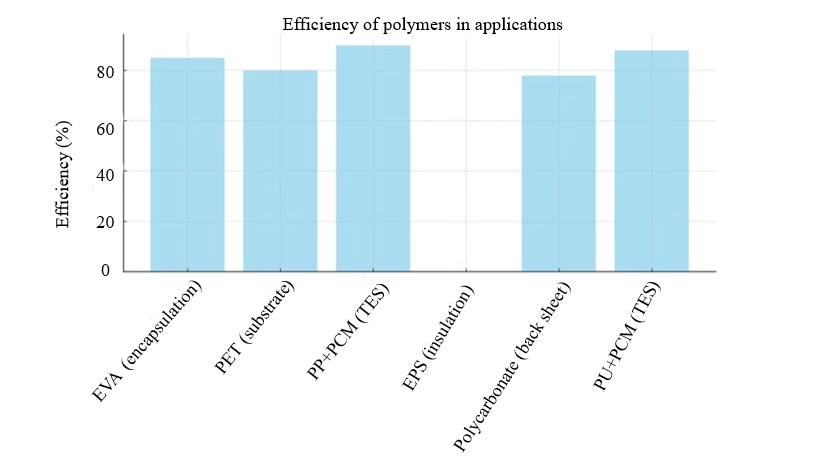
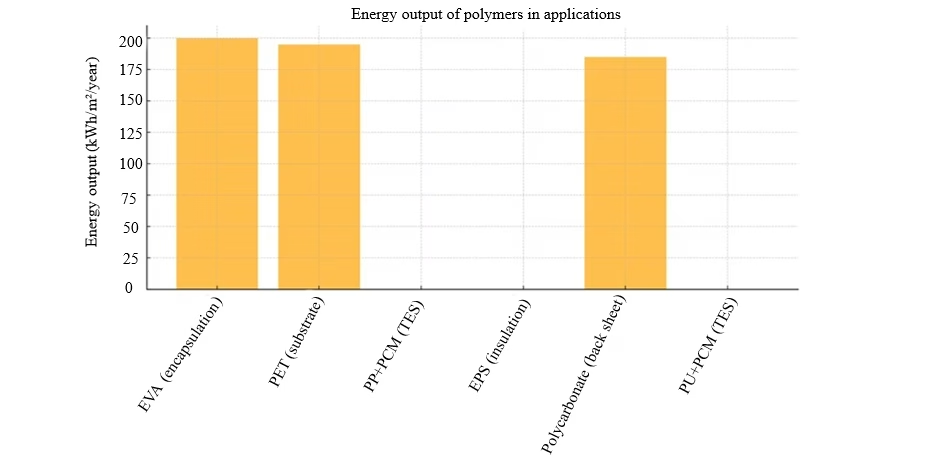
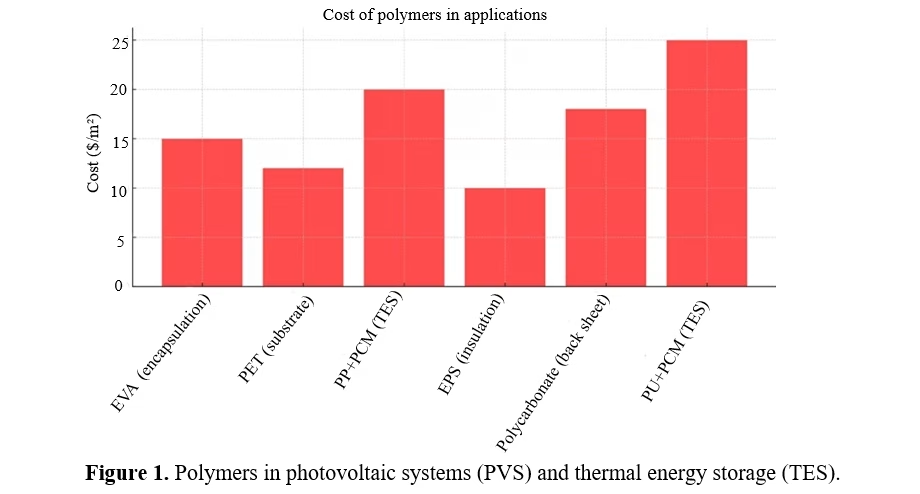
Implementing technologies for sustainable energy generation is essential to promote green building and minimize environmental effects. Owing to their diverse properties, polymers have gained immerging prominence in improving the efficiency and functionalities of various energy systems. Thermal energy storage Exploring the potential usage of polymers in energy generation for green buildings 1. The goals include assessing the performance and efficiency of polymer-based alternative technologies, while also investigating their environmental and economic implications. While such experimental data can lead to the holistic analysis of the performance of polymer materials in energy conversion efficiency and durability, exploring polymeric materials through computational modeling can help overcome many of the challenges faced experimentally, particularly, under varying environmental conditions. Furthermore, a comparative evaluation of diverse polymer-based energy systems is performed to identify their role in decreasing energy consumption, minimizing the carbon footprint, and providing a sustainable design for green buildings in the long run. The preliminary investigation shows powerful polymers, enabling energy systems for vastly improved functional flexibility and favourable component economics, yet with high-device efficiency. Their lightweight nature and ability to be engineered for specific applications like flexible solar panels and advanced insulation, contribute greatly to modern green construction. The analysis of its environmental impact also shows significant cuts in both greenhouse gas emissions and operational expenditure, cementing their place in sustainable architecture. We therefore believe that this study distinctively point out how polymer based energy system could help develop new technologies for cleaning energy in the green building. These findings are intended to shape future research and practice towards the evolution of environmentally responsible and energy-efficient construction practices and materials.
Keywords: Polymers, sustainable, energy, green, building.
[This article belongs to Special Issue under section in Journal of Polymer & Composites (jopc)]


References
- Putri KNA, Intasanta V, Hoven VP. Current Significance and Future Perspective of 3D-Printed Bio-Based Polymers for Applications in Energy Conversion and Storage Systems. Heliyon. 2024 Jan 10;10(1):e05479. DOI: 10.1016/j.heliyon.2023.e05479.
- Kabir KM, Binzaid S. Innovation of Sustainable Energy Generation from Lightweight Vehicle Applications. Energy Conversion and Management: X. 2024 Feb 12;12:100061. DOI: 10.1016/j.ecmx.2023.100061.
- Wang H, Li H, Lee CK, Suliani N, Nanyan M. A Systematic Review on Utilization of Biodiesel-Derived Crude Glycerol in Sustainable Polymers Preparation. International Journal of Polymer Science. 2024 Feb 15;2024:203146. DOI: 10.1155/2024/203146.
- Luleburgaz S, Cakmakci E, Durmaz H, et al. Sustainable Polymers from Renewable Resources through Click and Multicomponent Reactions. European Polymer Journal. 2024 Jan 18;170:111148. DOI: 10.1016/j.eurpolymj.2023.111148.
- KV GM, George J, Balachandran M. Polymer-Nanocarbon Composites: A Promising Strategy for Enhanced Performance of Organic Solar Cells. Emergent Materials. 2024 Feb 5;7(1):59-72. DOI: 10.1007/s42247-023-00432-2.
- Xu J, Wang P, Bai Z, Cheng H, Wang R, Qu L. Sustainable Moisture Energy. Nature Reviews Materials. 2024 Jan 24;9(1):15-28. DOI: 10.1038/s41578-023-00649-1.
- Prasad V, Alliyankal Vijayakumar A, Jose T, George SC. A Comprehensive Review of Sustainability in Natural-Fiber-Reinforced Polymers. Sustainability. 2024 Jan 11;16(3):631. DOI: 10.3390/su16030631.
- Kumar R, Lee D, Ağbulut Ü, Kumar S, Thapa S. Different Energy Storage Techniques: Recent Advancements, Applications, Limitations, and Efficient Utilization of Sustainable Energy. Journal of Thermal Science and Engineering Applications. 2024 Feb 2;16(2):021203. DOI: 10.1115/1.4055098.
- Dutta H, Bora D, Chetia P, Bharadwaj C. Biopolymer Composites with Waste Chicken Feather Fillers: A Review. Journal of Environmental and Sustainable Energy. 2024 Jan 22;25(1):149-162. DOI: 10.1016/j.jese.2023.11.021.
- Hayat A, Raza S, Amin MA, Ajmal Z. Developing New-Generation Covalent Organic Frameworks as Sustainable Catalysts: Synthesis, Properties, Types and Solar Energy Production. Materials Science and Engineering R: Reports. 2024 Jan 27;144:100542. DOI: 10.1016/j.mser.2023.100542.
- Bin Abu Sofian A, Sun X, Gupta VK, et al. Advances, Synergy, and Perspectives of Machine Learning and Biobased Polymers for Energy, Fuels, and Biochemicals for a Sustainable Future. Energy & Fuels. 2024 Jan 15:1-15. DOI: 10.1021/acs.energyfuels.4b01539.
- Mousavi SM, Hashemi SA, Kalashgrani MY, et al. Bioresource Polymer Composite for Energy Generation and Storage: Developments and Trends. The Chemical Engineering Journal. 2024 Feb 10;450:129-140. DOI: 10.1016/j.cej.2023.129132.
- Si W, Zhang S. The Green Manufacturing of Thermoplastic Starch for Low-Carbon and Sustainable Energy Applications: A Review on Its Progress. Green Chemistry. 2024 Feb 18;26(2):410-423. DOI: 10.1039/d3gc04274h.
- Mashhadikhan S, Ahmadi R, Amooghin AE, et al. Breaking Temperature Barrier: Highly Thermally Heat Resistant Polymeric Membranes for Sustainable Water and Wastewater Treatment. Sustainable Energy & Fuels. 2024 Mar 2;8(3):187-201. DOI: 10.1039/d3se00445g.
- Ali N, Mostafa EM. Biocarbon-Enhanced Flexible Nanofiber Mats for Sustainable Energy Generation and Wearable Device Applications. Fibers and Polymers. 2024 Mar 8;25(3):900-914. DOI: 10.1007/s12221-024-1064-8.
- Cui X, Wu M, Liu X, et al. Engineering Organic Polymers as Emerging Sustainable Materials for Powerful Electrocatalysts. Chemical Society Reviews. 2024 Jan 28;53(4):1319-1333. DOI: 10.1039/d3cs00668c.
- Li N, Zhang Y, Liu X, et al. Optimization and Kinetics of Crown Ether-Based Hydroxyl-Rich Organic Polymers for Sustainable CO2 Fixation and Iodine Vapor Adsorption. Sustainable Energy & Fuels. 2024 Mar 12;8(4):145-156. DOI: 10.1039/d3se00497g.
- Mansy AE, El Desouky EA, Taha TH, et al. Sustainable Production of Bioethanol from Office Paper Waste and Its Purification via Blended Polymeric Membrane. Energy Conversion and Management. 2024 Feb 22;268:115903. DOI: 10.1016/j.enconman.2023.115903.
- Akyüz ES, Telli E, Farsak M, et al. Hydrogen Generation Electrolyzers: Paving the Way for Sustainable Energy. International Journal of Hydrogen Energy. 2024 Feb 25;49(8):2772-2782. DOI: 10.1016/j.ijhydene.2023.12.078.
- Nagao Y. Proton‐Conducting Polymers: Key to Next‐Generation Fuel Cells, Electrolyzers, Batteries, Actuators, and Sensors. ChemElectroChem. 2024 Mar 4:e202300846. DOI: 10.1002/celc.202300846.
- Manickaraj, K., Karthik, A., Palanisamy, S., Jayamani, M., Ali, S.K., Sankar, S.L., & Al‐Farraj, S.A. Improving mechanical performance of hybrid polymer composites: Incorporating banana stem leaf and jute fibers with tamarind shell powder. 2025 BioResources.
- Mylsamy B, Aruchamy K, Shanmugam SK, Palanisamy S, Ayrılmis N. Improving performance of composites: Natural and synthetic fibre hybridisation techniques in composite materials–A Review. Materials Chemistry and Physics. 2025 Jan 26:130439.
- Pekhtasheva, E., Mastalygina, E., Leonova, I., Palanisamy, S., Alagarsamy, A., Ayrilmis, N., Sillanpää, M., and Al-Farraj, S. A. “Investigation of toxicity in textile materials from natural and synthetic-based polymers utilizing bioassay performances,” 2025. BioResources 20(1), 765–789.
- Aruchamy, K., Karuppusamy, M., Krishnakumar , S., Palanisamy, S., Jayamani, M., Sureshkumar , K., Ali, S. K., and Al-Farraj, S. A. (2025). “Enhancement of mechanical properties of hybrid polymer composites using palmyra palm and coconut sheath fibers: The role of tamarind shell powder,” BioResources 20(1), 698–724.
- Kar A, Saikia D, Palanisamy S, Pandiarajan N. Calamus tenuis fiber reinforced epoxy composites: Effect of fiber loading on the tensile, structural, crystalline, thermal and morphological characteristics. Journal of Polymer Research. 2024 Nov;31(11):1-6.

Journal of Polymer & Composites
| Volume | 13 | |
| Special Issue | 04 | |
| Received | 13/01/2025 | |
| Accepted | 15/02/2025 | |
| Published | 05/06/2025 | |
| Publication Time | 143 Days |