Nagaraj G,
Dillip Kumar Mohanta,
Rajvardhan Jigyasu,
P. Vidyullatha,
Joshila Grace L K,
Muthukumar Subramanian,
- Associate Professor, Department of Mechanical Engineering, Sethu Institute of Technology, Tamil Nadu, India
- Assistant Professor, Department of Mechanical Engineering, Centurion University of Technology and Management, Odisha, India
- Assistant Professor, Department of Electrical Engineering, Netaji Subhas University of Technology, Delhi, India
- Associate Professor, Department of Computer Science and Engineering, Koneru Lakshmaiah Education Foundation, Vaddeswaram, Guntur, Andhra Pradesh, India
- Professor, Department of Computer Science and Engineering, Sathyabama Institute of Science and Technology, Chennai, Tamil Nadu, India
- Professor, Department of Computer Science and Engineering, Hindustan Institute of Technology & Science (Deemed to be University), Chennai, Tamil Nadu, India
Abstract
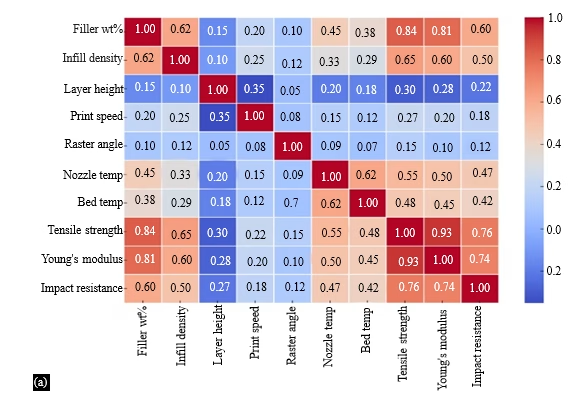
This study aims to develop an interpretable and high-accuracy machine learning framework for predicting the mechanical properties of 3D-printed fiber-reinforced polymer composites, with a focus on structure–property correlations relevant to polymer processing and functional performance. Composite specimens based on PLA and ABS matrices were fabricated using FDM with varying weight fractions (5–20 wt%) of carbon and glass fibers. Standardized mechanical testing (ASTM D638, D256, D790) was performed to evaluate tensile strength, elastic modulus, and impact resistance across 324 printed samples. A structured dataset comprising 12 input features including material and processing parameters was used to train XGBoost, SVR, and Random Forest regression models. Recursive feature elimination and SHAP-based explain ability were integrated to ensure dimensional relevance and interpretability. XGBoost outperformed all baseline models, achieving an R² of 0.94 and RMSE below 2.1 MPa. SHAP analysis identified filler wt%, nozzle temperature, and infill density as the most influential parameters. Visualizations such as 3D correlation plots and formulation-specific prediction collages validated prediction accuracy and exposed localized error patterns in high-filler composites. This work uniquely integrates real mechanical data, SHAP explain ability, and multiscale visualization into a predictive framework, offering physically grounded, design-relevant insights for polymer composite development an advancement over existing black-box approaches. The proposed framework establishes a reproducible, transparent methodology for data-driven prediction of polymer composite behavior, enabling intelligent design optimization in reinforced thermoplastics and opening avenues for future adaptive modeling.
Keywords: Polymer composites, 3D printing (Fused Deposition Modeling), mechanical property prediction, fiber-reinforced thermoplastics, structure–property relationships, SHAP interpretability, PLA and ABS composites
[This article belongs to Journal of Polymer & Composites ]

References
- Rooney, K., Dong, Y., Basak, A. K., & Pramanik, A. (2024). Prediction of Mechanical Properties of 3D Printed Particle-Reinforced Resin Composites. Journal of Composites Science, 8(10), 416. https://doi.org/10.3390/jcs8100416
- Sharma, A., Mukhopadhyay, T., Rangappa, S. M., Siengchin, S., & Kushvaha, V. (2022). Advances in Computational Intelligence of Polymer Composite Materials: Machine Learning Assisted Modeling, Analysis and Design. Archives of Computational Methods in Engineering, 29(5), 3341–3385. https://doi.org/10.1007/s11831-021-09700-9
- Champa-Bujaico, E., Garcia-Diaz, P., & Díez-Pascual, A. M. (2022). Machine Learning for Property Prediction and Optimization of Polymeric Nanocomposites: A State-of-the-Art. International Journal of Molecular Sciences, 23(18), 10712. https://doi.org/10.3390/ijms231810712
- Mamodiya and I. Kishor, “A Comparative Study on the Performance of DualAxis Solar Tracking Systems and Fixed Solar Arrays,” in Proc. 5th Int. Conf. on Information Management & Machine Intelligence (ICIMMI ’23), Jaipur, India, 2024, Art. no. 116, pp. 1–4, doi: 10.1145/3647444.3647943
- Nawafleh, N., & Al-Oqla, F. (2022). Artificial neural network for predicting the mechanical performance of additive manufacturing thermoset carbon fiber composite materials. Journal of the Mechanical Behavior of Materials, 31(1), 501–513. https://doi.org/10.1515/jmbm-2022-0054
- Pugar, J., Gang, C., Huang, C., Haider, K. W., & Washburn, N. R. (2022). Predicting Young’s Modulus of Linear Polyurethane and Polyurethane-Polyurea Elastomers: Bridging Length Scales with Physicochemical Modeling and Machine Learning. ACS Applied Materials & Interfaces, 14(14), 16568–16581. https://doi.org/10.1021/acsami.1c24715
- Arora, P. Agarwal, A. Mittal, U. Mamodiya and P. Juneja, “SA based Optimization of Controller Parameters for Crystallization Unit of Sugar Factory,” 2022 6th International Conference on Trends in Electronics and Informatics (ICOEI), Tirunelveli, India, 2022, pp. 341-346, doi: 10.1109/ICOEI53556.2022.9776904
- Moumen, A., Lakhdar, A., Laabid, Z., & Mansouri, K. (2022). Towards smart modeling of mechanical properties of a bio composite based on a machine learning. International Journal of Electrical and Computer Engineering, 12(3), 3138. https://doi.org/10.11591/ijece.v12i3.pp3138-3145
- Baturynska, I. (2019). Application of Machine Learning Techniques to Predict the Mechanical Properties of Polyamide 2200 (PA12) in Additive Manufacturing. Applied Sciences, 9(6), 1060. https://doi.org/10.3390/APP9061060
- Isabona, L. L. Ibitome, A. L. Imoize, U. Mamodiya, A. Kumar, M. M. Hassan, et al., “Statistical characterization and modeling of radio frequency signal propagation in mobile broadband cellular next generation wireless networks”, Computational Intelligence and Neuroscience, vol. 2023, no. 1, pp. 5236566, 2023 S. K. Sunori,
- Cassola, S., Duhovic, M., Schmidt, T., & May, D. (2022). Machine learning for polymer composites process simulation– a review. 246, 110208. https://doi.org/10.1016/j.compositesb.2022.110208
- Mamodiya and N. Tiwari, “Design and implementation of an intelligent single axis automatic solar tracking system”, Mater. today Proc., vol. 81, pp. 1148-1151, 2023
- Kumar B N, D., & Dutt K, M. (2023). A Study On Mechanical Properties Of 3d Printed Hybrid Polymer Composites. Journal of Namibian Studies : History Politics Culture. https://doi.org/10.59670/btwhrn64
- Kishor, A Prototype Framework for Customizing Virtual Reality Interactions for Paralyzed Patients Integrating Physical and Rehabilitation Modalities,” in Recent Advances in Sciences, Engineering, Information Technology & Management, 1st ed., London, U.K.: CRC Press, Taylor & Francis Group, 2025, pp. [insert actual page range if known]. doi: 10.1201/9781003598152-47.
- Greco, P. F., Pepi, C., & Gioffrè, M. (2024). A novel biocomposite material for sustainable constructions: Metakaolin lime mortar and Spanish broom fibers. Journal of Building Engineering. https://doi.org/10.1016/j.jobe.2023.108425
- Yun Debbie, S. X., Muiruri, J. K., Wu, W.-Y., Yeo, J. C. C., Wang, S., Tomczak, N., Thitsartarn, W., Tan, B. H., Wang, P., Wei, F., Suwardi, A., Xu, J., Loh, X. J., Yan, Q., & Zhu, Q. (2024). Bio-Polyethylene and Polyethylene Biocomposites: An Alternative Towards a Sustainable Future. Macromolecular Rapid Communications, e2400064. https://doi.org/10.1002/marc.202400064
- Zulfiqar, A., Shah, A. ur R., Khalil, M. S., Azad, M. M., Zulfiqar, Y., Naseem, M. S., & Song, J.-I. (2023). Enhancing properties of jute/starch bio-composite material through incorporation of magnesium carbonate hydroxide pentahydrate: A sustainable approach. Materials Chemistry and Physics. https://doi.org/10.1016/j.matchemphys.2023.128690
- Wang, S., Muiruri, J. K., Soo, X. Y. D., Liu, S., Thitsartarn, W., Tan, B. H., Suwardi, A., Li, Z., Zhu, Q., & Loh, X. J. (2022). Bio-Polypropylene and Polypropylene-based Biocomposites: Solutions for a Sustainable Future. Chemistry-an Asian Journal, 18(2), e202200972. https://doi.org/10.1002/asia.202200972
- Rehman, N. U., Ullah, K. S., Sajid, M., Ihsanullah, I., & Waheed, A. (2024). Preparation of Sustainable Composite Materials from Bio‐Based Domestic and Industrial Waste: Progress, Problems, and Prospects‐ A Review. Advanced Sustainable Systems. https://doi.org/10.1002/adsu.202300587
- McNeill, D., Pal, A., Mohanty, A. K., & Misra, M. (2023). High Biomass Filled Biodegradable Plastic in Engineering Sustainable Composites. Composites Part C: Open Access. https://doi.org/10.1016/j.jcomc.2023.100388
- Bindiya Jain, Mr Jeetandra Singh, Dr. Udit Mamodiya. Improving Polymer Composite Properties through Reinforcement Learning guided Prototyping a Novel Approach for Material Engineering. Journal of Polymer and Composites. 2024; https://journals.stmjournals.com/jopc/article=2024/view=156890
- Palanisamy, S., Kalimuthu, M., Palaniappan, M., Alavudeen, A., Rajini, N., Santulli, C., … Al-Lohedan, H. (2021). Characterization of Acacia caesia Bark Fibers (ACBFs). Journal of Natural Fibers, 19(15), 10241–10252. https://doi.org/10.1080/15440478.2021.1993493
- Almeshaal, M., Palanisamy, S., Murugesan, T. M., Palaniappan, M., & Santulli, C. (2022). Physico-chemical characterization of Grewia Monticola Sond (GMS) fibers for prospective application in biocomposites. Journal of Natural Fibers, 19(17), 15276–15290. https://doi.org/10.1080/15440478.2022.2123076

Journal of Polymer & Composites
| Volume | 13 | |
| Issue | 04 | |
| Received | 16/05/2025 | |
| Accepted | 29/05/2025 | |
| Published | 07/06/2025 | |
| Publication Time | 22 Days |