Patil Naomi Sachin,
Vrishti Garg,
Manoj Soni,
Khushi Kumari,
Aliza,
- Scholars, Department of Mechanical and Automation Engineering, Indira Gandhi Delhi Technical University for Women, Delhi, India
- Scholars, Department of Mechanical and Automation Engineering, Indira Gandhi Delhi Technical University for Women, Delhi,
- Professor, Department of Mechanical and Automation Engineering, Indira Gandhi Delhi Technical University for Women, Delhi, India
- Scholars, Department of Mechanical and Automation Engineering, Indira Gandhi Delhi Technical University for Women, Delhi, India
- Scholars, Department of Mechanical and Automation Engineering, Indira Gandhi Delhi Technical University for Women, Delhi, India
Abstract
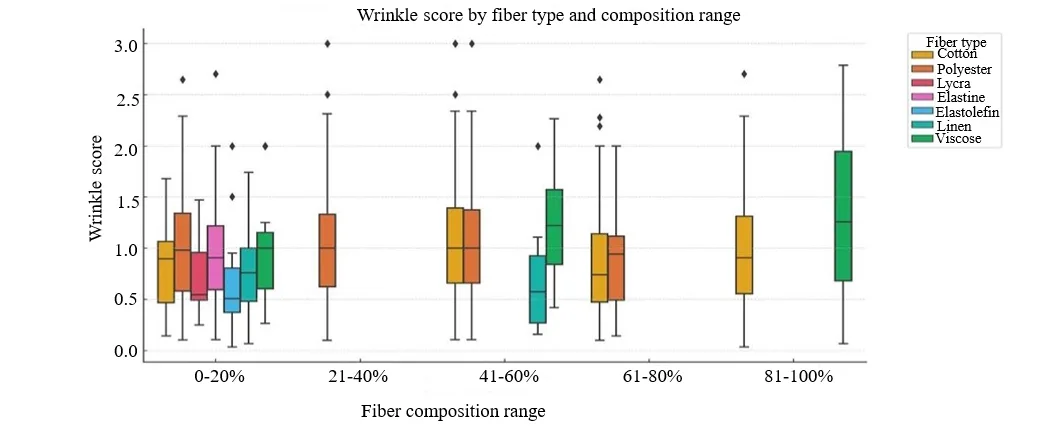
This study investigates the wrinkle behavior of cotton-polyester blended fabrics by analyzing data from over 1,200 store-handled garments. Integrating concepts from polymer chemistry and computer vision, it aims to establish a smart textile care framework based on fiber-specific wrinkle characteristics. The research identifies how cotton’s hydrophilic and non-elastic structure results in increased wrinkling, while polyester’s thermoplastic and crystalline properties enhance wrinkle resistance. Elastomeric fibers like Lycra contribute to wrinkle recovery through reversible elastic deformation. A visual scoring rubric was developed to assess wrinkle severity, frequency, and surface coverage, which was then combined with YOLO-based image analysis to automate wrinkle detection. This process enabled the generation of a composite wrinkle score by correlating visual wrinkle patterns with fiber compositions. To systematically examine the impact of different fiber blends, Central Composite Design (CCD) was employed to create an experimental matrix covering seven polymer types. This facilitated the development of a temperature prediction model capable of recommending optimal ironing temperatures between 130–175°C for each fabric type. The results show a consistent inverse correlation between polyester content and wrinkle formation, offering data-driven insights for designing more efficient garment care protocols. The study presents a significant advancement in intelligent fabric management, enabling the development of fiber-aware ironing systems that optimize energy usage, preserve fabric integrity, and improve user convenience. By bridging material science with machine learning, this research contributes a scalable solution for personalized garment care in both domestic and industrial settings.
Keywords: Wrinkle formation, viscoelasticity, cotton-polyester blends, polymer chemistry, ironing temperature prediction.
[This article belongs to Journal of Polymer & Composites ]

References
- Ugbolue SC. Structure/property relationships in textile fibres. Textile Progress. 1990 Jun 1;20(4):1-43.
- Grishanov S. Structure and properties of textile materials. InHandbook of textile and industrial dyeing 2011 Jan 1 (pp. 28-63). Woodhead Publishing.
- Gupta BS. Textile fiber morphology, structure and properties in relation to friction. InFriction in textile materials 2008 Jan 1 (pp. 3-36). Woodhead Publishing.
- Burkinshaw SM. Physico-chemical aspects of textile coloration. John Wiley & Sons; 2016 Feb 8.
- Almetwally AA, Elfowaty HM. Optical-related properties and characterization of some textile fibers using near-infrared spectroscopy. AUTEX Research Journal. 2024 Mar 2;24(1):20230014.
- Rodriguez-Hernandez J. Wrinkled interfaces: Taking advantage of surface instabilities to pattern polymer surfaces. Progress in Polymer Science. 2015 Mar 1;42:1-41.
- Liu N, Sun Q, Yang Z, Shan L, Wang Z, Li H. Wrinkled interfaces: taking advantage of anisotropic wrinkling to periodically pattern polymer surfaces. Advanced Science. 2023 Apr;10(12):2207210.
- Peterlin A. Morphology and properties of crystalline polymers with fiber structure. Textile Research Journal. 1972 Jan;42(1):20-30.
- Boisse P, Hamila N, Vidal-Sallé E, Dumont F. Simulation of wrinkling during textile compositereinforcement forming. Influence of tensile, in-plane shear and bending stiffnesses. Composites Science and Technology. 2011 Mar 22;71(5):683-92.
- Lv J, Zhou P, Zhang L, Zhong Y, Sui X, Wang B, Chen Z, Xu H, Mao Z. High-performance textile electrodes for wearable electronics obtained by an improved in situ polymerization method. Chemical Engineering Journal. 2019 Apr 1;361:897-907.
- Hu J, Meng H, Li G, Ibekwe SI. A review of stimuli-responsive polymers for smart textile applications. Smart Materials and Structures. 2012 Apr 18;21(5):053001.
- Hu J, Lu J. Smart polymers for textile applications. InSmart polymers and their applications 2014 Jan 1 (pp. 437-475). Woodhead Publishing.
- Chatterjee S, Chi-leung HUI P. Review of stimuli-responsive polymers in drug delivery and textile application. Molecules. 2019 Jul 12;24(14):2547.
- Jahid MA, Hu J, Zhuo H. Stimuli-responsive polymers in coating and laminating for functional textile. InSmart Textile Coatings and Laminates 2019 Jan 1 (pp. 155-173). Woodhead Publishing.
- Bashari A, Hemmati Nejad N, Pourjavadi A. Applications of stimuli responsive hydrogels: a textile engineering approach. Journal of the Textile Institute. 2013 Nov 1;104(11):1145-55.
- Vigneswaran C, Chandrasekaran K, Senthilkumar P. Effect of thermal conductivity behavior of jute/cotton blended knitted fabrics. Journal of Industrial Textiles. 2009 Apr;38(4):289-307.
- Aruchamy K, Subramani SP, Palaniappan SK, Pal SK, Mylsamy B, Chinnasamy V. Effect of blend ratio on the thermal comfort characteristics of cotton/bamboo blended fabrics. Journal of Natural Fibers. 2022 Jan 2;19(1):105-14.
- Özdemir H. Thermal comfort properties of clothing fabrics woven with polyester/cotton blend yarns. Autex Research Journal. 2017 Jun 27;17(2):135-41.
- Komolafe A, Beeby S, Torah R. Improving durability and electrical performance of flexible printed e- textile conductors via domestic ironing. Flexible and Printed Electronics. 2024 Jun 7;9(2):025015.
- Downey KM, Elmcuist RE. Cotton Fabrics as Affected by Variations in Pressure and in Length of Exposure During Ironing.
- SIGCOMM A. SIGCOMM Workshop on Hot Topics in Optical Technologies and Applications in Networking.
- Liu F, Ye M, Du B. Cloth-aware Augmentation for Cloth-generalized Person Re-identification. InProceedings of the 32nd ACM International Conference on Multimedia 2024 Oct 28 (pp. 4053-4062).
- Perkins JL, You MJ. Predicting temperature effects on chemical protective clothing permeation. American Industrial Hygiene Association Journal. 1992 Feb 1;53(2):77-83.
- Xu X, Rioux TP, Pomerantz N, Tew S. Effects of fabric on thermal and evaporative resistances of chemical protective ensembles: Measurement and quantification. Measurement. 2019 Mar 1;136:248- 55.
- Xu X, Rioux TP, Pomerantz N, Tew S, Blanchard LA. Heat strain in chemical protective ensembles: Effects of fabric thermal properties. Journal of Thermal Biology. 2019 Dec 1;86:102435.
- Fusco G. A parametric analysis of fabric pressing (Doctoral dissertation, UNSW Sydney
- Karthik A, Bhuvaneshwaran M, Senthil Kumar MS, Palanisamy S, Palaniappan M, Ayrilmis N. A review on surface modification of plant fibers for enhancing properties of biocomposites. ChemistrySelect. 2024 Jun 4;9(21):e202400650.
- Palaniappan M, Palanisamy S, Khan R, H. Alrasheedi N, Tadepalli S, Murugesan TM, Santulli C. Synthesis and suitability characterization of microcrystalline cellulose from Citrus x sinensis sweet orange peel fruit waste-based biomass for polymer composite applications. Journal of Polymer Research. 2024 Apr;31(4):105.
- Murugesan TM, Palanisamy S, Santulli C, Palaniappan M. Mechanical characterization of alkali treated Sansevieria cylindrica fibers–Natural rubber composites. Materials Today: Proceedings. 2022 Jan 1;62:5402-6.
- Palanisamy S, Mayandi K, Palaniappan M, Alavudeen A, Rajini N, Vannucchi de Camargo F, Santulli C. Mechanical properties of phormium tenax reinforced natural rubber composites. Fibers. 2021 Feb 1;9(2):11.
- Palanisamy S, Kalimuthu M, Santulli C, Palaniappan M, Nagarajan R, Fragassa C. Tailoring epoxy composites with Acacia caesia bark fibers: Evaluating the effects of fiber amount and length on material characteristics. Fibers. 2023 Jul 17;11(7):63.

Journal of Polymer & Composites
| Volume | 13 | |
| Issue | 04 | |
| Received | 16/04/2025 | |
| Accepted | 28/04/2025 | |
| Published | 06/06/2025 | |
| Publication Time | 51 Days |