B. Vamsi Krishna,
P. Venu Gopal,
Ashok Kumar Suluguru,
- Associate Professor, Department of Civil Engineering, Malla Reddy Vishwavidyapeeth Secunderabad, Telangana, India
- PG Scholar, Department of Structural Engineering, Department of Civil Engineering, Malla Reddy Engineering College, Secunderabad, Telangana, India
- Associate Professor, Department of Civil Engineering, Malla Reddy Engineering College, Secunderabad, Telangana, India
Abstract
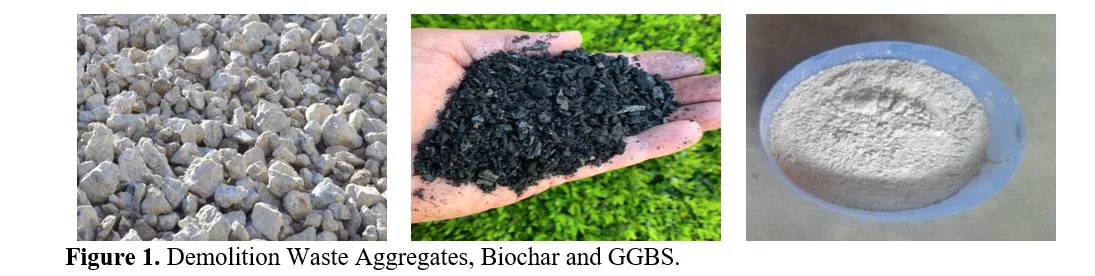
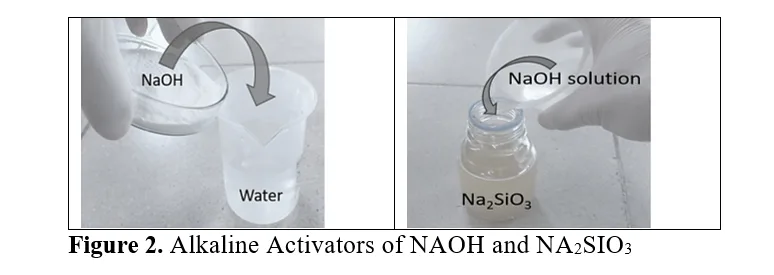
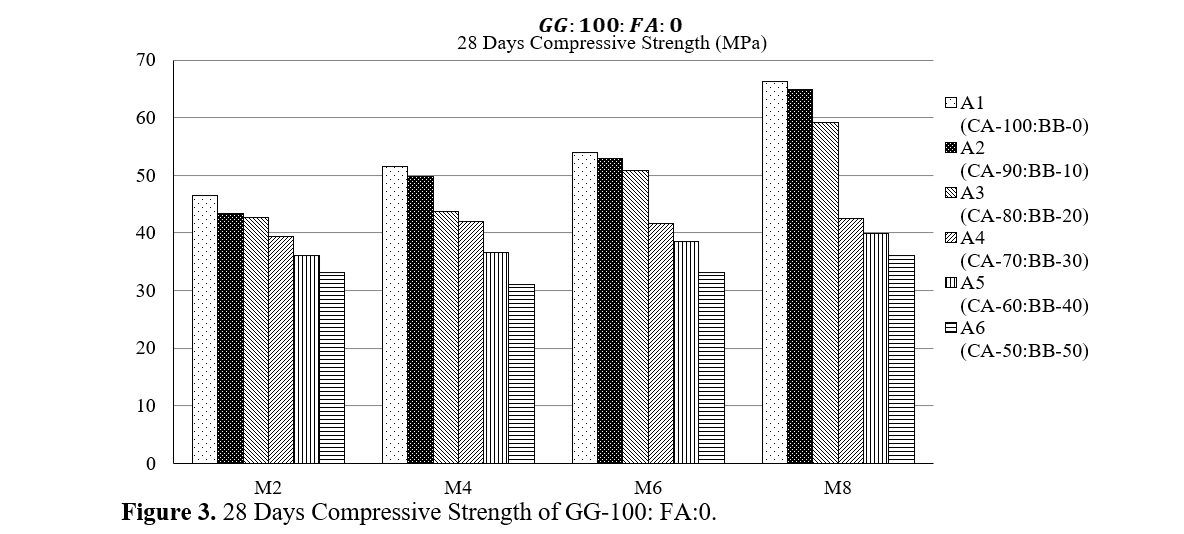
The growth of the world population has led to a heightened need for housing, making construction a crucial sector. Cement, a critical element in concrete mixtures, is indispensable in construction activities. Yet, the diminishing reserves of natural resources such as limestone and rocks, essential for cement manufacturing, necessitate sustainable options. This research investigates the creation of sustainable concrete blends by incorporating biochar and ground granulated blast furnace slag (GGBS), activated with alkaline solutions (NaOH and Na₂SiO₃) at various concentrations (2, 4, 6, and 8). Demolition waste aggregates replaced coarse aggregate in varying mix proportions aimed at achieving maximum compressive strength. Findings revealed that using 100% GGBS with 100% coarse aggregate at 8 molarity resulted in a compressive strength of 66.20 MPa at 28 days. When incorporating 10% biochar into a mix of 100% GGBS at 8 molarity, the compressive strength reached 64.90 MPa at 28 days. It was noted that reducing GGBS from 100% to 25% and increasing biochar from 0% to 75%, alongside construction waste aggregates from 10% to 50%, led to a decline in compressive strength. Furthermore, higher molarity corresponded to increased compressive strength.
Keywords: Sustainable concrete composites, biochar, ground granulated blast furnace slag (GGBS), construction wastes, sodium hydroxide, sodium silicate, alkaline activators.
[This article belongs to Special Issue under section in Journal of Polymer & Composites (jopc)]
References
- Awall, Md. Robiul, et al. “Compressive Strength Behavior of Concrete by Partial Replacement of Regular Construction Waste with Over-Demolition WasteAggregate.” Innovative Infrastructure Solutions, vol. 2, no. 1, 25 Apr. 2017, 1007/s41062-017-0059-6.
- Błaszczyński, Tomasz Z., and Maciej R. Król. “Alkaline Activator Impact on the Sustainable Binders.” IOP Conference Series: Materials Science and Engineering, vol. 245, Oct. 2017, p. 022036, 1088/1757-899x/245/2/022036. Accessed 30 Nov. 2022.
- Ayrilmis, N. et al. (2024) “Utilizing waste manhole covers and fibreboard as reinforcing fillers for thermoplastic composites,” Journal of reinforced plastics and composites. doi: 10.1177/07316844241238507.
- ACI 440.2R-17 Guide for the Design and Construction of Externally Bonded FRP Systems for Strengthening Concrete Members (Reaffirmed 2022)
- Ayuluri SR, Vamsi Krishna B. Settlement analysis of Piled Raft Foundation System (PRFS) in soft clay. IOSR Journal of Mechanical and Civil Engineering (IOSR-JMCE). 2017;14(2):62–8.
- Bahoria, B. V. et al.(2024) “Verification of the mechanical behavior of concrete with partial replacement of the fiber resulting from tire retreading,” Materials today: proceedings. doi: 10.1016/j.matpr.2024.04.067.
- Hussain SM, Krishna BV, Kumar VR. Application and analysis of last planner system in the construction industry. Impact Journal. 2014:33–44.
- Gandhi, S. et al.(2024) “Analysis of potential incorporation of waste into asphalt pavements,” Materials today: proceedings. doi: 10.1016/j.matpr.2024.05.097.
- Krishna BV, Rao DM. A comparative and experimental study on the mechanical properties of various steel and glass fiber reinforced high strength concrete. IRJET. 2015;2:129–33.
- Krishna BV, Reddy ER. Applications of green materials for the preparation of eco-friendly Construction Wastes and pavers. International Journal of Engineering & Technology. 2018;7(3.29):75–9.
- Kumar RA, Krishna BV. Design of Pre-Stressed Concrete T-Beams. International Journal of Scientific Engineering and Research (IJSER). 2014 Aug;2(8).
- Kumar VV, Krishna B. Seismic Analysis OfMultistoreyed Buildings With And Without Floating Columns. Journal of Engineering Services.;10(11).
- Kumar RA, Krishna BV. Design of Pre-Stressed Concrete T-Beams. International Journal of Scientific Engineering and Research (IJSER). 2014 Aug;2(8).
- Krishna BV, Hussain SA, Kumar VR. Ceraplast and Ceraproof Admixtures Behaviour on High Strength Concrete. International Journal of Engineering Research. 2014 May;3(5).
- Krishna BV, Kumar AP, Reddy ER. Shear Wall Analysis And Design Optimization In Case Of High Rise Buildings Using By Etabs. Solid State Technology. 2020 Nov 1;63(2s).
- Krishna BV, Kumar PS, Chandana K, Bhoomesh S, Gopal PV. Comparative Analysis & Design of RCC & Steel Preheater Tower Structure by Using STAAD. Pro. InIOP Conference Series: Earth and Environmental Science 2023 (Vol. 1130, No. 1, p. 012025). IOP Publishing.
- Krishna BV, Reddy MV, Naresh V, Tanuja DV, Bharat TS. Fragility Comparison for Soft Storey Infill Reduced Structures by Incremental Dynamic Analysis. InIOP Conference Series: Earth and Environmental Science 2023 (Vol. 1130, No. 1, p. 012029). IOP Publishing.
- Naga Chaitanya C, Vamsi Krishna B. An experimental study of flexural strength of reinforced concrete beam due to corrosion. IOSR Journal of Mechanical and Civil Engineering (IOSR-JMCE) e-ISSN. 2014:2278–1684.
- Palanisamy, S. et al.(2024) “Fostering sustainability: The environmental advantages of natural fiber composite materials – a mini review,” Environmental Research and Technology, 7(2), pp. 256–269. doi: 10.35208/ert.1397380.
- Reddy LV, Krishna B. Influence of Na2CO3, NaHCO3 and Organic Substances (Algae) in Water on Physical Properties of Blended Pozzolonic Portland Cement. Int. J. Eng. Res. Technol.(IJERT). 2014;3:35–41.
- Srikanth I, Krishna BV. Study on the effect of gust loads on tall buildings. International Journal of Structural and Civil Engineering Reseach. 2014;3:92–106.
- Venkatesh B, Vamsi Krishna B. A study on the mechanical properties of light weight concrete by replacing course aggregate with (pumice) and cement with (fly ash). Int J Eng Tech Res. 2015;4(8):331–6.

Journal of Polymer & Composites
| Volume | 13 | |
| Special Issue | 02 | |
| Received | 13/05/2024 | |
| Accepted | 10/09/2024 | |
| Published | 20/02/2025 | |
| Publication Time | 283 Days |