Shweta V Bhat,
- Student, Department of Bioinformatics, BioNome, Bengaluru, Karnataka, India
Abstract
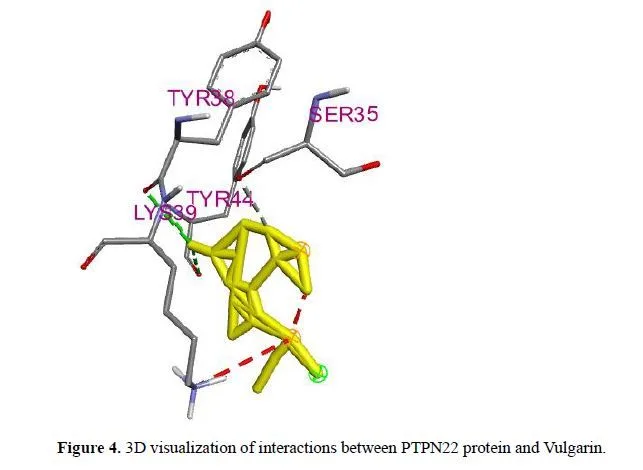
Rheumatoid arthritis (RA) is a long-term autoimmune condition characterized by inflammation of the synovial membrane, commonly resulting in swelling, pain, stiffness, and overall fatigue. Protein tyrosine phosphatase non-receptor type 22 (PTPN22) has been identified as a risk factor linked to various autoimmune diseases, including RA. In the PTPN22 gene, two missense Single nucleotide polymorphisms (SNPs) are associated with autoimmune conditions. The R620W (C1858T, rs247660) variant in exon 14 has been shown to elevate the negative regulation of B and T cell activation. On the other hand, the R263Q (G788A, rs33396649) variant in exon 10 affects enzyme activity by altering a key amino acid. This study explores the potential of the phytochemical compounds from Artemisia vestita, a folklore medicinal plant with anti-inflammatory and antipyretic properties in the treatment of RA using computational tools. PyRx, a virtual screening software was employed to carry out the molecular docking stimulations. The compounds from A. vestita which demonstrated the most favorable binding with PTPN22 were Vulgarin, Thujyl alcohol, iso-3-Thujyl acetate, (+)-alpha-Thujone and Verbenone. These compounds were chosen for further in-silico analysis and were evaluated for drug-like properties based on ADMET parameters, Lipinski’s rule of five and five physiochemical parameters: Bioavailability score, GI absorption, PAINS and Brenk alerts and solubility. The compound Vulgarin exhibited the best affinity toward PTPN22. Hence, the molecular interaction between PTPN22 and Vulgarin was visualized in DS BIOVIA Discovery Studio Visualizer.
Keywords: Rheumatoid arthritis, Artemisia vestita, protein tyrosine phosphatase non-receptor type 22(PTPN22), molecular docking, in silico analysis
[This article belongs to International Journal of Bioinformatics and Computational Biology ]

References
1. Di Matteo A, Bathon JM, Emery P. Rheumatoid arthritis. Lancet 2023;402(10416):2019–2033. doi: 10.1016/s0140-6736(23)01525-8.
2. Huang J, Fu X, Chen X, Li Z, Huang Y, Liang C. Promising therapeutic targets for treatment of rheumatoid arthritis. Front Immunol. 2021;12:686155. doi: 10.3389/fimmu.2021.686155.
3. Li R, Yuan X, Ou Y. Global burden of rheumatoid arthritis among adolescents and young adults aged 10–24 years: A trend analysis study from 1990 to 2019. PLoS One. 2024;19(4):e0302140. doi: 10.1371/journal.pone.0302140.
4. Wan L, Liu J, Huang C, Chen X, Zhao L, Fan H, et al. Inflammation caused by different immune cell subsets is involved in bone destruction of rheumatoid arthritis. Xi Bao Yu Fen Zi Mian Yi Xue Za Zhi. 2020;36(11):1026–1031.
5. Federico, Dı́az-González, María, Hernández-Hernández. Rheumatoid arthritis. Med Clin (Barc). 2023;161(12):533–542. doi: 10.1016/j.medcle.2023.07.008.
6. Iven M. Rheumatoid arthritis. 2023:317–327. doi: 10.1016/b978-0-323-91890-9.00008-8.
7. Korol I, Baumeister RH. Treating rheumatoid arthritis. JAAPA. 2023;36(9):1–5. doi: 10.1097/01.jaa.0000937316.70181.ff.
8. Nighojkar PA, Momin M, Phadatare SP. Rheumatoid arthritis – Pharmacology and its management with traditional herbs. Indian Journal of Traditional Knowledge. 2017;16(2):284–289.
9. Diaz-Gallo L-M, Martin J. PTPN22 splice forms: A new role in rheumatoid arthritis. Genome Med. 2012;4(2):13. doi:10.1186/gm312.
10. Pasha U, Nisar H, Nisar H, Abid R, Ashraf NM, Sadaf S. Molecular dynamic simulations unravel the underlying impact of missense mutation in autoimmunity gene PTPN22 on predisposition to rheumatoid arthritis. J Interferon Cytokine Res. 2023;43(3):121–132. doi: 10.1089/jir.2022.0216.
11. Taher AR, Nassir NF. The PTPN22 as master regulation in autoimmune diseases and its susceptibility to rheumatoid arthritis. South Asian Res J Bio Appl Biosci. 2024;6(04):94–107. doi: 10.36346/sarjbab.2024.v06i04.001.
12. Mittal V, Barak A, Singhal A. Nature’s pharmacy: Herbal interventions in rheumatoid arthritis treatment: A comprehensive review. Curr Rheumatol Rev. 2024. doi: 10.2174/0115733971294467240326074155.
13. Turk MA, Liu Y, Pope JE. Non-pharmacological interventions in the treatment of rheumatoid arthritis: A systematic review and meta-analysis. Autoimmun Rev. 2023;22(6):103323. doi: 10.1016/j.autrev.2023.103323.
14. Bora KS, Sharma A. The genus Artemisia: A comprehensive review. Pharm Biol. 2011;49(1):101–109. doi: 10.3109/13880209.2010.497815.
15. Tan RX, Zheng WF, Tang HQ. Biologically active substances from the genus Artemisia. Planta Med. 1998;64(4):295–302. doi: 10.1055/s-2006-957438.
16. Dogra S, Singh J, Koul B, Yadav D. Artemisia vestita: A folk medicine with hidden herbal fortune. Molecules. 2023;28(6):2788. doi: 10.3390/molecules28062788.
17. Yin Y, Gong FY, Wu XX, Sun Y, Li YH, Chen T, et al. Anti-inflammatory and immunosuppressive effect of flavones isolated from Artemisia vestita. J Ethnopharmacol. 2008;120(1):1–6. doi: 10.1016/j.jep.2008.07.029.
18. Vlasiou MC. Molecular docking in computer-aided drug discovery: a powerful tool for targeted therapeutics. In: Computer-Aided Drug Discovery Methods: A Brief Introduction. 2024:63–90. doi: 10.2174/9789815305036124010005.
19. Roy SP. Introduction to computer-based simulations and methodologies in pharmaceutical research. In: Software and programming tools in pharmaceutical research 2024:1–24. doi: 10.2174/9789815223019124010003.
20. Shamim S, Munawar R, Rashid Y, Qadar SMZ, Bushra R, Begum I, et al. Molecular docking: An insight from drug discovery to drug repurposing approach. In: Unravelling Molecular Docking – From Theory to Practice. IntechOpen; 2024. doi: 10.5772/intechopen.1005526.
21. Gangadharan AK, Kundil VT, Jayanandan, A. Computational tools in drug-lead identification and development. In: Haridas M, Abdulhameed S, Francis D, Kumar SS, editors. Drugs from Nature: Targets, Assay Systems and Leads. Singapore: Springer; 2024. https://doi.org/10.1007/978-981-99-9183-9_4.
22. Baroroh U, S Si, Biotek M, Muscifa ZS, Destiarani W, Rohmatullah FG, et al. Molecular interaction analysis and visualization of protein-ligand docking using Biovia Discovery Studio Visualizer. Indonesian J Comput Biol. 2023;2(1). doi: 10.24198/ijcb.v2i1.46322.
23. Mohanraj K, Karthikeyan BS, Vivek-Ananth RP, Chand RB, Aparna SR, Mangalapandi P, et al. IMPPAT: A curated database of Indian medicinal plants, phytochemistry and therapeutics. Sci Rep. 2018;8(1):4329. doi: 10.1038/s41598-018-22631-z.
24. Kim S, Chen J, Cheng T, Gindulyte A, He J, He S, et al. PubChem 2023 update. Nucleic Acids Res. 2023;51(D1):D1373–D1380. doi: 10.1093/nar/gkac956.
25. Berman HM, Westbrook J, Feng Z, Gilliland G, Bhat TN, Weissig H, et al. The Protein Data Bank. Nucleic Acids Res. 2000;28:235–242. doi: 10.1093/nar/28.1.235.
26. Bhagyashree LJ, Rohane SH. Drug designing in discovery studio. Asian J Res Chem. 2021;14(2):135–138. doi: 10.5958/0974-4150.2021.00025.0 .
27. Daina A, Michielin O, Zoete V. SwissADME: A free web tool to evaluate pharmacokinetics, drug-likeness and medicinal chemistry friendliness of small molecules. Sci Rep. 2017;7:42717. doi: 10.1038/srep42717.
28. Xiong G, Wu Z, Yi J, Fu L, Yang Z, Hsieh C, et al. ADMETlab 2.0: An integrated online platform for accurate and comprehensive predictions of ADMET properties. Nucleic Acids Res. 2021;49(W1):W5–W14. doi: 10.1093/nar/gkab255.
29. Dallakyan S, Olson AJ. Small-molecule library screening by docking with PyRx. Methods Mol Biol. 2015;1263:243–250. doi: 10.1007/978-1-4939-2269-7_19.
30. O’Boyle NM, Banck M, James CA, Morley C, Vandermeersch T, Hutchison GR. Open Babel: An open chemical toolbox. J Cheminform. 2011;3:33. doi: 10.1186/1758-2946-3-33.
31. Boarder M, Dixon J, Newby D, Navti P, Zetterström T. Rheumatoid arthritis. In book: Pharmacology for Pharmacy and the Health Sciences. 2016. doi: 10.1093/9780198728832.003.0009.
32. Adhikari, MD G, Dhakal, MD B, Shrestha, MD S. Rheumatoid arthritis – Symptoms and treatment demystified. AJPHI. 2024;1(01). doi: 10.69512/ajphi.v1i01.41.
33. Hider SL, Muller S, Prior JA, Helliwell T, van Schaardenburg D, Mil AVDH, et al. SAT0708 Symptoms indicative of inflammatory arthritis are common in the primary care population: Findings from the symptoms in persons at risk of rheumatoid arthritis survey. A Rheum Dis. 2017;76:1043–1043. doi: 10.1136/ANNRHEUMDIS-2017-EULAR.5503.
34. Zhang C, Ma P, Qin A, Wang L, Dai K, Liu Y, et al. Current immunotherapy strategies for rheumatoid arthritis: The immunoengineering and delivery systems. Research (Wash DC). 2023;6:0220. doi: 10.34133/research.0220.
35. Naredla B, Sagarla U, Prasanthi D. Updates on novel treatments for rheumatoid arthritis. Res J Sci Technol. 2023;15(4):225–2. doi: 10.52711/2349-2988.2023.00039.
36. Tizaoui K, Terrazzino S, Cargnin S, Lee KH, Gauckler P, Li H, et al. The role of PTPN22 in the pathogenesis of autoimmune diseases: A comprehensive review. Semin Arthritis Rheum. 2021;51(3):513–522. doi: 10.1016/j.semarthrit.2021.03.004.
37. Budlewski T, Sarnik J, Galita G, Dragan G, Brzezińska O, Popławska M, et al. SNP in PTPN22, PADI4, and STAT4 but Not TRAF1 and CD40 increase the risk of rheumatoid arthritis in Polish population. Int J Mol Sci. 2023;24(8):7586. doi: 10.3390/ijms24087586.
38. Yang C, Hu DH, Feng Y. Essential oil of Artemisia vestita exhibits potent in vitro and in vivo antibacterial activity: Investigation of the effect of oil on biofilm formation, leakage of potassium ions and survival curve measurement. Mol Med Rep. 2015;12(4):5762–5770. doi: 10.3892/mmr.2015.4210.
39. Sary HG, Khedr MA, Orabi KY. Novel Vulgarin derivatives: Chemical transformation, in silico and in vitro studies. Molecules. 2023;28(8):3421. doi: 10.3390/molecules28083421
40. ElGamal RA, Galala AA, Abdel-Kader MS, Badria FA, Soliman AF. Microbial transformation of the sesquiterpene lactone, vulgarin, by Aspergillus niger. Molecules. 2023;28(9):3729.
41. Ando M, Tajima K, Takase K. Studies on the syntheses of sesquiterpene lactones. III. Improved synthesis of vulgarin. Bull Chem Soc Jpn. 1979;52(9):2737–2738. doi: 10.1246/bcsj.52.2737.

| Volume | 03 | |
| Issue | 01 | |
| Received | 27/12/2024 | |
| Accepted | 09/01/2025 | |
| Published | 30/01/2025 | |
| Publication Time | 34 Days |